Back
Article
How Frontegg is securing humans — and AI Agents — in the cloud
Insight Partners | September 04, 2025| 3 min. read
SaaS platforms first arrived more than 25 years ago, but became widespread during the pandemic when cloud-based systems changed from optional to essential business infrastructure. Despite this, building product-critical features such as authentication, security, notifications, and reporting is far from straightforward, even though they are considered standard components of modern SaaS.
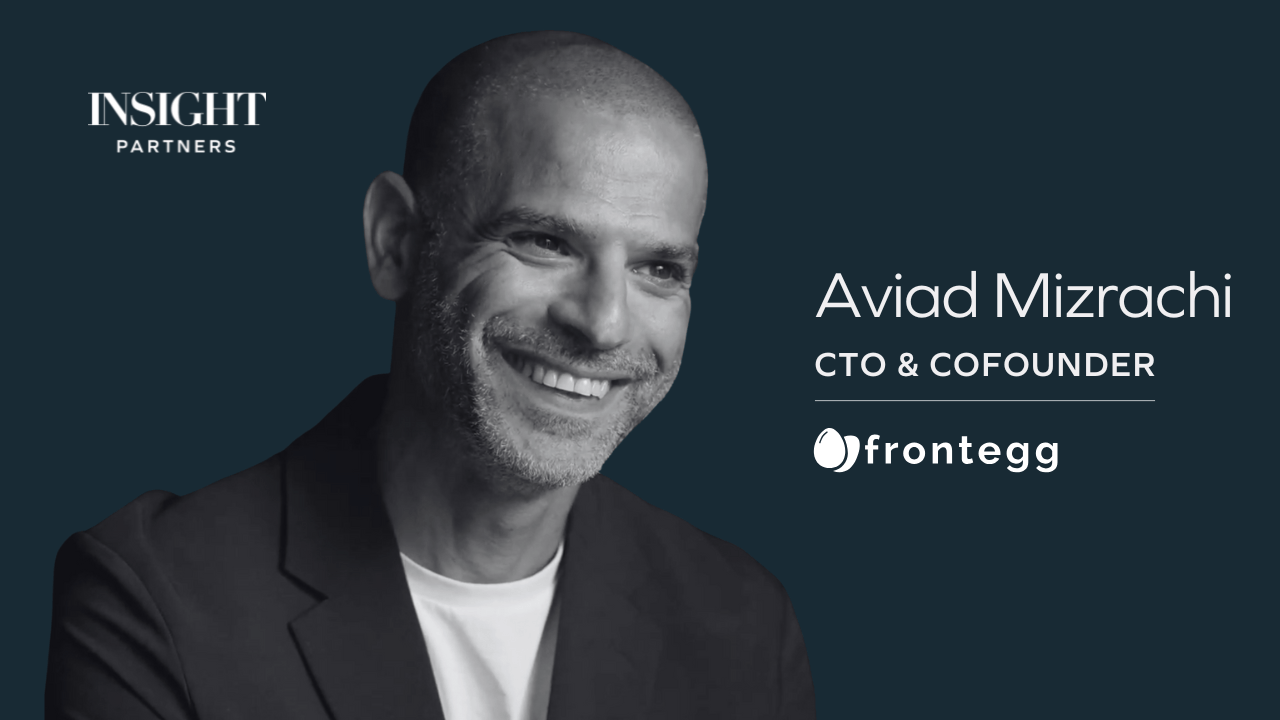
While working at cybersecurity company Check Point in the late 2010s, Sagi Rodin, a cloud security director, and Aviad Mizrachi, manager of an R&D group, observed team after team sink time into building authentication and access controls from scratch — effort and resources that could otherwise have been invested in the core product.
“It’s easy to see how the long and growing list of non-core requirements that are necessary for bringing a new product to market puts a significant burden on the development team,” Mizrachi told Devmio in 2022. “This is starting to become an innovation barrier, raising the cost of entry for new products to come to market.”
With decades of full-stack development experience between them, Rodin and Mizrachi saw the need for a plug-and-play user management solution offering essential features such as single sign-on (SSO) and multi-factor authentication (MFA), without extensive coding.
They took a leap of faith and left Check Point in September 2019 to build Frontegg, an all-in-one user management solution tailored to the needs of B2B SaaS companies.
From stealth to scale
They spent a year in stealth mode, raising $1M in pre-seed funding, making their first hires, and working on a set of pre-built product capabilities that could easily integrate within SaaS apps.
Rodin and Mizrachi — CEO and CTO, respectively — officially hatched Frontegg in September 2020. Their solution provided SaaS companies with access to features like authentication and notifications, without the development time.
Over the next two years, growth was rapid. The company raised a $5M seed round in October 2020; won its first customers, including Israeli adtech unicorn AppsFlyer; and launched its customer-facing layer in May 2021, transforming Frontegg from an authentication provider into a full identity platform.
It was then that Insight Partners invested, leading Frontegg’s $25M Series A in December 2021, and Managing Director Praveen Akkiraju joined the company’s board. Just seven months later, the company raised a $40M Series B, co-led by Insight and Stripes.
By the end of 2022, amid a 33% surge in global SaaS spending, Frontegg was growing rapidly, serving more than 150 B2B SaaS companies around the world, including Datadog, Okera, and Tomorrow.io.
Identity reimagined in the era of AI
If one thing has defined Frontegg’s trajectory, it’s the widespread adoption of AI. “When we are building products … everything is based on AI,” says Mizrachi. “If you don’t use tools like GPT, you basically live in the previous century.”
The Frontegg team embraced AI early. “We’ve got a high percentage of code, being — I wouldn’t say developed — but helped, with AI,” explains Mizrachi. “The rapid pace of these tools allows us to develop much faster.”
Beyond efficiency, AI has fundamentally altered the nature of digital identity: Frontegg now has to manage people as well as the autonomous systems acting alongside them, says Mizrachi. “Up until even a few years ago, we were dealing with users and challenges around users. Now, with the world of AI, what is a user?”
And the speed of AI adoption has created more risks, he adds. “This rapid pace poses a lot of security challenges and security risks. Rapid pace means adoption of new tools and technologies, and that means that the security goes out of the hands of security teams.”
For one thing, computing power is much greater now, Mizrachi points out. “There’s a very interesting game of how fast can an AI agent get a breached password or hack into a user account using the breached password? The compute power is now cheaper and the agents and the AI [are] becoming much smarter.”
As agents increasingly interact with each other, managing data access and permissions becomes more complex, bringing a greater risk of leaks and breaches. “What data can they share? … Do they act on behalf of a user, or do they act as autonomous, or a mix of both? And the actions that they do on behalf of a user, how are they being tracked? Everything regarding that is a complete challenge,” says Mizrachi.
“Rapid [AI adoption] is great for the success of the company, but it’s also very challenging for security.”
“AI agents are our newest users”
That’s why Frontegg launched a tool in early 2025 specifically for developers building and managing AI agents.
Frontegg.ai aims to provide secure, scalable authentication, authorization, and security layers for these autonomous systems. “AI agents are our newest users,” says Mizrachi. “And we need to adapt to that.”
Existing infrastructure was not designed with autonomous agents in mind, and before Frontegg.ai, there was a lack of identity standards explicitly tailored for AI agents. “Without proper identity infrastructure, you can build an interesting AI agent — but you can’t productize it, scale it, or sell it,” Mizrachi says.
Frontegg’s own developers ran into these hurdles while building Dorian, a cybersecurity, customer identity and access management security AI agent built into the Frontegg platform.
“When we launched it, we decided that we are not building yesterday’s products, we are building tomorrow’s products.”
“You think about technology that was relevant six months ago, which might not be relevant today because the world has changed,” says Mizrachi.
Adjusting to a world of AI agents
Today, Frontegg is a full-stack customer identity and access management (CIAM) platform with a suite that manages the entire user journey, from signup to subscription.
By saving developers time, offering more control to security teams and enabling product teams to bring new features to market more quickly, it has transformed user management for SaaS companies.
But as SaaS continues to evolve — and as machines join humans in the user base — Frontegg is also helping redefine what identity means in a digital-first world.
“We know that agents will stay,” says Mizrachi. “We need to adjust to this world of agents communicating with other agents instead of humans communicating with other humans.”
*Note: Insight Partners has invested in Frontegg.