What leaders need to get right in 2026: Insights from our experts in GTM, enterprise, and government
Founders and leaders are heading into 2026 with two competing truths: AI is already reshaping how software is built, sold, and priced, and yet companies are still in the early innings of figuring out what actually works. Experiments and pilots are no longer enough. Boards, customers, and employees are looking for durable ROI, clearer strategy, and leaders who can separate signal from hype.
To cut through the noise, we asked experts from teams that work closely with founders, executive teams, and leaders across our global portfolio and broader networks about what’s top of mind as they advise and connect with CEOs and ScaleUp leaders. Drawing on what they’re seeing in boardrooms, enterprise peer networks, and public-sector advisory work, they highlight six shifts and advice that will define the ScaleUps that come out on top.
You can also read last year’s Onsite GTM trends and this year’s Investor predictions at the links.
AI will stop being a science experiment and start being judged like a business investment
Managing Director Hilary Gosher: “All these [AI] investments that folks have been making — all the dabbling and pilots and things like that — now that the chickens have come home to roost, this is the year where people really want to see real ROI.”
“I still think it’s ‘random acts of AI’, where some leaders are more forward-thinking than others, and so they’ve adopted this more rapidly, and you’ve seen value in obvious low-hanging fruit areas.”
Operating Partner Pablo Dominguez: “[In 2025] people were trying to figure out what was working and what didn’t work, even though AI had been around for two to three years. We’re now seeing that in 2026, people are hunkering down and really thinking about structure and process.”
“The companies that we see doing well now, we expect will do better in 2026 — the ones that really focus on their data, core structure, processes, and have the fundamentals down. The companies that don’t say, ‘Oh, I’ll just have AI build content, I’ll just have AI do my forecasting.’ They’re going to be struggling because they don’t understand the basics…Don’t think AI is going to replace stuff you’ve never had.”
Managing Director Byron Lichtenstein agrees: “There is a culling process that will happen with AI…You’re starting to see that there’s maybe too much hype.”
“People are going to be more discerning in 2026 than they were in 2025. There are going to be use cases that are very much proven out. You have to be using AI in some part of your business. But there’s going to be other places where … [you] actually don’t need to use it.”
“You’ll see this mixed reaction of pushing really hard on the use cases that have worked, and pulling back on the use cases where there are only middling results.”
But picking the right use cases is only half the story. The real gains come when AI forces companies to rethink how work actually gets done.
Lichtenstein, again: “[AI has] forced the conversation of revisiting your processes: ‘How do I think about my people versus my tools? How do I potentially pair AI with just changing my process to be more effective and more efficient?’”
“You should aim to get somewhere between 2% to 5% margin, based on just using AI tools and getting more efficient. [With] marketing spend alone, I think you should get a point…I think in R&D, you should probably get another point. And then, in terms of customer success, you should probably land somewhere between 1% to 2%.”
Speed, not scale, will decide the winners as AI-native challengers out-iterate their competition
The window for incumbents is closing fast. AI has fundamentally changed the economics of building software, and challengers are capitalizing on this advantage.
Managing Director Dionne Chingkoe: “The barrier to entry for [AI startups] to build is very low, but that’s also true for competitors and other upstarts. So the sooner and faster they can build a reinforcement learning loop where people are putting in new data, new intelligence, new decisions into their specific product…increasingly, their competitors don’t have access to that same loop.”
The numbers bear this out. Development cycles that once took months now take weeks.
Dominguez: “Companies are leveraging system integrators to build that new product…in 30 to 60 days versus six to 18 months. That is becoming a reality now.”
“Think about it as if you were to start a brand new company and try to destroy your [old] company, and you have AI and no technical debt, what would you do? Because that’s what your competitors are doing.”
Gosher: “Brand and reputation are a moat. Data is a moat. Your customers are a moat. But where you’re threatened is the speed of innovation, ease of use, and ease of adoption.”
“The cycle time with which AI-native companies produce products because they’re using Lovable and n8n, and they’re rapidly prototyping, and putting new products in front of customers, testing and iterating very quickly, is so much faster than the old cloud paradigm.”
Maintaining speed requires rethinking how the company operates from first principles.
Managing Director Mike Hayes: “You should constantly drive simplicity into your foundation…What’s universally true, no matter what? As the world is changing, how do you focus on the basics that matter?”
Technical expertise will become table stakes across many more roles
The war for talent is shifting. After years of go-to-market roles dominating hiring priorities, companies are bringing technical expertise into every function.
Operating Partner Bryan Powell: “If you look at the past couple years…we saw demand for CPOs and CTOs actually coming down through late 2022, 2023, part of 2024. But with how ChatGPT hit the market, you’re seeing the demand for technologists shoot through the roof. There’s way more demand for technologists than we have in the past couple of years, and I think that’s going to continue to happen.”
But as well as traditional engineering roles, companies are looking for hybrids — people who combine functional depth with technical skills.
Dominguez: “Because AI is democratizing knowledge, I think the roles that win are people who have functional and technical expertise. The age of the old salesperson who’s playing golf and schmoozing — ‘I brought my three sales engineers and product specialists, they’ll handle the tough questions’ — I think are gone.”
“You need to be able to answer first-, second-, third-level technical questions. You need to be able to demo. Yes, your sales engineer will talk five levels down with the technical people, but this is no longer, ‘My job was just to open the door.’”
This shift goes right up to the CEO level. The traditional path from go-to-market leadership is being challenged by the need for technical fluency.
Powell: “The attributes of a CEO are changing. [One] is having a strong AI point of view. Someone who has actually done it, versus the people who are just talking about it.”
“If you look at most traditional CEOs, they often come from the go-to-market ranks. And I think with how fast AI is moving into organizations, I expect we’ll start seeing more chief product officers or CPTOs move into that CEO slot.”
Beyond just using AI, business leaders need to become evangelists.
Powell: “If you’re going to be a CEO, you better become [an AI] zealot. Embrace it and push it into the organization…Work directly with the executive leadership team to get it down into the organization to the lowest common denominator.”
Gosher: “[The CEO] needs to have a head of AI transformation managing all the various activities across the organization, but that person needs to report to them. AI transformation is a cross-functional effort.”
AI will boost productivity, but the process will be much slower and messier than the hype suggests
Lichtenstein: “People are going to experiment a ton with Agents. I do think it’ll change the way people work, but I don’t think you’re going to see mass adoption just yet. I think most people will probably spend more before they see the efficiencies.”
“You’re in this very classic hype cycle of, ‘[AI] is going to change the world.’ If you go out 10 years, it will 10,000% have changed the world, [but] I don’t think it’s going to be very linear.”
Chingkoe: “Despite the incredible leaps that have been made with AI development, the pace of true impact will be slowed by: trust from end users, change management within organizations, and maintainability of both AI code and new workflows.”
“We saw the trust lag with self-driving cars — we have had the technology for some time, but broad roll-out has been slow and measured. Similarly, the idea that people are going to let nondeterministic AI code write their financial services software…even if the technology gets closer, we’re so far from the comfort level around that. The answer is not never, but it will take time and scaffolding.”
“On the maintainability point, once we do have working AI code and working AI workflows, there is insufficient mindspace today to consider how to maintain it all — how to debug code that is a black box, how to maintain data pipelines where AI is powering a core workflow. That could lead to a catastrophic, very public company failure. Not necessarily a security breach or a hack, but just a crash, and no one can solve why.”
However, there are some business functions where AI is already having a big impact.
Powell: “I definitely think in the talent function, agentic AI is going to become more and more common, because you’re going to have to sift through the wheat from the chaff. I walked through two agentic AI interviews for a software engineer, and they were so good. Natural language, asking follow-ups — probing questions. As it was happening, I’m thinking, ‘Wow, this is the wave of the future.’”
“If you think about most organizations, roughly 80% of the roles they hire are…mid to junior level roles. I can see agentic AI screening and doing most of that work for you at the top of the funnel.”
Gosher: “Most of our companies spend more than 50% of their budget on ‘keep the lights on’ (KLO) activities. Increasingly, GPT codecs and other products can take old programming languages and refactor them, and the refactoring of tech debt is going to free up this KLO time. One of our portfolio companies…wants to go from 54% to 25% KLO, and the 25% that is freed up is going to be focused on innovation.”
Government will finally begin to capture AI efficiency gains and show return on investment — and the window for leaders is wide open
For founders eyeing the public sector, the moment is arriving. AI adoption in the public sector is moving from experimentation to implementation, creating concrete opportunities for commercial software companies.
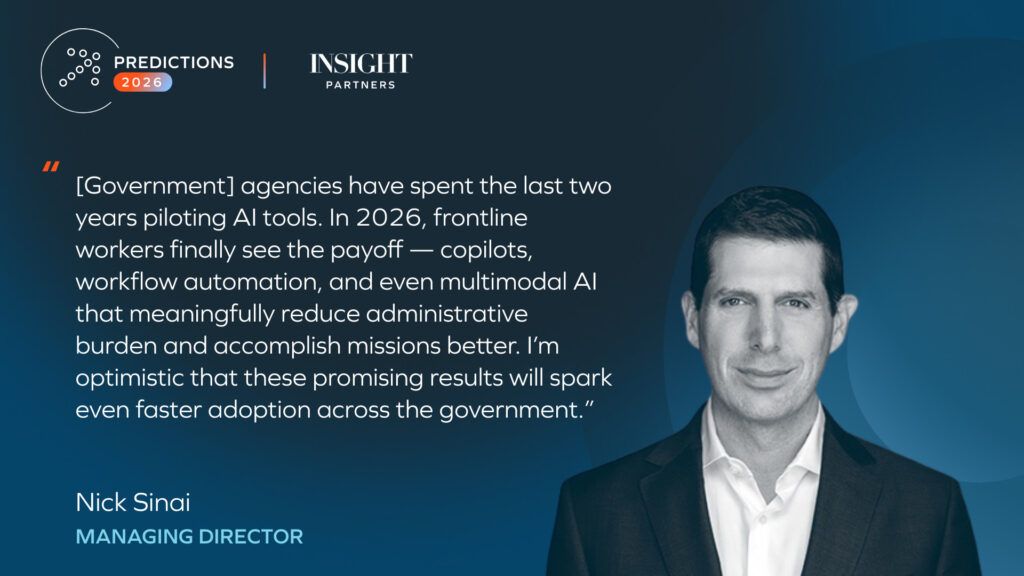
Managing Director Nick Sinai: “AI is without a doubt top of mind for government buyers, for government leaders. What’s encouraging is that there’s meaningful leadership support across the federal government to enable a broad set of employees to use AI.”
The opportunities span both civilian and defense applications. On the civilian side, case management workflows offer immediate value.
Sinai: “A lot of government is case management…so there is a fair amount of bureaucratic writing, summarization, triage, determinations. That’s an area, whether it’s the summarization, whether it’s looking for fraud, or teeing things up for human decision making…There’s great opportunity to bring AI and generative AI to those workflows. I’m also bullish about the potential of agentic AI, but we’ll probably see a relatively slower uptake in 2026 as government officials work through not only the big opportunities but also the potential risks.”
In defense contexts, data fusion is a major unlock.
Sinai: “In the military context, a lot of data sits in siloed systems…There’s really an opportunity to bring things together. This idea of data fusion, which has been around for a few years, but I think this is the year where, especially with big foundation models and other genAI technologies, we’re able to do multimodal in a way that is actually useful for the warfighter.”
Beyond productivity gains, AI is beginning to enable better decision-making.
Sinai: “2026 is the year AI starts enabling better decisions…Everything from benefits triage and fraud scoring to maintenance prioritization, cybersecurity routing, and mission planning. Always under human oversight, but with real operational impact.”
“To set the stage for even more success, government leaders should direct their focus on the foundational, long-horizon work required for government-wide integration of AI — most notably buying down decades of accumulated technical debt, modernizing digital infrastructure, and adopting commercial tech industry data and software development best practices.”
For founders, the key is understanding where government customers actually are.
Sinai: “Effective government leaders care about whether frontline employees, frontline soldiers, and frontline citizens are really getting their needs met…but government still buys software traditionally. Compliance matters. Government buyers still tend to buy software with integration and support services, and often have significant technical debt or a legacy technical stack. If you understand where government customers are and what degrees of freedom they have and don’t have, I think you’re going to be much more successful as a founder.”
AI will rewrite the SaaS playbook for how to scale and how to sell
Especially for software companies selling into the enterprise, AI is forcing fundamental changes to how software companies grow. One major recurring topic is moving from traditional SaaS “per seat” pricing to outcome and/or consumption-based pricing models.
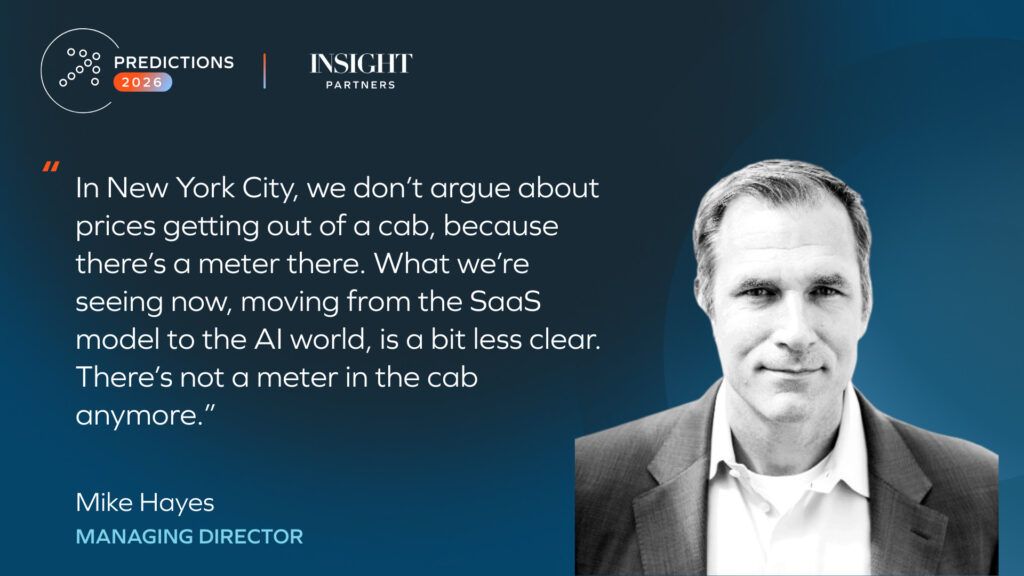
Hayes: “When we pivoted to SaaS [at VMware], the main problem was…you need to be able to meter each of those products. In other words, I need to charge you based on some sort of consumption metric.”
“What we’re seeing now, moving from that SaaS model to the AI world, is a little bit less clarity. The holy grail is outcome-based pricing…[saying], ‘We’re going to create a bunch of shared value, and we’re going to divide that value in half. If we don’t create value, you don’t pay.’ But not all companies can take that risk.”
Gosher adds another wrinkle of pricing and product complexity by factoring in ever-changing customer expectations.
“We’re seeing that copilots and incremental enhancements to existing products are increasingly expected as table stakes. What buyers are willing to pay for are net-new workflows and entirely new product capabilities — particularly those that use data in fundamentally different ways to deliver insights that weren’t previously possible.”
Additional pressure will come when LLMs shift their focus to revenue.
Chingkoe: “Like any other venture model in the world, at some point, LLMs will likely stop offering tokens at a subsidy and look to increase their prices. We all remember the $2 Uber rides when they were trying to corner the market. We anticipate the same price jump will happen here. Suddenly, your queries are rate-limited, and organizations have to start managing volume, expense, and ROI. People have already begun to experience this with the most recent releases. There are many factors, such as how AI infrastructure develops, that will help determine the end state, but in all cases, the SaaS P&L we recognize today will be refactored.”
“When one of the large model players eventually wins the turf war, and they decide to focus on monetization, it is going to be very painful for organizations that have come to rely on subsidized AI use. This will test everyone — organizations that have come to rely on AI as a means of reducing headcount, startups that are leveraging AI to build and develop, as well as individuals who have come to rely on the technology.”
Alongside pricing, AI is also transforming the buyer journey.
Dominguez: “Generative engine optimization (GEO) is transforming how you show up as a firm. Traditional websites, traditional content are not going to get the job done. We’re seeing some of the best companies [asking], ‘What is the LLM going to surface to somebody who wants to purchase my product?’”
“Your job is to influence…because the LLM has said, ‘Here are 10 vendors’ [and I’ve replied], ‘Fine, reduce it to three and tell me which one I should buy,’ so I’ve already made a decision, right or wrong.”
“Think about how our parents might have bought cars 30 years ago. Zero information. You show up to the dealership, and you’re like, ‘Teach me.’”
“Now, because of LLMs, I’m 80 to 90% informed by the time I talk to somebody, and I’ve already made a decision…People show up and go, ‘I’m willing to pay $45,000 for this, I know exactly what the engine does, I know the different cars you have on the lot, I’ve got the VIN numbers.’”
We’re also seeing the pace of AI development causing enterprises to delay buying decisions in some cases.
Hayes: “I meet with a lot of executives in senior leadership roles at all the big Fortune 10, 50, 100 firms that are hesitant to make purchasing decisions, because the AI and technology train is moving rapidly. That can lead to interminable paralysis.”
Despite all this disruption, the companies poised to succeed will be those that keep their operations simple — even as they race to integrate AI.
Hayes, again: “You have to constantly drive simplicity into the foundation of your company…That’s, I think, universally true, even in the age of AI.”
“The market is changing so quickly that the meta-skill is being what a company needs to be in that specific moment, while balancing that with repeatability… build agility into the operating model. Design an organization so that individuals can fail, but the organization doesn’t.”
What founders and leaders should be focused on in 2026
Gosher: “Urgency. Leaders need to move faster — they cannot stand still, they cannot wait, the time is now, or they will be left behind. They have to change their mindset from being a ScaleUp mindset to a startup mindset.”
Dominguez: “After a year of AI experimentation, leaders now need to focus. Select a few high-impact use cases, execute deeply, and deliver real value. Driving AI adoption requires clear leadership, a mandate from the top, and accountability. It should be strategic and embedded in the culture, built on strong data foundations and processes.”
Powell: “In an AI-driven world, CEOs should be zealot-like in their ability to effect change in the organization — working directly with their leadership team to drive change all the way down in the organization to individuals.”
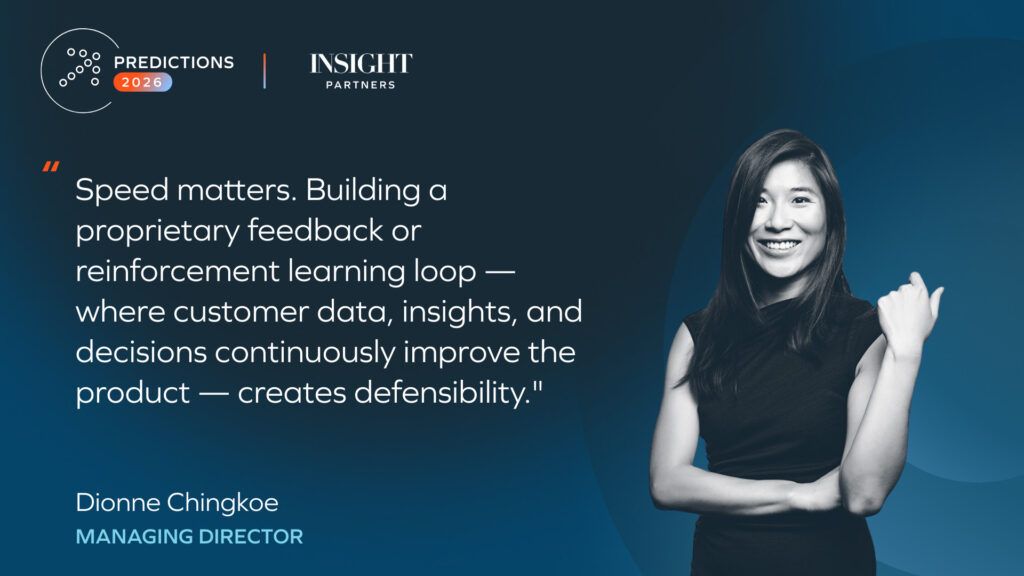
Chingkoe: “Speed matters. Building a proprietary feedback or reinforcement learning loop — where customer data, insights, and decisions continuously improve the product — creates defensibility. Many AI startups today rely on generic LLMs layered onto workflows, which unlocks value but is easy to replicate. Moving fast to build differentiation is essential, especially as attention and capital flow into these markets.”
Lichtenstein: “Growth — but efficient growth — should be the top priority. Over the last few quarters, we’ve started to see an inflection point with growth beginning to reaccelerate. Sustaining that momentum, while doing so efficiently, is the most important focus. AI can serve as a meaningful accelerant and tailwind, and companies should be deliberate about how they leverage it.”
Sinai: “There’s a little bit of the AI window dressing. Focus on how you actually develop the functionality that is core to solving the problem for the customer? Where are the AI features really helping your customer solve a meaningful problem?”
Hayes: “The most critical capability is organizational agility — the ability to evolve the product roadmap as needed without trying to be everything to everyone. It means staying flexible, maintaining focus, and avoiding stagnation.”
Editor’s note: This post contains forward-looking statements and predictions regarding the future of AI. These statements are based on our current expectations and assumptions, and actual results may differ materially from those expressed or implied in these statements. The information provided in this post is for informational purposes only and does not constitute financial, investment, or professional advice. This post should not be considered as a recommendation to buy, sell, or hold any particular investment or security. Investments in AI and related technologies involve inherent risks, and past performance is not indicative of future results.