Insight Partners
More By The Author
Back
ScaleUp:AI
How Kiteworks is building the private data network for the AI era
Insight Partners | January 28, 2026| 3 min. read
Today’s companies depend on sensitive information — customer data, financial records, proprietary information — to do business. But that same data is also their greatest liability, making them vulnerable to hacks, leaks, and compliance breaches.
And as organizations adopt more AI tools and share data across multiple partners and systems, the potential attack surface only grows. How do you get the full benefit of AI and digital collaboration without losing control of the information that fuels it?
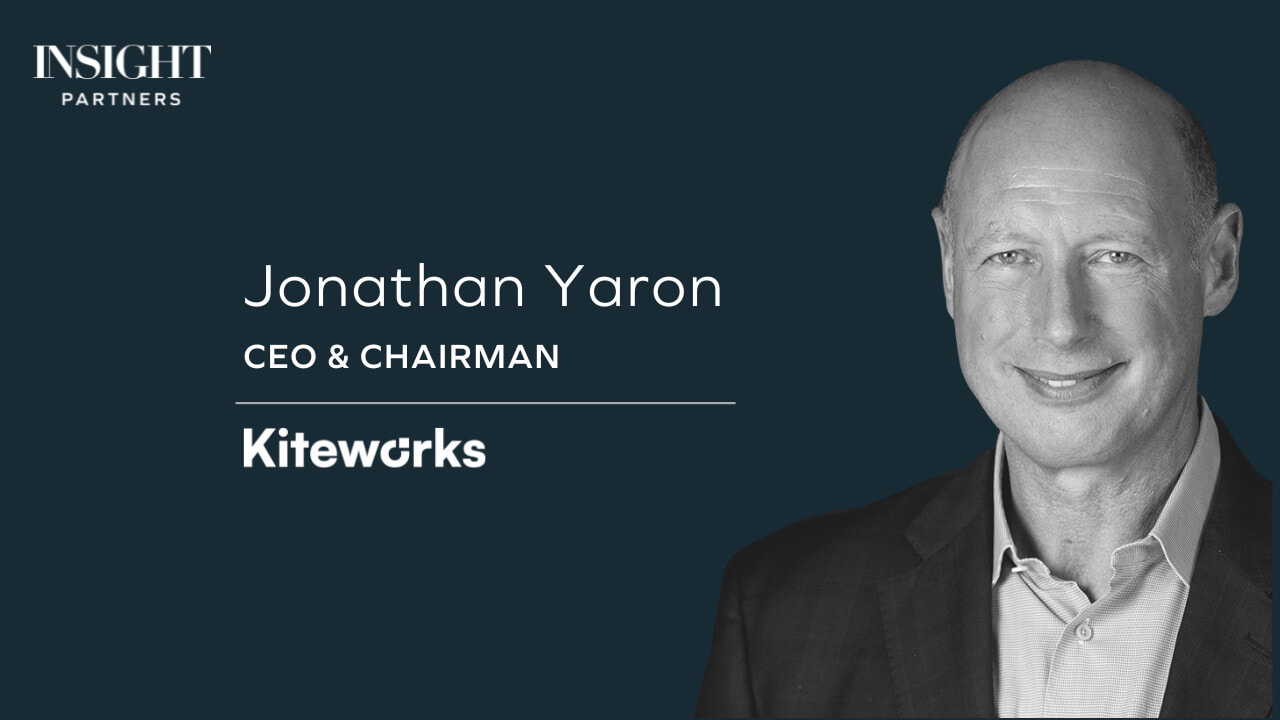
One answer to that question is Kiteworks, the secure transfer company led by CEO and Chairman Jonathan Yaron.
“Kiteworks is a cybersecurity and AI infrastructure that protects sensitive data,” he explains. “It enables organizations to communicate with the outside world in any shape or form, in a very secure manner.”
Reviving a legacy
Yaron first encountered Kiteworks (then Accellion) in 2015, while consulting for the private equity firm that owned it. The file-sharing company, founded in 1999, was struggling. Yaron was brought on as an active chairman to help build a recovery plan.
“I thought the company had great potential, but needed some major changes,” he recalls.
Yaron had more than two decades of enterprise software industry experience behind him, during which he had successfully built and sold two software companies and mentored numerous CEOs. So, when he suggested Kiteworks recruit a new CEO in 2017, they didn’t have to look far.
What unfolded next was one of cybersecurity’s biggest turnarounds. Yaron rebuilt the executive team and pivoted the company from file transfer software to a unified, zero-trust data protection platform, transforming its sales figures in the process.
“The market shifted in our direction. I got a company that [was losing] money, and now it makes $60 to $70M a year in EBITDA. So we’ve gone a very long way.”
The timing couldn’t have been better, he says.
By 2024, Kiteworks had been profitable for five consecutive years, serving 100 million end users and more than 3,650 global enterprises and government agencies, including some of the world’s largest banks, law firms, and pharmaceutical companies. That August, the company raised a $456M series D led by Insight Partners, valuing Kiteworks at $1B.
A safer way to share
Kiteworks’ core product is the Private Data Network (PDN), a secure infrastructure layer that separates internal systems like Microsoft, Salesforce, and Oracle from external communications. The PDN ensures that data movement, whether via email, APIs, web forms, or file transfers, flows through a single, monitored gateway.
“Kiteworks protects, tracks, and reports every single transaction that happens between the organization and the outside world,” explains Yaron. “Every file that moves around is tracked, encrypted, identified, and accounted for.”
But where Kiteworks really shines is compliance. “Regulated industries have books of regulations and contracts,” says Yaron. “There are a lot of inconsistencies in all these contracts and commitments, and they’re all around data privacy.”
Kiteworks is one of the few security platforms authorized by FedRAMP and helps its users meet stringent regulatory requirements, including the General Data Protection Regulation (GDPR) and the Health Insurance Portability and Accountability Act (HIPAA). And, now, the company is investing in an AI-powered engine to automate the process.
“Basically,” Yaron explains, “you pour in all your data…then it shows you the inconsistencies.” The system ingests regulatory texts, legal contracts, and internal policies, identifies inconsistencies, and automatically generates a JSON file that enforces those rules inside Kiteworks, controlling where data can go, who can see it, and how it’s stored.
“That revolutionizes compliance and regulation, because there’s a huge gap today between what is written and committed in the legal contracts and what IT does.”
Inside the AI strategy
Kiteworks’ AI configuration engine is part of the company’s four-year AI roadmap, which will include new releases and updates every three months, layering in new agentic and natural-language capabilities.
The work begins internally. Kiteworks has used AI to streamline internal processes such as translating documents and writing complex data privacy position papers, as well as deploying agentic AI for automated account-based marketing.
The company’s bot crafts personalized outreach emails based on website visitor analytics and public corporate information, Yaron explains.
“All I’ll say is [we’ve been] running at a rule of 50 for quite a few years, and some of it is because of these efficiencies.”
The company is also committed to supporting the MCP protocol, enabling external systems to “talk” to Kiteworks using natural language rather than code, connecting encryption and policy enforcement directly into AI workflows.
“Institutions have a lot of proprietary information, and most of it should not be shared in the public domain,” says Yaron. “The AI engine doesn’t discriminate. It’ll digest any piece of information. How do you identify the pieces that are really sensitive and block them? And then how do you strip off information that shouldn’t be in the public domain?”
To ensure AI systems can safely distinguish between personal, regulated, and shareable content, Kiteworks partners with classification tools that operate inside the enterprise.
These are the tenets of Kiteworks’ AI strategy: a platform that understands data, context, intent, and risk — helping organizations “enjoy the AI world” while keeping their most private information secure, auditable, and under control.
Building to win agentic AI
For Yaron, the key to success in the AI era is discipline. Rather than unleashing AI to act autonomously, Kiteworks’ systems and teams guide it through structured, incremental tasks.
“You have to break down the process into tiny slivers,” says Yaron, much like you would train people: carefully, iteratively, and with context.
“Once you teach it, just like you teach a young child, it will grow and flourish and do it accurately.”
This philosophy is crucial for succeeding in the next era of AI, he argues. “If, as leaders, you know how to break down the processes…you’re going to win in agentic AI, and you’ll be able to do things you couldn’t do with human beings.”
*Editor’s Note: Insight Partners has invested in Kiteworks. This article is part of our ScaleUp:AI 2025 Partner Series, highlighting insights from the companies and leaders shaping the future of AI.