Insight Partners
More By The Author
Back
Article
How Pictor Labs is turning tissue into data to revolutionize diagnosis
Insight Partners | March 23, 2026| 3 min. read
Histopathology — examining tissue under a microscope to diagnose disease — underpins many important decisions in medicine. It’s how clinicians confirm cancer, assess disease progression, and guide treatment plans. Yet the core technology underpinning it hasn’t fundamentally changed in over a century.
When a biopsy is sent to the lab for testing, it’s sliced into paper-thin sections that are dipped into a sequence of chemical dyes. The dyes “stain” the tissue samples to reveal hidden cellular structures, helping doctors determine factors such as cancer type or disease progression.
But this dyeing process can be extremely slow and resource-intensive. Labs often batch samples together, meaning it can take days to get results to doctors, and even longer for those results to move through reporting systems, consultations, and scheduling before patients can be appropriately treated.
Further, conventional staining workflows consume and alter tissue sections, meaning each test can leave less material available for crucial next steps like molecular diagnostics, genetic sequencing, and other precision medicine processes.
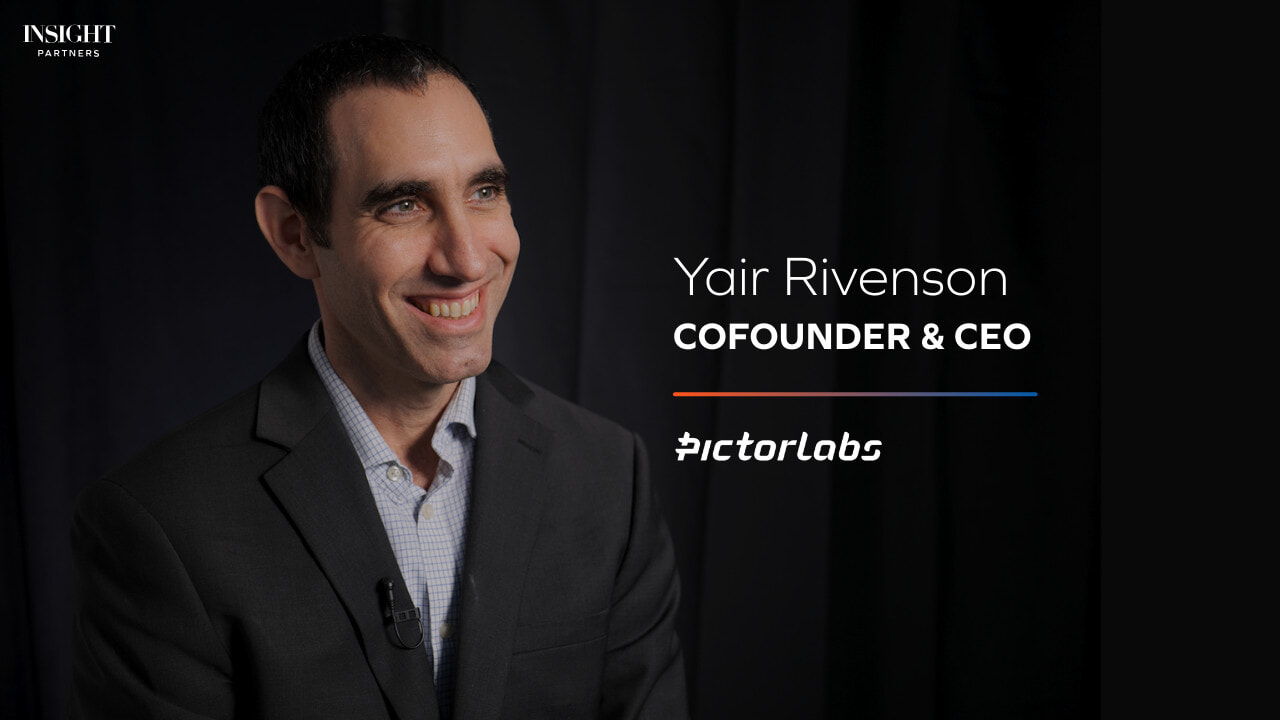
Yair Rivenson, cofounder and CEO of digital pathology startup Pictor Labs, saw this process firsthand while working as a researcher at UCLA in 2019. He and cofounder Aydogan Ozcan worked with tissue samples as part of their deep learning microscopy research. It seemed strange to him that, in the era of digital and AI, histopathologists still relied on limited physical tissue samples.
“For me,” he says, “the question was immediately, why can’t we teach a computer to do that? Why do we need the chemistry part?”
Turning cell stains into software
Pictor Labs exists to simulate the staining process. “The information is there,” explains Rivenson. “We can basically image the tissue, edit it as it is in its native form, and compute that contrast so that the pathologist can study the same exact tissue in the exact same way that they’re currently doing.”
In practice, the process still involves biopsy, tissue sectioning, and glass slides. But instead of staining tissue sections with physical chemical dyes, Pictor Labs images unstained tissue and uses AI to generate virtual stains from the underlying optical signal.
“The standard process today is like how they develop film in these different baths. It’s not [very] different to that.”
Then, using technology powered by AI and deep learning algorithms, Pictor Labs can apply virtual stains to the image without physically staining or altering the tissue. “In other words, now the pathologist can get multiple ‘stains’ on the same tissue section,” says Rivenson. “It’s very quick.”
But speed isn’t the only benefit. Running multiple virtual tests on the same tissue section reduces the need for additional biopsies.
“With the standard process today, you literally need to cut multiple sections from the same biopsy. At some point, you run out of material,” says Rivenson.
And that’s not just because it’s potentially invasive, he adds. “Re-biopsy will cost you thousands of dollars…The problem with healthcare, from what I’m seeing right now, is there’s no big thinking [on behalf of] the patient.”
Pictor Labs’ process is designed to reduce turnaround time, preserve tissue for downstream analysis, and improve workflow efficiency.
“Until we break these molds, I don’t think things will get much better.”
Scaling beyond the lab
Pictor Labs launched in late 2020 following seed funding, after emerging from research at UCLA School of Engineering and Medicine. As the company evolved, it refined its approach to focus on software and AI algorithms that could integrate into existing pathology and lab workflows.
“It’s not enough to come up with the best technology,” explains Rivenson. “What is really necessary is to understand the workflow of each and every customer that you talk to. And I have to tell you, we cannot find the exact workflow [of] any lab that we work with. There’s always some wrinkles, something that makes their process slightly unique.”
“You need to make your technology as robust and as seamlessly available [as possible], to become part of the workflow.”
As Pictor Labs grew, it established partnerships mostly across the pharmaceutical industry to support the adoption of its technology in research and translational settings.
In 2024, the company announced a $30M Series B led by Insight Partners, with the intention of accelerating adoption, expanding the team, and investing in innovation. In 2025, the company launched ClearStain, an AI-powered virtual staining platform designed to support digital sequencing and molecular diagnostic workflows.
Built on Pictor Labs’ earlier iterations, ClearStain packages its technology into a workflow-ready platform that integrates virtual staining directly into the tissue selection and annotation process, rather than operating as a standalone imaging tool. In evaluations, the virtual images closely matched what pathologists were used to seeing on chemically stained slides, across almost every region reviewed.
Healthcare’s innovation adoption gap
For all its promise, Rivenson is realistic about what it takes for new technology to gain traction in healthcare. “I think there is an interesting innovation adoption gap,” he says. “Healthcare is a bit more conservative than other systems…The fact that things need to be regulated and approved by a lot of people makes adoption slower.”
Diagnostic workflows generally sit at the center of patient care, so any changes must pass through layers of regulation, testing, and trust. It’s critical that any new approach is additive, rather than disruptive. “So the technology, other than being amazing and cool, needs to really embed itself in the workflows.”
“You want to make sure that the innovation is solving real, grounded problems.”
That pragmatism extends to how Pictor Labs thinks about AI. While AI underpins its virtual staining technology, Rivenson is clear that automation comes with great responsibility.
“If you’re using AI…you’re still responsible for the [work],” he says. “Every company that is using AI will need to be somewhat accountable for that, especially in the healthcare industry.”
Making precision medicine possible for every patient
Despite these barriers, the direction of travel is clear for Pictor Labs: By digitizing tissue earlier, the company aims to shift histopathology from a linear process battling scarcity into the foundation for data-driven care.
“Once our technology is embedded with clinical labs, I think that’s the most important thing and the biggest success for Pictor Labs,” he says. “If you could change the whole process around pathology upstream [of] the patient, you can start using smaller biopsies, [run] additional analysis, and have enough material to do precision medicine…for every patient.”
*Note: Insight Partners has invested in Pictor Labs.