Insight Partners
More By The Author
Back
Article
Way Security wants to rebuild the foundation of enterprise identity
Insight Partners | July 27, 2026| 3 min. read
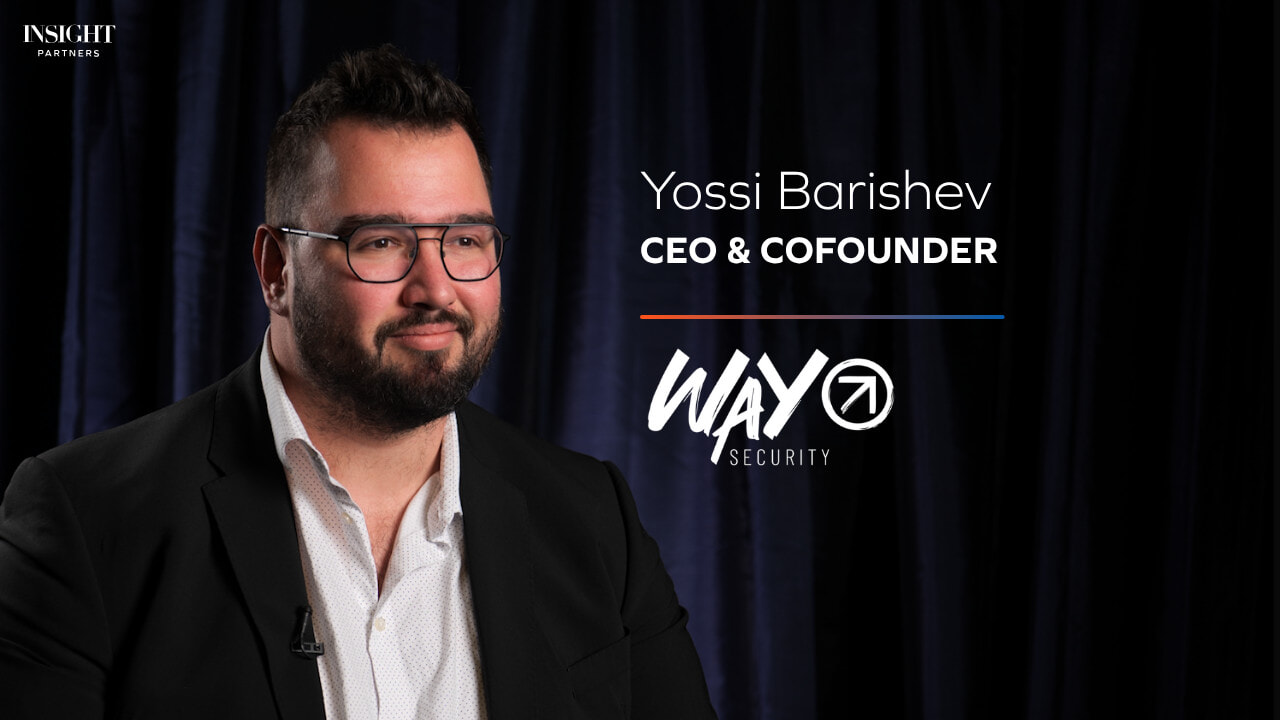
Cybersecurity has always been about two things: trust and identity. For Yossi Barishev, cofounder and CEO of Way Security, AI has changed the pace of security, but it hasn’t changed those fundamentals.
“AI did not rewrite the laws of security physics,” says Barishev. “Whatever gaps or lags in maturity have existed across organizations have now just been amplified by the velocity that AI introduces.”
One such gap AI has exposed is in identity and access management (IAM), which ensures that the right people have access to the right IT resources, for the right reasons, at the right time.
The problem, as Barishev sees it, is that most enterprise identity infrastructure is patchwork: point solutions bolted together, human resources information systems and identity providers with incomplete records, and, now, more and more non-human identities sprawling without clear ownership or a system of record. Enterprises are trying to use AI solutions to automate without addressing what’s broken underneath.
“Everything in identity today is built on a foundation that’s around 20 to 30 years old,” says Barishev. “Those technologies can no longer really hold the modern enterprise infrastructure together.” With Way Security, Barishev and CTO Yonatan Rosenberg want to fix that foundation and rebuild identity infrastructure for the AI age.
“The primary pain we’re solving is, how can we enable enterprise identity management around the existing complexity that reality brings us?”
Identity infrastructure hasn’t kept up
Way Security was born out of the founders’ frustration. Both Barishev and Rosenberg have spent most of their careers leading security teams at large companies, including together at Sygnia, and have grown increasingly discontented with how identity infrastructure is falling behind the pace of technological change.
“We had so much internal frustration,” says Barishev. “We rely so much on manual labor, just throwing humans at this problem space. And we were so fed up with this reality where for every dollar we spent on software, we’re spending three to five bucks on just the enablement of those solutions.”
After a year in stealth, Way Security launched in July 2026, with funding from Insight Partners and Glilot Capital.
Barishev’s previous role was running the security team at Fireblocks, a digital asset infrastructure company, which has secured over $10T in digital asset transactions for more than 2,400 institutional clients. The role shaped his perspective on what good security infrastructure should look like.
“We had the world’s leading adversaries breathing down our necks.”
“The primary takeaway I had from my experience over there is, how can you have a pragmatic approach to having security where business enablement is at its core?” says Barishev. “You’re building infrastructure that can scale and be pliable enough on one end, but at the same time enabl[ing] the velocity with which a modern organization should be able to move.”
No HR for AI Agents
IAM has always been one of the central pillars of enterprise security, and for good reason.
“At the epicenter of every single breach in history, there was always the theme of identity, because identities are the catalysts of access,” says Barishev. “The main principles of security in the age of AI have not changed…It’s still all about how adversaries can compromise identities as fast as possible.”
What has changed is the speed at which that can happen, and the fact that a growing number of those identities are non-human, both operating within the organization and attacking it from without.
A big part of the difficulty AI introduces is governance and figuring out the scope of its agency. Human employees have defined roles, responsibilities, and managers, and they sit within an organizational structure that determines what they should and shouldn’t have access to. AI doesn’t yet have that structure.
“There is no HR system for Agents,” says Barishev. “The main challenge we’ll see in the coming years is…how can we actually have a well-defined scope of what’s that purpose of that particular AI Agent…[and] seeing how we can have predictability into its behavior.”
For Barishev, the solution lies in treating an Agent as just another employee.
“Whatever internal governance structure you have so far, you’re not supposed to reinvent it for the age of AI. You just need to apply it in an appropriate way for this new animal you now need to deal with.”
“You need to fight fire with fire”
Security has a fundamental asymmetry. The defender needs to secure every single vector; the attacker only needs to find one weak link. AI has made this even more unbalanced because it can now happen at machine speed.
For Barishev, the answer is making sure security can match the velocity of AI, both in how enterprises defend themselves and in how security products are built.
“You need to fight fire with fire,” says Barishev. “The same way AI is being utilized to enable innovation, enable velocity, enable businesses, we need to do the same thing and apply it for the enablement of everything in security, everything in infrastructure.”
“We need to basically place as many hurdles as possible, as many guardrails as possible, applying the concept of defense in depth…to basically demotivate the adversary.”
Building the new perimeter of the enterprise
Barishev and Rosenberg are applying that principle to building Way Security. Rebuilding identity infrastructure from the ground up is an ambitious engineering challenge, and the incumbents in this space — Microsoft, SailPoint, Saviynt, and CyberArk — have decades of engineering work behind their solutions.
“I don’t think that we could have enabled technologically what we do as Way without having AI as a catalyst for it,” says Barishev. “If we want to have the ability to enable these giants and create a path for them and for the industry itself into the age of AI, there’s a lot of engineering work that comes into it.”
“People won’t be waiting five years for us to ship whatever we build. We need to do this now.”
Looking ahead, Barishev thinks the future of AI in security hinges on how the industry governs it.
“If we’re able to, as an industry, standardize around how we govern AI, how we secure AI, how we apply the basic principles of identity and access management to it…we’ll be in a great state, because identity is, was, and will be the actual perimeter of the enterprise.”
And the plan is for Way Security to play a central role in that future.
*Note: Insight Partners has invested in Way Security.