Back
Thought Leadership
Agent-led growth: The next GTM motion is already here
Neal Behrend | March 13, 2026| 7 min. read
Here’s the thing about new GTM motions: The window of advantage is typically widest right at the beginning. The companies that built for product-led growth (PLG) early — Slack, Dropbox, Zoom — didn’t wait until the product-led playbook was fully proven. Snowflake and DocuSign nailed account-based experience (ABX) early and ran circles around teams still doing spray-and-pray. The same window is open now for a new GTM motion.
The pattern: New infrastructure → New GTM motion
Many dominant GTM motions in enterprise software were unlocked by a new layer of enabling infrastructure. Sales-led growth has always existed, but became scalable when CRMs like Salesforce gave sellers relationships at scale. From Insight’s perspective, product-led growth reached efficiencies when product analytics tools like Mixpanel and Amplitude made self-directed user experiences measurable and repeatable. Account-based experience crystallized when intent data platforms like 6sense* enabled precision targeting at the account level.
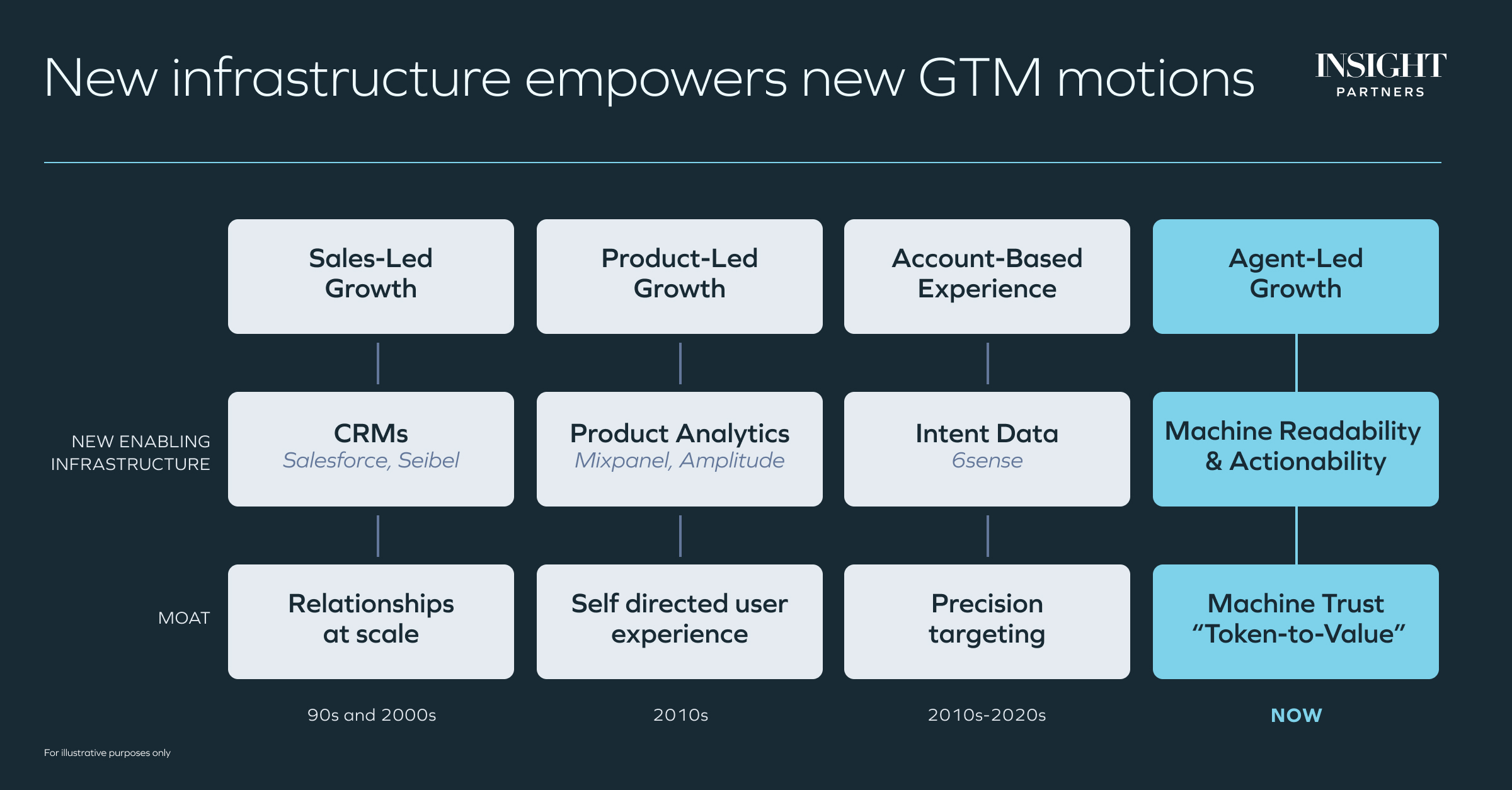
Prior motions have followed a similar arc: new infrastructure develops, early movers build around it, and latecomers do their best to copy. We believe the same dynamic is forming now, and winners are already being crowned.
A new infrastructure stack is emerging right now — and a new motion is forming around it. We’re calling it Agent-led growth. Prior motions have followed a similar arc: new infrastructure develops, early movers build around it, and latecomers do their best to copy. We believe the same dynamic is forming now, and winners are already being crowned.
Defining ALG: The distinction that matters
The term “Agent-led growth” is already in use, but it describes two very different things under the same label.
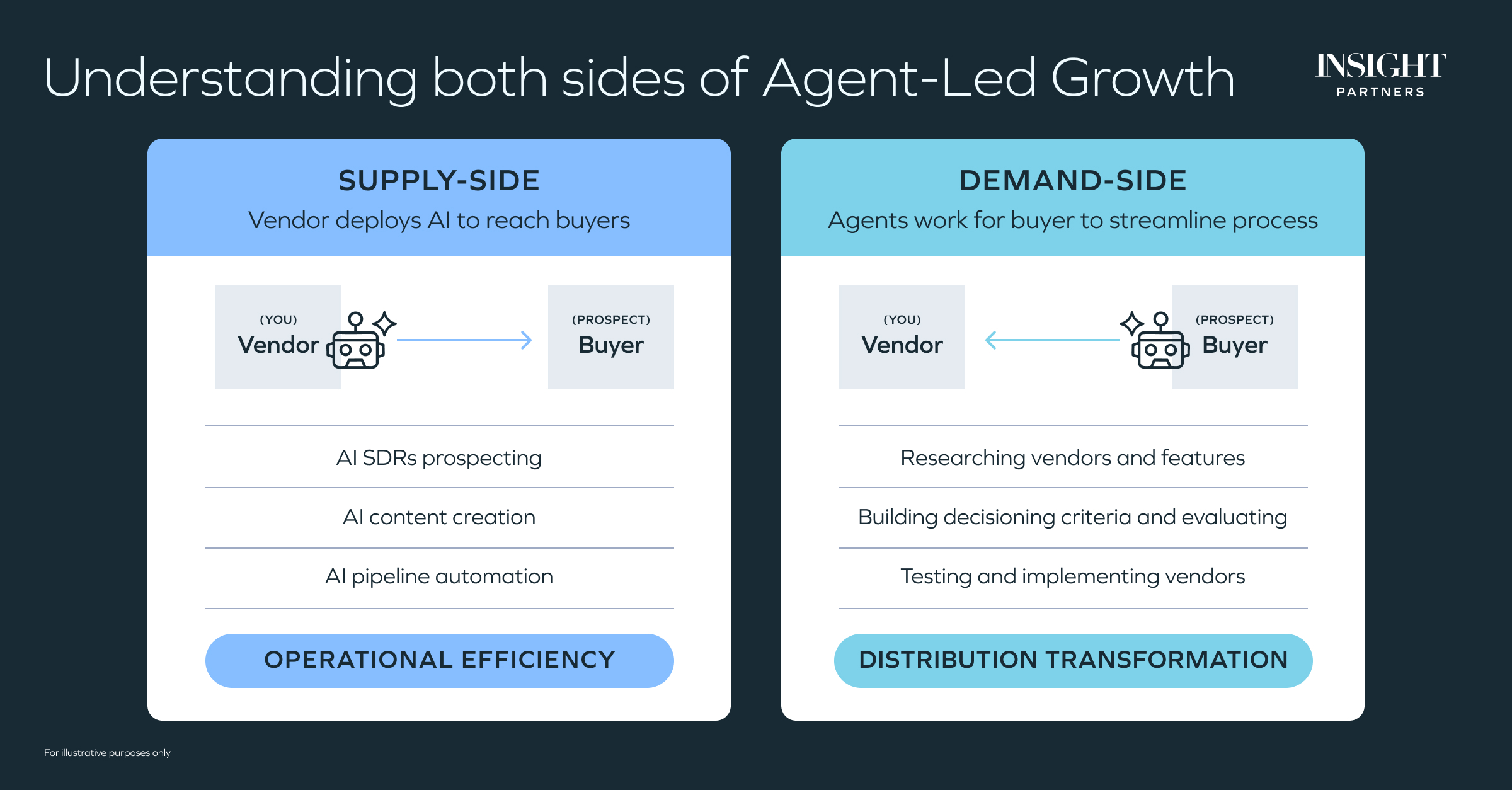
If you ask ChatGPT or Gemini, you’ll likely get the definition of supply-side Agent-led growth. That is, AI Agents deployed by companies to reach buyers more efficiently: agentic SDRs, AI content creation, AI-ified pipeline automation. This is genuinely valuable; we talk about it with our portfolio companies — but it’s an efficiency gain on existing motions, not a structural shift in how markets work.
Demand-side is driving the opportunity — and risk
Demand-side Agent-led growth — as defined here — is different. Agent-led growth is what happens when AI Agents work for the buyer: researching vendors, compiling feature matrices, testing capabilities, evaluating options, and ultimately recommending or initiating purchases on the buyer’s behalf. Supply-side ALG improves the economics of your current funnel. Demand-side ALG changes whose funnel it is.
Supply-side ALG improves the economics of your current funnel. Demand-side ALG changes whose funnel it is.
Demand-side ALG is where the structural opportunity — and the structural risk — lives. This shift is most pronounced so far in the developer ecosystem, where Agents have (so far) been given the most authority to act. The market hasn’t yet crowned defaults in category-specific B2B SaaS — CRM, HR, marketing automation, and vertical software. The developer ecosystem tipped in under 18 months. The question isn’t whether other categories follow it; it’s whether you or your competitors will be positioned when buyer trust shifts to Agents in your category.
Two early Agent-led growth winners
The clearest proof points so far are in the developer ecosystem, where AI Agents have both trust and autonomy. Vibe coding tools — Bolt, Lovable, Cursor, Claude Code* — don’t just write code. They can make infrastructure decisions for the developer. A de facto default stack is emerging, not through sales processes or marketing spend, but through Agent selection.
Supabase became the default backend for many vibe coding platforms, and it didn’t start out through business development, but by Agent selection. That preferential placement drove the company from 1 million to 4.5 million developers in under 12 months. The CEO credited the dynamic directly: “Our sign-up rate doubled in three months because of Bolt, Lovable, Cursor.” The valuation reflected the momentum from $765M in September 2024 to $5B by October 2025.
Resend, a transactional email provider, went from zero to 400,000 users since its 2023 launch. When you ask Claude Code to add email functionality to a repo, it chooses Resend 63% of the time. Their much larger competitor, SendGrid, is chosen in 7% of tests.
A de facto default stack is emerging, not through sales processes or marketing spend, but through Agent selection.
Why might Agents pick these products?
- Both have extensive, machine-readable documentation
- Both offer free tiers that remove the need for budget approval and grow through usage-based pricing
- Both have clean, predictable APIs that minimize the decisions an Agent has to make
- Both are heavily represented in LLM training data through open-source work and community publishing
The pattern is consistent: These products minimize the work an Agent must do to form a confident recommendation.
There’s a useful way to think about this: token-to-value. How many tokens does it take an Agent to determine your product solves the user’s need, and how many more does it take to implement? It’s the machine-readable parallel to time-to-value in PLG. Gaps in your documentation, ambiguous pricing pages, and missing integration examples can add tokens.
In our experience, the faster an Agent reaches a confident answer, and the easier an Agent can implement a solution if selected, the more likely that product lands in the default set — and those defaults compound quickly.
The full funnel is shifting, not just discovery
Much of the conversation about AI and GTM has focused on discovery: Generative Engine Optimization (GEO), Answer Engine Optimization (AEO), AI search visibility, and getting cited in LLM outputs. GEO is real, important, and table stakes. But it’s only the top of the funnel.
ALG extends further down in ways that are less discussed and potentially more consequential. At the evaluation stage, Agents can autonomously compile feature matrices, browse documentation, and test capabilities — often before a sales conversation begins. Research shows that 77% of buyers purchase from their AI-informed preliminary favorite. In many cases, the Agent has already formed a point of view before your seller gets on the call.
At the decision stage, the seller’s role shifts. They are no longer creating demand — they are confirming or combating a pre-formed preference. If the Agent’s evaluation landed in your favor, the seller’s job is to reinforce. If it didn’t, they’re walking into a remediation conversation.
At the purchase stage, Agent-initiated transactions are live in the consumer’s mind already. ChatGPT’s Instant Checkout was an early experiment. B2B implications are near-term.
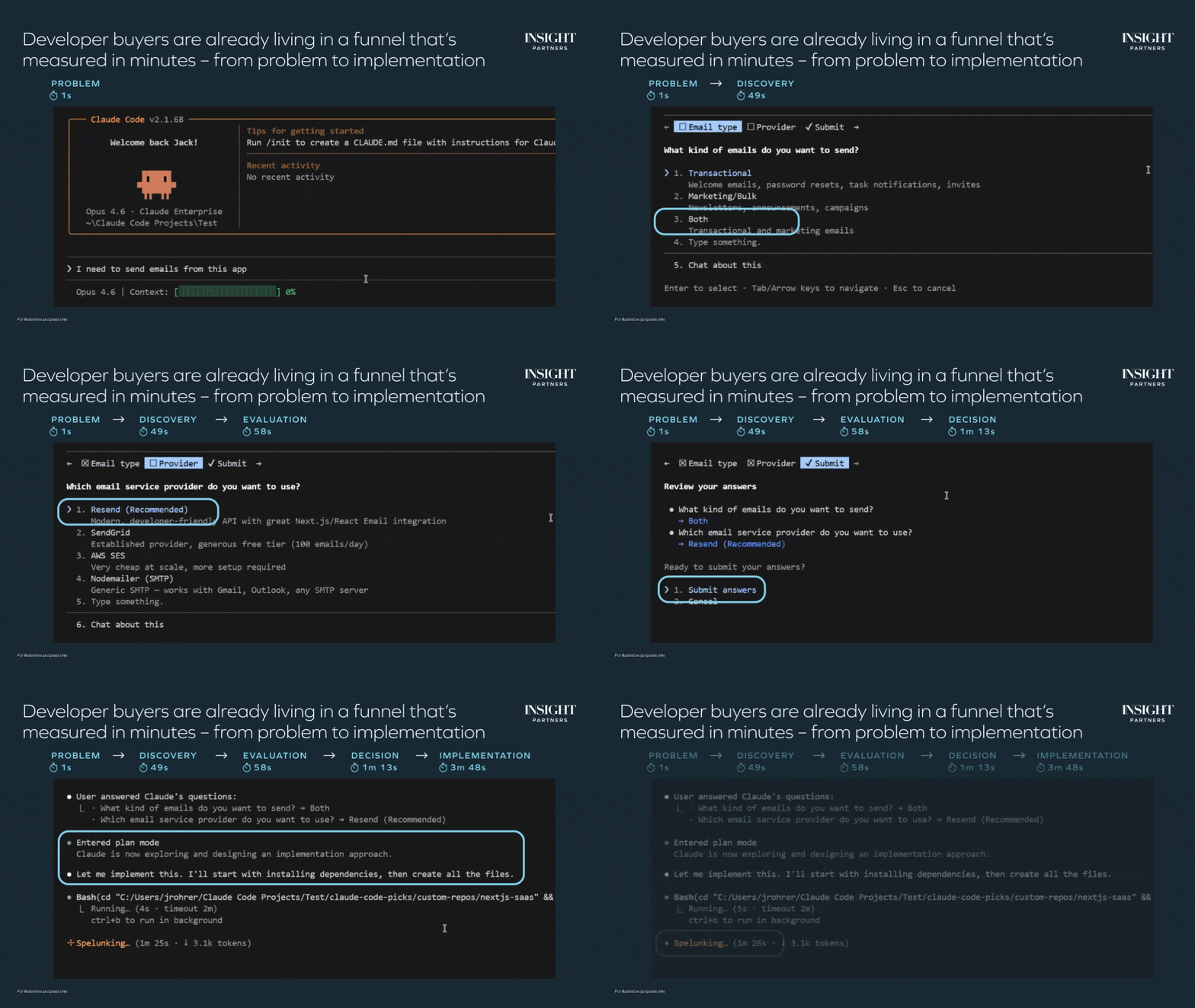
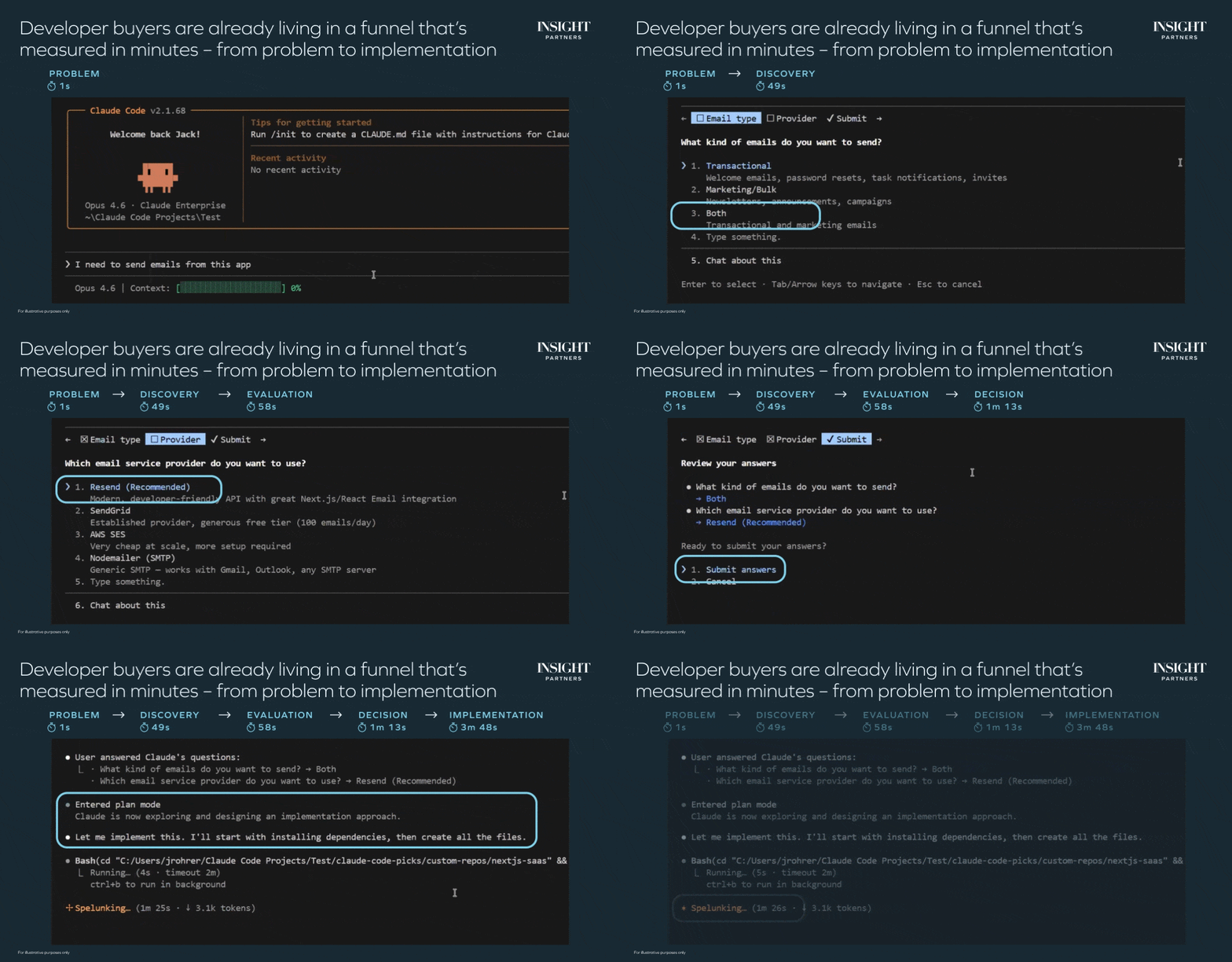
The speed of this is striking. Developers using Claude Code can go from problem awareness to production integration in under five minutes — Resend requires just one command to your Agent for implementation. The funnel doesn’t disappear in an Agent-mediated world; it accelerates.
Watch this motion play out in situ
The gif below shows a real-life use case of a developer in Claude Code moving through each traditional phase of the funnel — from problem to implementation — in less than four minutes.
WebMCP: The new motion gets its infrastructure
The GTM motions mentioned needed their enabling infrastructure. CRM for SLG. Product analytics for PLG. Intent data for ABX.
Agent-led growth is getting its infrastructure now.
The protocol stack is forming around four layers. Anthropic’s Model Context Protocol (MCP) enables Agents to connect to backend tools and data. Google’s Agent-to-Agent protocol (A2A) enables Agents to coordinate with each other. Google’s and Stripe’s protocols enable Agent-initiated transactions and payments.
But there was a gap. All of these protocols operated behind the scenes — backend systems, API layers, server infrastructure — great for developers but excluding everyone else. The browser, where the rest of us interact with the web, was still a visual medium that Agents had to awkwardly navigate by taking screenshots and guessing where to click. Research shows two-thirds of computing spent on AI-web interaction was wasted on this guesswork.
That gap closed a few weeks ago.
On February 12th, Google and Microsoft published WebMCP — the Web Model Context Protocol — as an open standard. It shipped in Chrome 146. And it changes the relationship between websites and AI Agents.
The simplest implementation is remarkably accessible. You add a few HTML attributes to your existing forms — a tool name and a description — and Chrome can translate those forms into structured tool schemas that an AI Agent can invoke. No backend changes. No new infrastructure. Your existing website becomes Agent-ready.
Now, think about this in the context of the funnel we just watched above.
WebMCP transforms each stage of the buyer journey. Agents can now programmatically test your product through your website — running searches, exporting data, configuring settings — turning evaluation from a vendor-controlled demo into an always-on, buyer-controlled test. At the purchase stage, it collapses the conversion path: Instead of multiple human steps between recommendation and action, an Agent completes the transaction directly, with the user simply confirming.
The compounding effect: As we have observed, Agents that find your tools reliable will preferentially recommend you over time, building a “machine trust” moat that mirrors how brand trust works in the human world.
The playbook: What companies should do now
Y Combinator joked about changing its motto to “build something Agents want.” “Sell something Agents can buy” seems closer to the mark.
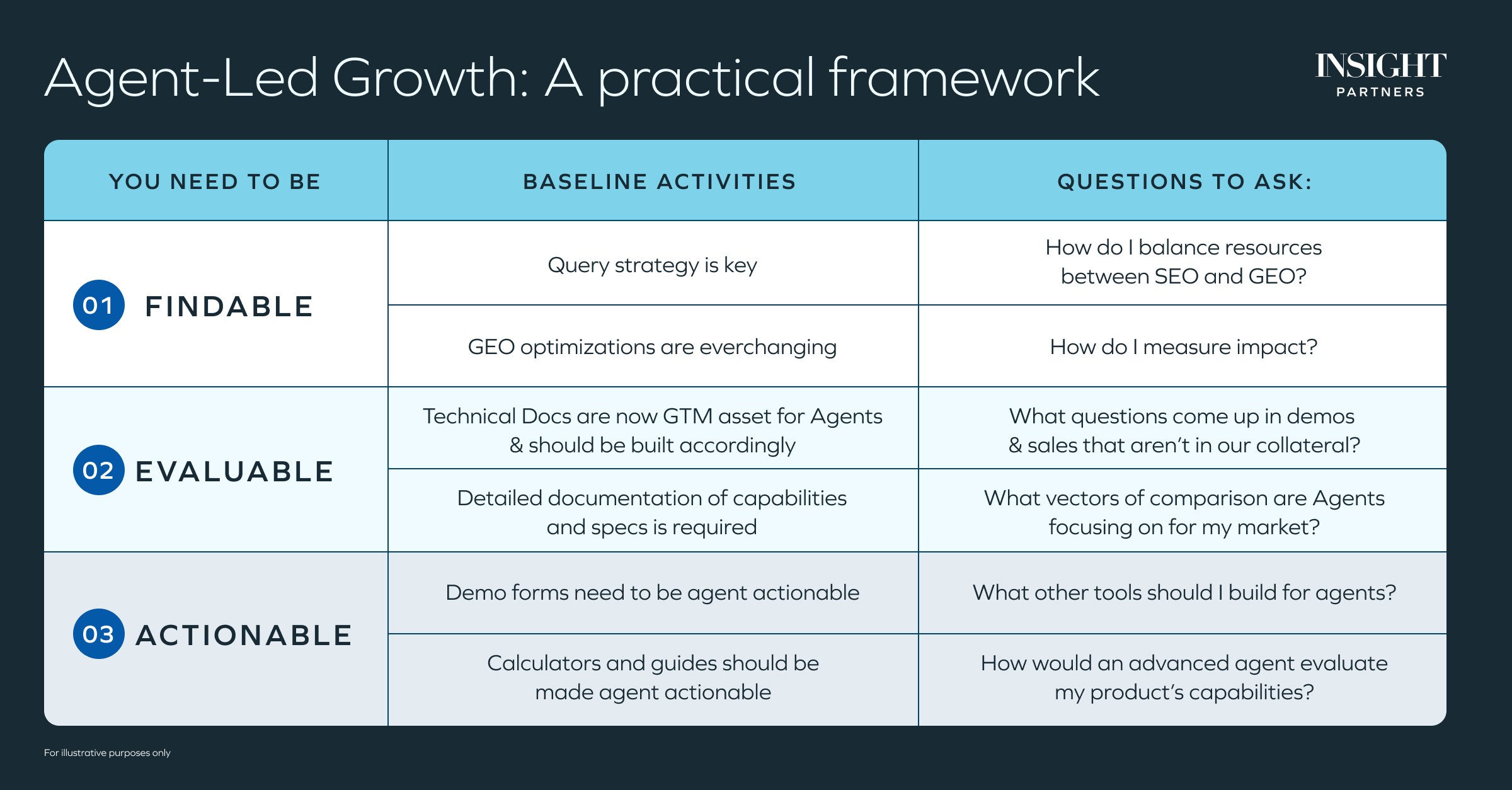
Expert analysis by GTM leaders at Insight points to a consistent set of principles on how Agents learn and act. The practical framework distills to three properties your product and GTM need to evaluate to win in an Agent-mediated world.
Findable
Invest in GEO and AEO. This is table stakes for AI discovery, but it’s not static. The query strategy matters, and the balance between SEO and GEO investment is a live question GTM teams should revisit regularly. The measure of success is whether Agents surface you when they’re problem-aware on behalf of a buyer.
Evaluable
Treat documentation as a GTM asset, not a support function. Agents read documentation, not pitch decks. Both Supabase and Resend invested heavily in developer docs over marketing. What questions come up in demos and sales conversations that aren’t captured in your public-facing collateral? Those questions are exactly what Agents will expose, and answering each of them adds tokens and compute for the Agent.
Detailed capability documentation, pricing transparency, and structured product detail pages are now core to the go-to-market stack. The concrete design target is minimizing token-to-value — the tokens it takes an Agent to go from problem-aware to implemented — and the teams succeeding with Agent-led growth are actively auditing their documentation against that goal, not just keeping the docs up to date with version numbers.
Actionable
Coordinate with engineering to annotate key conversion paths — demo requests, trial sign-ups, pricing pages — for WebMCP. Trial tiers or usage-based pricing remove the need for budget approval, enabling Agent-initiated provisioning with limited human sign-off. Ask honestly: How would an advanced Agent evaluate your product’s capabilities today, and what would it encounter? The answers tend to surface gaps quickly.
None of this replaces good marketers and sellers. This playbook works best as a layer on top of coherent human GTM. Agents reward consistency — between what your marketing writes, what your docs show, and what your sellers say. Also, the stakes of human interaction are raised. Your buyer is further down the funnel and is putting a greater premium on their time. The teams that win at ALG will be the ones who treat their Agent messaging as an extension of their existing positioning.
Earn the default
94% of B2B buyers are already using LLMs in their research process. The infrastructure is being built in real time. You don’t have to commit your company to a fully agentic flow to take advantage of this shift, just like you could implement some best practices from PLG without becoming Dropbox. Think about removing barriers to Agents evaluating and implementing your solutions. If your competitors do this before you, Agents will build a moat of familiarity and trust with their products.
Agent-led growth is what happens when AI Agents don’t just help buyers discover vendors — they evaluate, compare, and transact on their behalf. The companies that make themselves visible, evaluable, and actionable to machines will build the next generation of durable advantages in B2B software.
The open question isn’t whether ALG will reshape B2B distribution. It’s which categories get reorganized first — and whether the current market leaders in each category will be the ones who adapt and earn their default status, or the ones who get disrupted in rapid fashion.
Editor’s note: Insight has invested in OpenAI, Anthropic, StackBlitz, and 6sense.
This post contains forward-looking statements and predictions regarding the future of AI. These statements are based on our current expectations and assumptions, and actual results may differ materially from those expressed or implied in these statements. The information provided in this post is for informational purposes only and does not constitute financial, investment, or professional advice. This post should not be considered as a recommendation to buy, sell, or hold any particular investment or security. Investments in AI and related technologies involve inherent risks, and past performance is not indicative of future results.