Back
Article
How AI is replacing the analytical hierarchy in enterprise software
Lonne Jaffe | April 09, 2026| 7 min. read

In Jack Dorsey and Roelof Botha’s article, “From Hierarchy to Intelligence,” they argue that AI doesn’t make organizational hierarchies faster — it replaces what they do. Most enterprise software was built to serve an information hierarchy. The analyst pulls the dashboard. The manager schedules the review. The VP presents the findings. The decision gets made, days or weeks later. Every layer adds latency. Every handoff loses context.
This is especially true in categories where the incumbent built its moat on complexity itself. Some software became so deeply embedded that organizations trained entire teams to operate it, where fluency in the platform became a career path, and where switching costs weren’t just technical but professional and cultural. That model worked for decades because the complexity itself was part of the product’s structural advantage.
With generative AI, some traditional software switching costs — implementation complexity, workflow lock-in, the professional ecosystems built around legacy platforms — feel like they are weakening, and fast. As AI gains the ability to map legacy data schemas to new intelligence layers in minutes, rather than years, and learns to reliably migrate and refactor code and customizations, complexity stops being a moat and becomes a liability.
While the Dorsey and Botha piece focuses primarily on building the “company world model” — the replacement of humans with AI to move information faster — we were particularly intrigued by the less-explored “customer world model” building that they mention. One moat that seems quite resilient to generative AI disruption is having privileged access to a fresh, secure, continuously improving proprietary data asset that makes AI more valuable. Proprietary runtime data that gets richer with every customer interaction is proving to be one of the more resilient sources of economic power. Across Insight’s portfolio of hundreds of software companies, we’re seeing this pattern repeat.
Specifically, as the Dorsey and Botha article mentions, transaction data is some of the richest data for AI to build context for:
“But the capability of the system is only as good as the quality of the customer signal feeding it. And money is the most honest signal in the world.
People lie on surveys. They ignore ads. They abandon carts. But when they spend, save, send, borrow, or repay, that’s the truth. Every transaction is a fact about someone’s life. Block sees both sides of millions of these transactions every day, the buyer through Cash App and the seller through Square, plus the operational data from running the merchant’s business. That gives the customer world model something rare: a per-customer, per-merchant understanding of financial reality built from honest signal that compounds. The richer the signal, the better the model. The better the model, the more transactions. The more transactions, the richer the signal.”
Insight portfolio company Quantum Metric provides a compelling real-world example of the “customer world model.” It captures how hundreds of millions of people interact with the world’s largest e-commerce sites, airlines, hotels, and financial services apps. Every click, every error, every abandoned cart, every failed login, across web and mobile, brought together in a high performance, secure way that protects privacy. Over 300 metric types, billions of sessions monthly, experience data reflecting roughly half the world’s internet users. It is one of the richest behavioral datasets in enterprise software.
This sparked a conversation between Quantum Metric founder and CEO Mario Ciabarra and Insight Partners Managing Director Lonne Jaffe about how AI can build this information layer in practice, and how SaaS product builders can think about building AI that transforms information into understanding and action.
Ciabarra: After 30 consecutive quarters of growth and crossing $100M in ARR, we hit a stretch in early 2025 where growth decelerated. Not because customers weren’t getting value, but because the market was shifting toward something we hadn’t yet built. We were caught in the uncomfortable middle: too much momentum to panic, not enough acceleration to lead.
Ciabarra: The catalyst came from our board. John Chambers, former CEO and Chairman of Cisco, has a rare intuition for inflection points. John saw two years ago that a window was opening and it was time to move, or risk getting left behind. And Lonne saw something we hadn’t fully articulated to ourselves.
Jaffe: Quantum Metric had one of the best instrument panels in the industry. What the market needed was an intelligence that could fly the plane.
Jaffe: This is a pattern we see repeatedly at Insight. Companies build extraordinary data assets and then stop short of actually analyzing them and “doing something,” leaving the customer to close the last few miles. In a pre-AI world, that was sometimes a reasonable product boundary. In 2026, it’s a vulnerability. Companies with a rich proprietary datasets need to ask whether they’re delivering data or delivering the understanding needed to actually take action.
Every company with a rich proprietary dataset needs to ask whether they’re delivering data or delivering the understanding needed to actually take action.
Ciabarra: That distinction — data versus understanding — unlocked everything for us. Data is a burden you give someone to solve. Understanding is a gift you give someone to take action. I’ve spent eleven years talking with digital leaders about the “what happened?” question. But most analytics — the entire legacy category, including platforms with multi-month implementations, seven-figure annual contracts, and ecosystems so complex they require dedicated specialists just to operate — has been in the burden business. The dashboards get built. The reports get run. But teams still don’t understand why things changed, or what to do about it.
Ciabarra: That gap between data and understanding is where the hierarchy lives. And that’s the machine we redesigned.
That gap between data and understanding is where the hierarchy lives. And that’s the machine we redesigned.
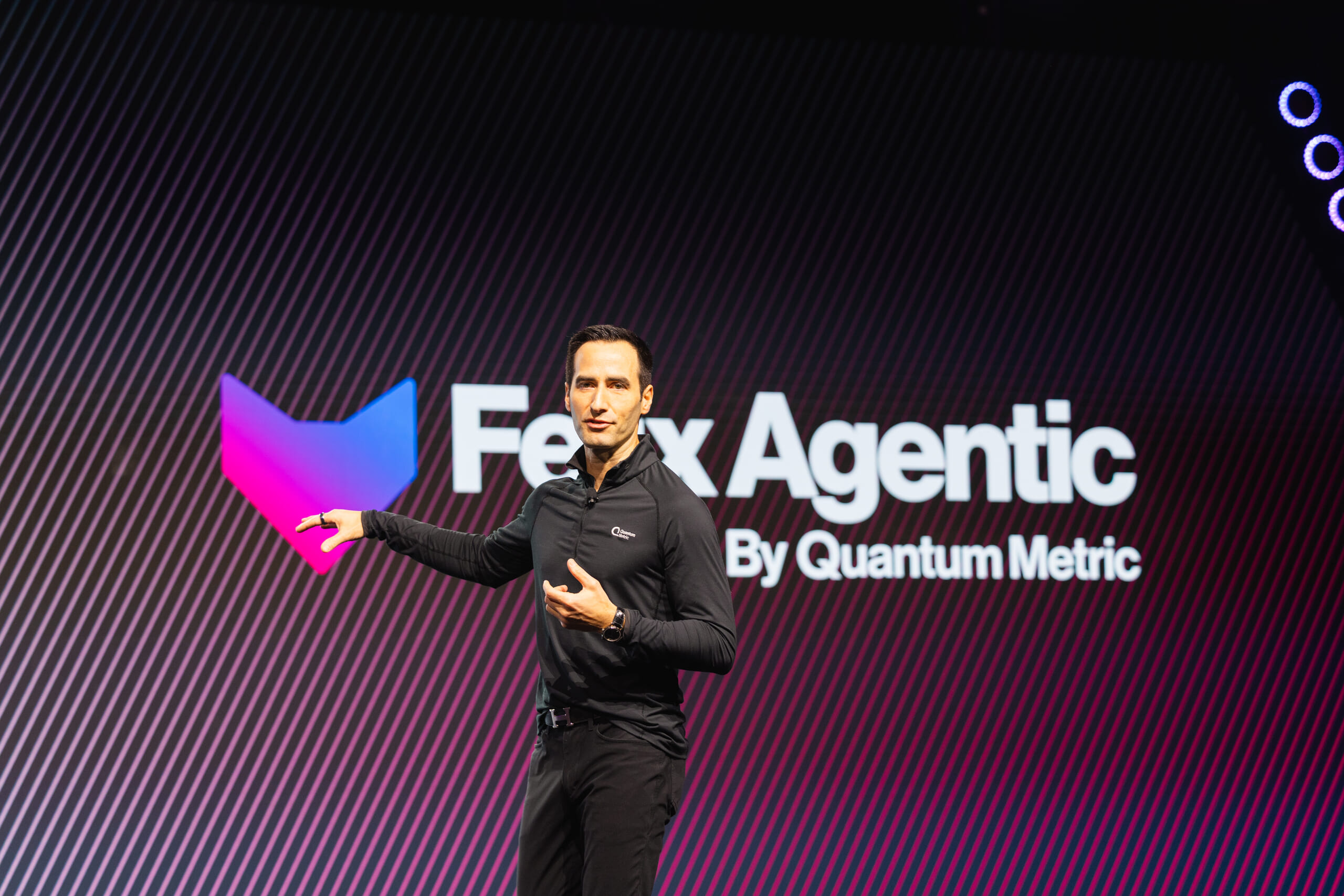
Ciabarra: Felix AI, our generative AI layer, launched in April 2024 and saw 400% usage growth in its first months of 2025, reaching a quarter of our largest enterprise customers. But that was the bridge. Last month at Quantum LEAP 2026, we launched Felix Agentic — an autonomous insight engine that continuously analyzes digital experience data, explains what changed, why it changed, and quantifies the business impact in the context of each enterprise’s own objectives. It replaces the analytical hierarchy with an intelligence layer accessible to every team, instantly.
Ciabarra: This was not a copilot bolted onto yesterday’s product. It was a net-new AI-native platform built on a dataset 2,700x richer than traditional analytics. Felix Agentic doesn’t just report that your conversion rate dropped. It tells you which segment, what friction point, how much revenue, and what to do next.
From an understanding layer to action
Jaffe: Understanding is itself an intermediate step. The real unlock — the one most companies haven’t fully internalized yet — is that by converting raw data into a structured understanding layer, you’re precomputing the context that agents need to act.
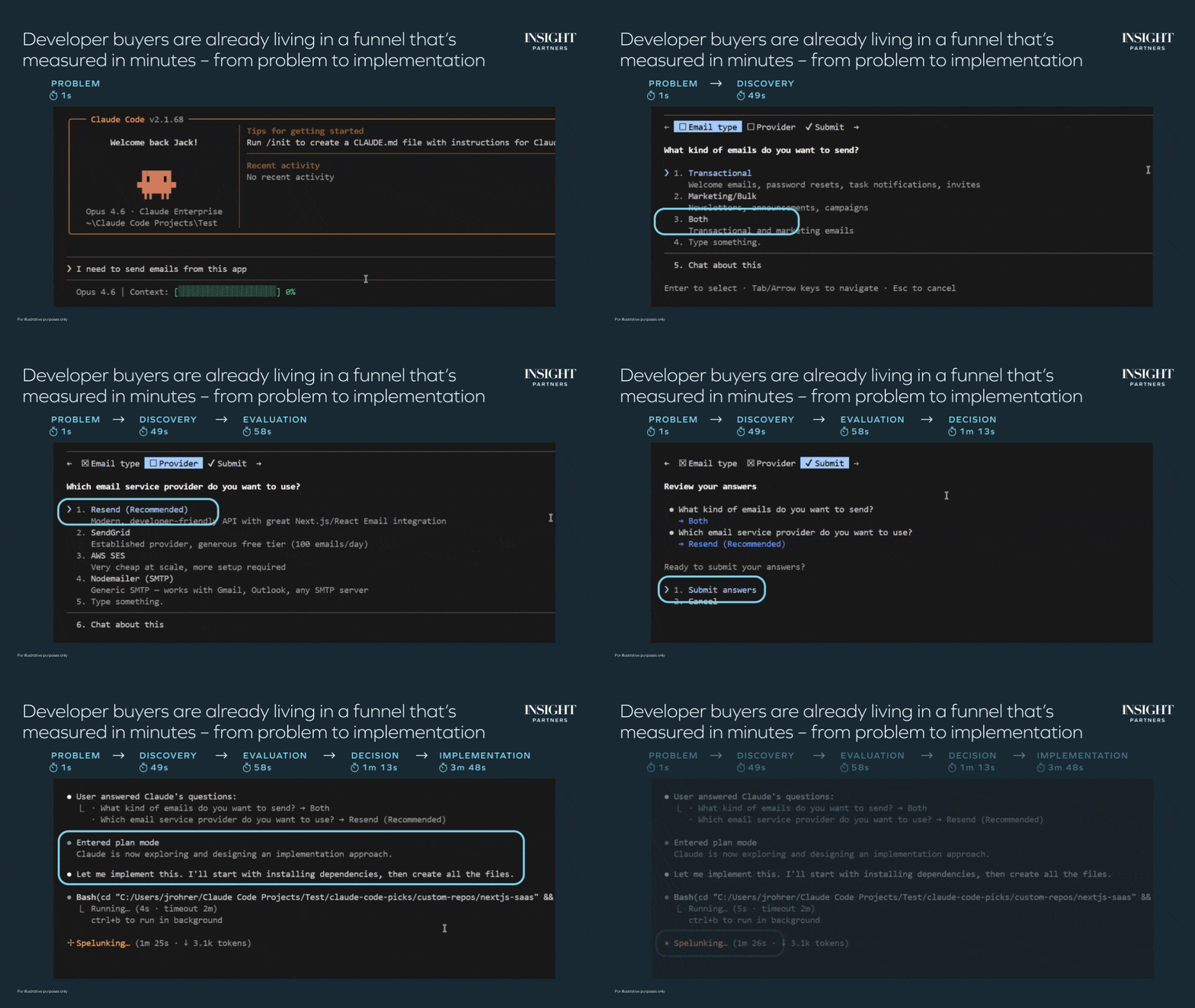
Jaffe: Consider the workflow: Felix Agentic detects that a checkout flow is failing for a specific segment on mobile, identifies the root cause as an API timeout, and quantifies the revenue impact at $47,000 per day. Today, that Felix Agentic insight goes to a human who files a ticket. Tomorrow — and “tomorrow” is maybe measured in quarters, not years — that structured understanding becomes the input for a coding agent like Claude Code, OpenAI Codex, etc. to generate the fix, open the pull request, and (if needed) route it for human approval. The shift isn’t data to understanding. It’s data, to understanding, to autonomous action.
Jaffe: Quantum Metric isn’t fully at that third stage yet. But the architecture is designed for it, and the distance is closing fast. The companies that are precomputing context today — converting messy production signals into structured, actionable understanding — we expect will be the ones whose agents work best when the capability arrives. Context preparation is the critical ingredient, and it’s happening now.
The companies that are precomputing context today … we expect will be the ones whose agents work best when the capability arrives. Context preparation is the critical ingredient, and it’s happening now.
Pushing through informational hierarchies
Ciabarra: The early results have been striking. At Vans, a single analyst covers 17 countries across EMEA. Felix Agentic catches issues that would have been nearly impossible to surface manually — like an add-to-cart error affecting specific products and sizes in specific markets, flagged before the morning standup, resolved before it reached the contact center.
Ciabarra: Perhaps the most telling signal came the day before LEAP, at our customer advisory board. Two Fortune 500 executives pulled me aside and said, almost identically: “I’m afraid for my team to see Felix tomorrow.” When I asked why: “Because they may feel like they’ve been replaced.” We talked through it. In practice, these teams become more strategic, not redundant. The analyst at Vans didn’t lose his job; he stopped being a bottleneck and started driving merchandising decisions across 17 countries. But the fact that two senior leaders independently had that reaction before they’d even rolled it out tells you something about the magnitude of the shift.
Ciabarra: Here’s another signal we didn’t expect. Within weeks of the launch, roughly a dozen enterprise customers independently approached us about consolidating their entire digital analytics and marketing analytics stacks onto Quantum Metric. Not adding us alongside their legacy platforms — replacing them. When your customers start coming to you with a consolidation thesis you didn’t pitch them, the market is telling you something.
Ciabarra: And one capability that’s resonating in ways we didn’t fully anticipate: AI agent visibility. We can now detect when an AI shopping agent — ChatGPT, Perplexity, or others — visits a customer’s site, and we can replay exactly what that agent did. On one major airline’s site, we found hundreds of AI agent sessions in a single week, with a zero percent purchase completion rate. The agents were failing on form fields and authentication flows that work fine for humans. Airlines, retailers, and travel companies are realizing that if their site doesn’t work for AI agents, those agents will simply send the customer to a competitor. Agents don’t have brand loyalty.
On one major airline’s site, we found hundreds of AI agent sessions in a single week, with a zero percent purchase completion rate. The agents were failing on form fields and authentication flows that work fine for humans.
Ciabarra: Q1 2026 was the strongest Q1 sales quarter in our history. Q2 is tracking to surpass it. After what we went through, those numbers carry weight beyond revenue. That’s evidence that when you choose a path, really choose it, and execute with everything you have, the market rewards clarity.
The emerging pattern for SaaS companies
Jaffe: The pattern here is general, and it’s relevant to many SaaS companies navigating this environment. It involves three characteristics:
First, they own a proprietary data asset that gets richer with every customer interaction — not data anyone can collect, but data only they and other competitors at scale can collect. In cybersecurity, companies like SentinelOne generate real-time telemetry from millions of endpoints that no one else sees. If someone gets attacked, all customers can get “herd immunity.” In digital experience, Quantum Metric captures behavioral signals at a depth and scale that can’t be replicated by bolting AI onto a thinner dataset.
Second, they’ve built an intelligence layer that delivers understanding rather than raw output — and increasingly, that understanding serves as precomputed context for autonomous agents to act on.
Third, they’ve restructured internally around the new model rather than bolting AI onto the old one.
An approach that doesn’t work as well is adding mediocre AI features that don’t “really work” to justify price increases, protecting implementation complexity as a moat, hoping that workflow lock-in will hold through the next renewal cycle while they cut costs. When AI can automate the migration path that used to take years, those switching costs aren’t eroding gradually — they’re collapsing.
The comfortable middle is over
Dorsey and Botha pose that AI should replace organizational hierarchies. Our experience across the hundreds of software companies in Insight’s portfolio finds there is tremendous value in using AI to speed up the analytical and informational hierarchies that are actual pain points for speed and execution in today’s enterprises. In either path, SaaS companies should explore: what does your company understand that is genuinely hard to understand, and is that understanding getting deeper every day? The “comfortable middle” is over. The age of understanding and acting has begun.
Editor’s note: Insight has invested in Quantum Metric and SentinelOne.