Insight Partners
More By The Author
Back
Leadership
How Healthie is building the critical infrastructure behind accessible, longitudinal care
Insight Partners | May 19, 2026| 4 min. read
Longitudinal healthcare might sound like the latest contrived health trend, but it’s actually a remarkably straightforward, common-sense approach. Longitudinal care reorients healthcare around the patient, not the visit. Instead of fragmented, episodic interactions, it delivers continuous care over time.
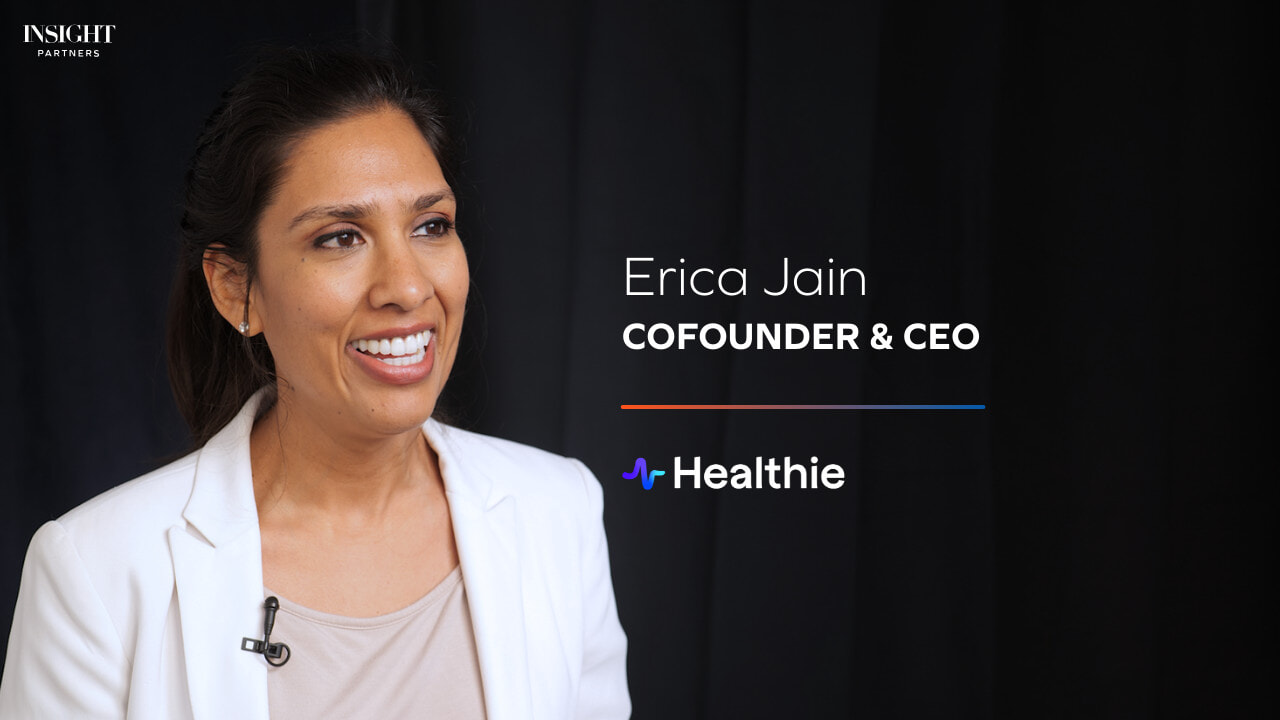
Erica Jain, cofounder and CEO of Healthie, saw this firsthand over a decade ago. Through her father’s employee benefits, her parents gained access to a collaborative healthcare team of dietitians, doctors, therapists, and chiropractors. “Over the course of a year,” she says, “it completely transformed their lives.”
It raised the question: “Why doesn’t everybody have access to this type of healthcare?” When she interviewed healthcare providers, they blamed a lack of technology. They were often resorting to pen and paper, for instance, because existing Electronic Health Records (EHRs) were designed for episodic, hospital-based care.
At the time, Jain was no stranger to structural gaps in healthcare. She had studied health disparities at Duke, worked in healthcare consulting, and spent time with the Clinton Health Access Initiative on nutrition programs in East Africa and India. Time and time again, she observed care models evolving faster than the infrastructure supporting them.
In late 2015, Jain met Cavan Klinsky, a fellow student at The Wharton School. They shared the idea that healthcare was being held back by legacy systems and workshopped an idea for an operating system that could bundle multiple providers’ patient records, scheduling, documentation, data tracking, and billing into a single integrated platform.
Klinsky built an early version of the platform over the holidays, and the pair launched Healthie, a full-stack solution for digital-first healthcare, in January 2016.
Designing a new backbone for healthcare
Healthie is designed to be the operating infrastructure for longitudinal care. The platform brings together records, telehealth, billing, and patient engagement into a single, API-first, certified EHR platform to enable regulated care that unfolds continuously between appointments.
Its first customers were individual practitioners, including dietitians, coaches, behavioral health providers, and small practices, rather than hospitals or enterprise buyers. The platform resonated with people trying to operate outside the traditional healthcare mold.
“Whether you have a small private practice, or you’re a tech-enabled digital healthcare company…you need tools for scheduling, booking, engagement, telehealth, the list goes on and on,” says Jain.
Healthie provides regulated healthcare infrastructure, and customers can use its APIs and developer tools to design their own custom workflows, integrations, and patient experiences without having to build an EHR themselves from scratch. That ability to customize is a key part of Healthie’s appeal, says Jain.
“You want to build technology that is business-differentiating, and that’s what our customers come to us for.”
“We provide the undifferentiated core infrastructure that they need to deliver health care, [and] they can build their own unique and engaging experiences on top of our technology.”
“One of our core values as a company is reliability”
Initial capital came in the form of small grants from campus competitions and the student preseed venture capital fund, the Dorm Room Fund. In the summer of 2016, both founders dropped out of school to pursue Healthie full-time, participating in the Techstars NYC accelerator program and raising $1.9M in pre-seed and seed funding.
This fueled rapid growth, but Healthie’s first two years in business were marked by costly mistakes: over-investing in sales and marketing, under-investing in tech and product, budgeting too loosely, and accumulating technical debt by prioritizing speed over product discipline.
By 2018, the company was forced to pause, shift away from its growth-at-all-costs mentality, and rebuild the product from the ground up, recognizing that in healthcare, speed without reliability carries consequences. “One of our core values as a company is reliability,” says Jain. “That’s a term we use internally, and it’s also a term that we use externally to really make sure that we’re constantly providing value.”
Despite burning through much of its seed funding, Healthie operated at a profit for close to five years before raising a $16.5M Series A in July 2022. By then, the platform was supporting thousands of clinicians across dozens of specialties, powering millions of appointments and processing hundreds of millions of dollars in patient payments.
An open feedback loop
In October 2024, Healthie raised a $23M Series B, reflecting its scale and the increasingly important role of infrastructure in outpatient care. By that point, the platform was supporting more than 25,000 clinicians caring for more than 10 million patients.
Jain credits Healthie’s success to the company’s customer-first approach, which directly shapes its product development. “We go so far as to actually publish our product roadmap online for all of our customers to see and contribute [to],” she says. “We talk to our customers every day, and I feel so lucky to get that much feedback.”
Jain personally reviews support tickets each week because she views each one as “an opportunity for our product to improve.” For Healthie, customer support interactions not only guide product evolution but, more broadly, indicate where healthcare innovation is going next.
The convergence of consumer expectations, policy changes, reimbursement shifts, post-COVID accelerants, and AI has created momentum that didn’t exist a decade ago. “We’re seeing healthcare following the footsteps of industries like fintech and consumer tech.”
“I often think about what the world would have looked like, and what the healthcare system would have looked like if a company like Healthie had existed 100 years ago. Where would we be on personalized, proactive, preventative medicine?”
As AI has entered healthcare workflows, Healthie has approached it as a tool for reducing the administrative burden on clinicians, rather than replacing them.
“AI [is] layered across our entire experience,” says Jain. “We’re rapidly rolling out more and more tools that allow our clinicians to spend less time on the administrative burden parts of seeing patients and allowing them to really focus on delivering better health care.”
This comes with inherent risks around data, acknowledges Jain. “I see a huge responsibility to do right by our customers and make sure that AI is used with safety and privacy. As we and others roll out AI in healthcare, it’s incredibly important to [make] decisions that are worthy of our patients’ data.”
Building a care ecosystem
A decade on, Healthie has grown into an AI-powered, Office of the National Coordinator for Health Information Technology (ONC)-certified EHR serving over 35,000 healthcare providers, delivering care to more than 20 million patients. But its ambitions extend beyond its own business. In 2024, the company launched ‘The Harbor,’ a marketplace that allows third-party tools to integrate directly into the platform, reflecting a belief that partnerships are essential to drive innovation at scale.
More than 70 companies have already joined. “My cofounder Cavan said it best last year when he said healthcare is too big a problem for one company to solve,” says Jain. “We view our place as a node within a very big and important ecosystem.”
That philosophy also underpins Healthie for Good, launched on the company’s 10th anniversary, which provides Healthie’s platform to nonprofit organizations to expand access to care in underserved communities.
For decades, healthcare was constrained by fragmented systems and competing incentives. Healthie is actively untangling that complexity by building the invisible infrastructure that enables modern, longitudinal care to scale.
*Note: Insight Partners has invested in Healthie.