Insight Onsite
More By The Author
Back
Marketing
What top-performing CMOs say about success in 2026
Insight Onsite | May 27, 2026| 4 min. read

Each year, Insight’s Onsite team runs qualitative surveys across the portfolio filled out by functional leaders (CxOs). This year, over 150 CMOs filled out the survey, across all sizes and stages of growth.
The top five findings from the survey were:
- Sales & Marketing alignment is critical with top marketing teams targeting bookings
- AI and automation adoption are a near-term priority for top performers
- Human-led channels are the durable moat in an AI-saturated digital space
- Top product marketing teams ensure messaging is activated with the sales team
- Operational excellence comes in the form of better processes, not always more complex ones
Executive Vice President Meg Fitzgerald and Vice President Dustin Zaloom presented the findings in a recent Onsite Hour. Rather than rely solely on financial data, the survey asked CMOs a direct question: How has your company performed relative to your closest competitor over the last 12 months? The roughly 25% who said they were doing “much better” became the top performer cohort. When cross-referenced against internal financial data, this self-reported proxy tracked closely to the rule-of-40 performance.
This piece comes from Onsite Hour, a weekly virtual event series for portfolio companies, created by Insight’s 100+ in-house experts. Survey and benchmarking reports are created by our Onsite Insights team.
Alignment is key, as top performers align with bookings
When CMOs rated their overall alignment with sales, the distributions looked nearly identical between top performers and the average. The real tell was at the low end: Not a single top performer rated their sales-marketing alignment as poor or terrible.
“Solid alignment with your go-to-market counterparts is really table stakes for top performance,” said Fitzgerald. “It’s not necessarily a differentiator, but it is a prerequisite.”
“Solid alignment with your go-to-market counterparts is really table stakes for top performance.”
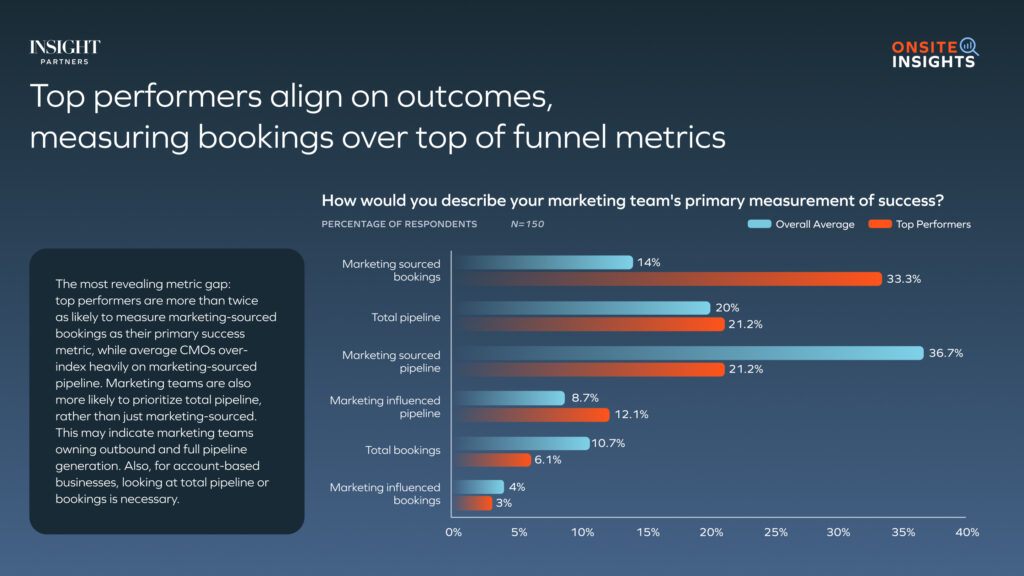
Where top performers do separate themselves is in how they measure success. Most companies track marketing-sourced pipeline. Top performers are more than twice as likely to hold themselves accountable for marketing-sourced bookings. That shared accountability can significantly change the relationship with sales.
The gap also shows up in the execution layer: shared funnel definitions, joint quarterly planning, and consistent feedback loops from the field. Top performers have built these into their operating rhythm. It’s not a one-time alignment exercise; it’s ongoing.
Over 75% of companies are doing account-based. Most are stuck.
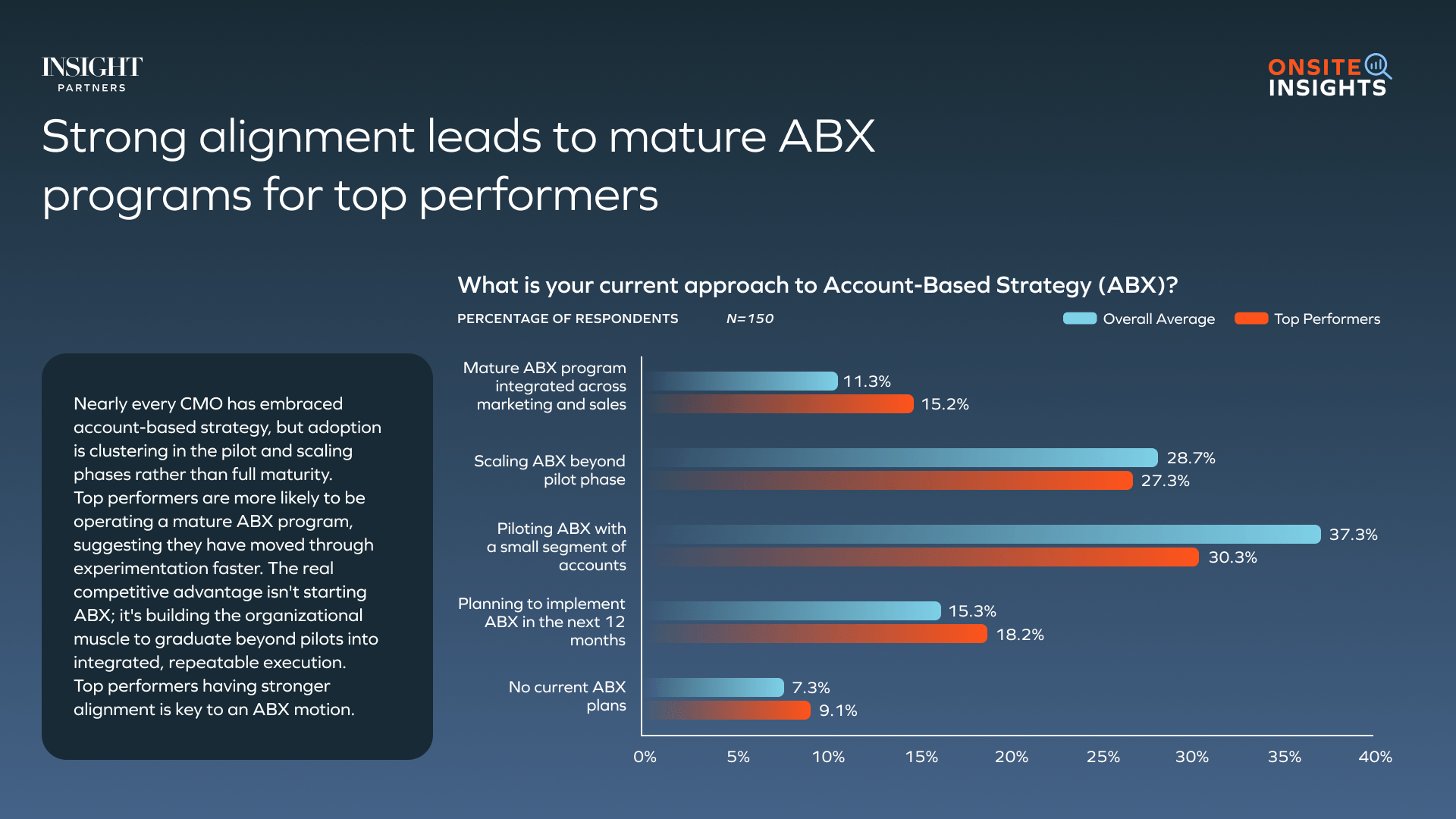
About 78% of companies have some version of account-based marketing in place, but most haven’t scaled beyond the pilot stage. Top performers are the ones who have — and the reason, more often than not, is that they had the sales-marketing alignment required to get there.
The plays they’re running also look different. Top performers go deeper on personalization: one-to-one named account plays, one-to-few plays, and tighter SDR integration. Average companies tend to spread efforts more broadly with a one-to-many approach.
Zaloom flagged a pattern he sees often: Companies operationalize intent data, but when a trigger fires, all they do is call the account faster. “That’s not really anything different. That’s just a prioritization mechanism,” he explained. Getting from intent signal to a genuinely differentiated play — a campaign, an event, direct mail — is where many companies stall.
Top performers use more AI across the org, but are more selective about it in content creation
Nearly twice as many top performers listed AI and automation adoption as a top-three priority. And AI tools ranked as the number one technology investment across the board, with nearly 50% citing them at the top of the list.
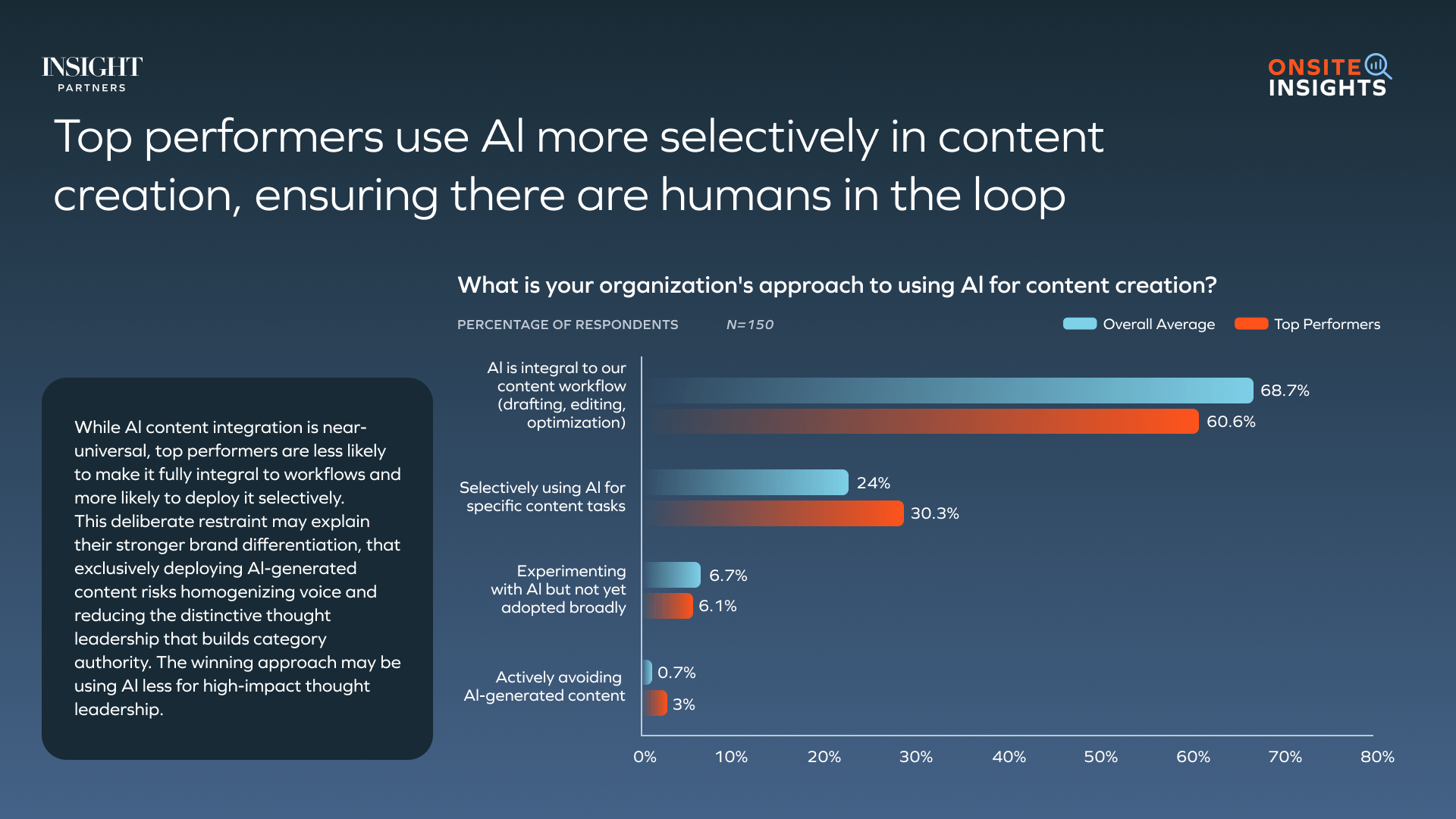
But the more interesting finding is how top performers use AI differently. In content creation, they’re more selective. They use AI to turn around commodity content faster, but they’re clear-eyed about what it can’t do: produce genuinely differentiated thought leadership grounded in proprietary data or subject matter expertise.
“Top-performing companies really separate the tasks of what AI is good at, and what humans still need to do,” Zaloom noted. Human-in-the-loop stays part of the process even as AI adoption increases.
“Top-performing companies really separate the tasks of what AI is good at, and what humans still need to do.”
On the creative and video side, top performers are also more likely to use agencies than their average counterparts. This is not because they’re avoiding AI, but because they understand that agencies offer the kind of flexible capacity that full-time equivalents can’t. Both levers are used together.
One example from the call: a product marketer used Claude* to build a messaging consistency tool — paste in any content, get a score against the company’s message house, and receive suggested edits. Low overhead, high adoption across the org.
The 50-50 budget split that’s separating the field
The old rule of thumb was 20 to 30% of program spend on brand, but the survey data pushes back on that. About a third of top performers are running a roughly 50-50 split between brand and performance. Among average companies, that number drops significantly.
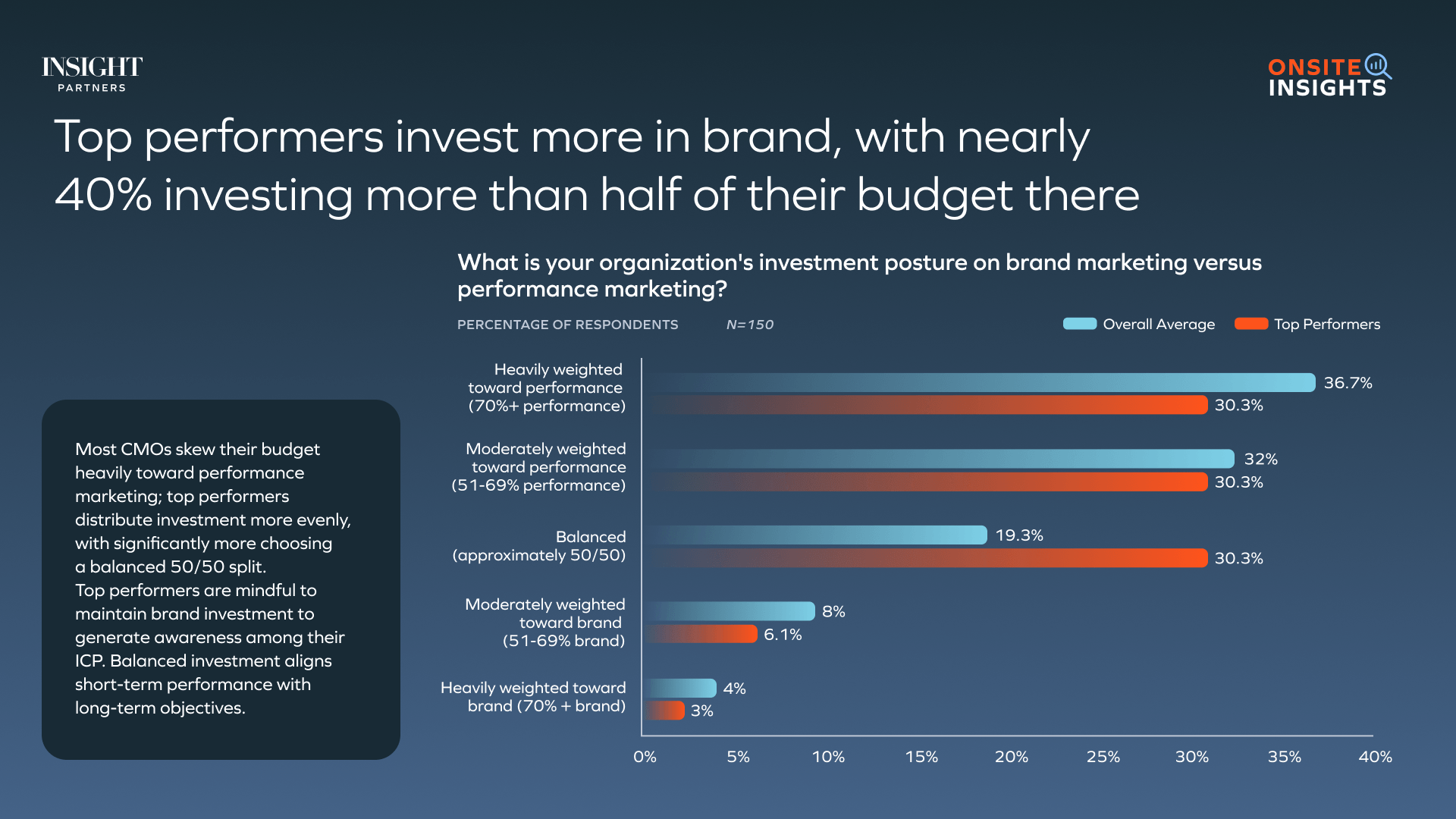
“If you’re only investing in performance marketing, you’re fishing from the same pond everyone else is,” Fitzgerald said. “Brand is what will make that performance spend more efficiently and effectively over time.”
“Brand is what will make that performance spend more efficiently and effectively over time.”
This matters even more in a world where nearly 75% of CMOs flagged AI replacing traditional search as the biggest GTM shift of the next two to three years. Today, around 70% of Google searches are zero-click. Buyers are doing discovery, evaluation, and meeting prep through AI before they talk to a single human. If your content isn’t optimized for that, you may not even be in the consideration set.
PR investment is growing
Despite still being largely reactive and ad hoc across the portfolio, PR investment is growing, and top performers are leading that charge. They’re less likely to staff it in-house, and more likely to work with full-service agencies that have genuine journalist relationships. As tech media has contracted, those relationships matter more than ever.
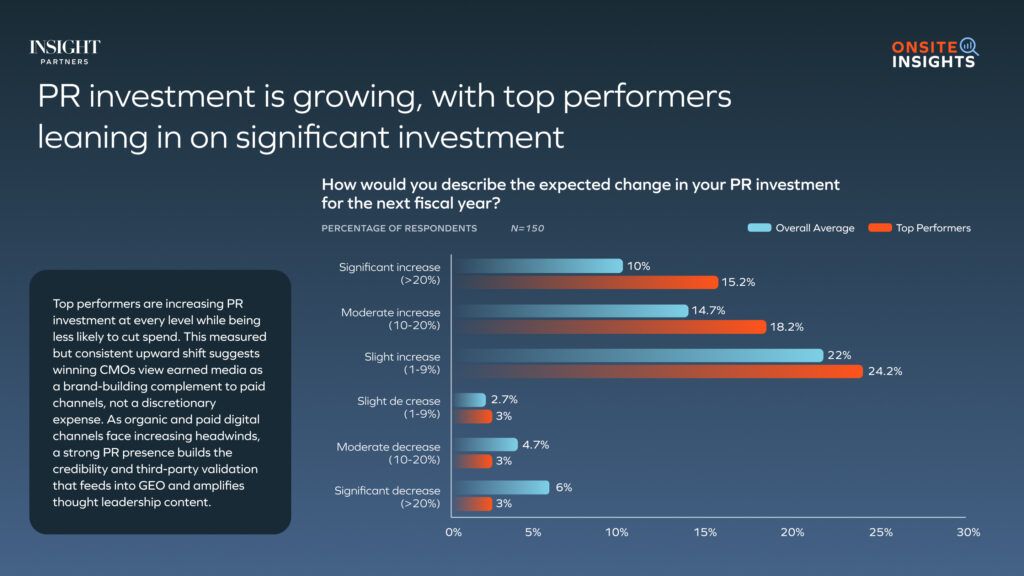
The generative engine optimization (GEO) connection is direct. AI search algorithms are gaining significant press coverage and third-party citations. Companies with strong PR footprints are more likely to show up in AI-generated answers.
Several CMOs on the call shared early proof points: One ran eight press releases over six weeks and saw a meaningful bump in answer engine optimization (AEO) and GEO as a result. Another paired a quarterly consumer sentiment survey with Cotality’s* first-party data to fuel a robust pitch calendar — and it’s showing up in search results.
Top performers are doing less
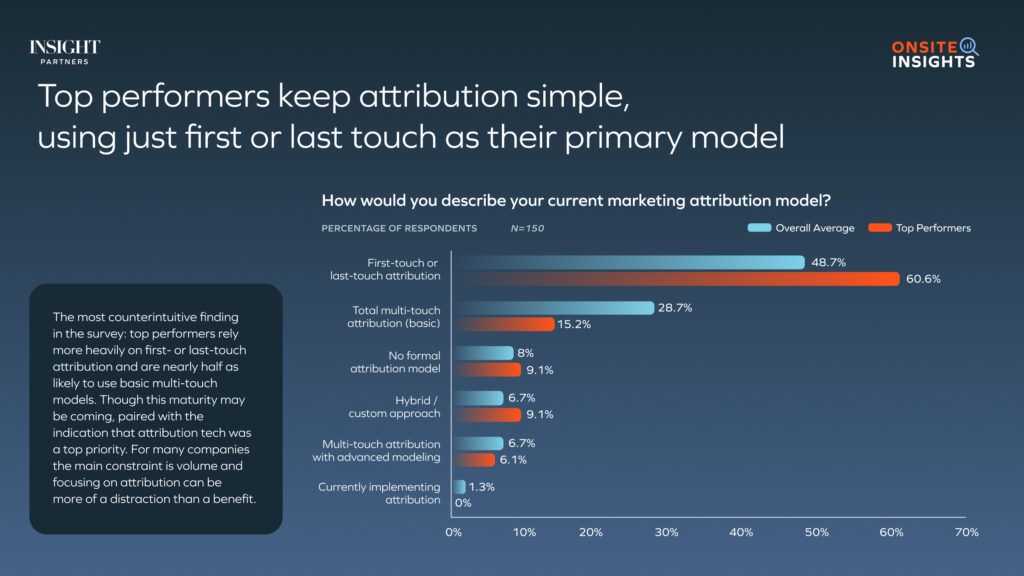
Perhaps the most counterintuitive finding in the survey: Top performers are running simpler operations, not more complex ones.
On planning cadence, top performers generally stick to annual plans and quarterly re-forecasts. Average companies are more likely to be doing rolling quarterly objectives and key results (OKRs). “If a lot of your strategy is dictated by building something over the course of the year, pivoting away from it every three months can be detrimental,” Zaloom noted.
On attribution, 60% of top performers use first- or last-touch models. The more a portfolio company debates attribution, the worse the outcomes tend to be.
On lead scoring, top performers are the least likely to have a formal methodology at all, while average companies are more likely to be running advanced AI-based scoring. Simple rules of the road, well understood by both teams, outperform complexity that no one can agree on.
On inbound routing, top performers rely on basic segmentation logic. Enterprise leads go to account executives; SMB leads go to SDRs. Average companies are more likely to funnel leads into nurture streams that rarely convert.
Complexity doesn’t produce better outcomes when it creates friction, misalignment, or debates that eat more time than the process saves.
*Editor’s Note: Insight Partners has invested in companies including Anthropic, Cotality, and OpenAI. For a full list of portfolio companies, visit insightpartners.com/portfolio.