The first two installments of this series answered why the forward deployed engineer (FDE) exists and what makes a great one. This final piece is about the work itself:
- What does an FDE actually do on any given day?
- How do the best teams turn one messy customer problem into production value in weeks?
- How do they turn that win into a better product?
No two days look the same for most FDEs. But our panelists defined a repeatable operating rhythm emerging from the ambiguity, and that rhythm is what separates a real FDE motion from professional services with a new name. In this third and final installment of our July Onsite Hour series, we explore the day-to-day of the craft with four leaders running the FDE motion across very different companies.
This article comes from Onsite Hour, a weekly virtual event series for portfolio companies, created by Insight’s 100+ in-house experts. This session, “A Day in the Life of an FDE: From Deployment to Impact,” featured four perspectives on FDE motions.
The discussion was moderated by Managing Director Ganesh Bell.
Panelists included:
- Srikrishnan Ganesan, cofounder and CEO at Rocketlane*, which FDE teams use to run and manage their work. Rocketlane also runs Frontline Forum, a community of FDE leaders and practitioners.
- Shailesh Ratadia, FDE Director at ServiceNow
- Jon Perry, FDE at nCino*
- Panos Michelakis, FDE at Wonderful*
Key learnings for leaders considering an FDE motion
Manage ambiguity, then time-box it.
The role has no fixed shape, so the discipline comes from the calendar. Every team on the panel commits to production value inside a hard window: three to four weeks at Rocketlane, six to eight at nCino, 12 to 14 at ServiceNow. “If we can do it quickly, it demonstrates to our customers that they can do it quickly as well,” said Perry.
Lead with the problem and impact, not the demo.
ServiceNow starts at the C-level with the most important business outcome, uses process mining to find where time leaks, and attaches a number to it. “We take the most impactful use case and start showing real business value within 12 weeks,” said Ratadia.
Be a partner, not a yes-man.
“The role of the FDE, if you want to actually be a partner of a client, is not always to be a yes man,” said Michelakis. Partners push back, stay proactive, and keep “stimulating a client’s mind” with new demos even when a project is blocked.
Design the engagement to hand off.
The win is not the build; it’s the customer building the next one. nCino counts a customer who learns to do it themselves as successfully as a solution the FDE ships. Ownership transfers, and the FDE moves to the next frontier.
Guard the front door, or risk becoming everything for everyone.
“It can quickly morph into an everything-for-everyone organization, and that doesn’t serve anyone,” said Perry. Ratadia’s one piece of advice was the same: “Have a good qualification criteria for why you exist.”
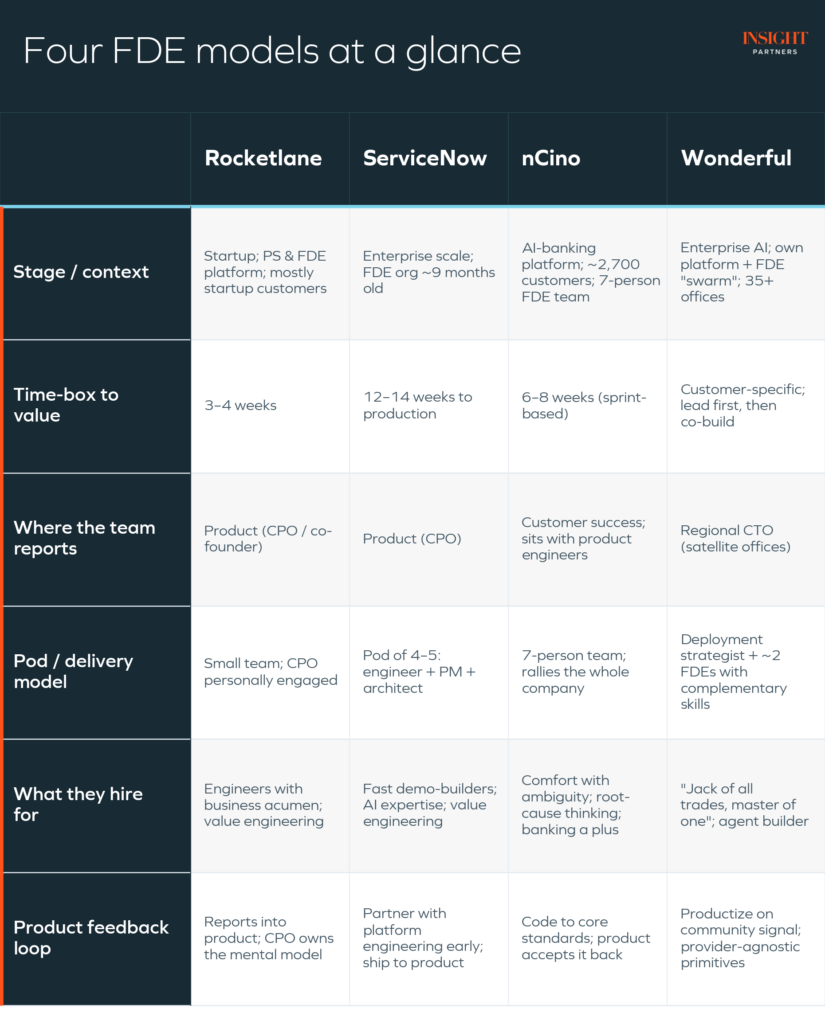
Four FDE models at a glance
Despite the role having the same title, FDEs can operate very differently. Here is how the panelists run the motion day to day.
What does a productive day actually look like?
“No two days look the same,” said Michelakis. “I can spend the full day writing code and fixing some bugs. Then I can spend the entire next day without touching my laptop at all, just being deployed at the customer side, making sure that I build relationships with the C-level and the engineering team.” A third day goes to the product and research and development (R&D) team.
That range is key to the job. The panel kept returning to a line Michelakis uses at Wonderful’s Greece office: an FDE should be “a jack of all trades and master of at least one”; a generalist who can still go deep somewhere. Using a football analogy to further illustrate, “Move a defender to attack, and he’s still gonna be an amazing footballer…he won’t match an elite striker, but he can still carry the team.”
A good day, in Ratadia’s words, produces “a clear problem statement, a clear outcome statement.” A bad day is the opposite. Ganesan offered an example of where you travel to a site, get blocked on access, and the momentum dies. Ratadia named a more subtle example of when a customer expects AI to solve a problem it cannot, and the FDE has to reset expectations with the data in hand.
What are the best teams hiring for?
The spike everyone named first was comfort with ambiguity. “The technology is constantly changing, so what it could do yesterday, or couldn’t do yesterday, it can do today,” said Perry. He wants people who get to the root of the problem and then pick the right tool, which is often not AI. “Everyone thinks that AI is this magic hammer that will fix everything, and often it’s not.”
After that, the profiles diverge. Ratadia hires builders who can whip up a demo on the spot, because “a demo is worth way more than the conversations that we have.” Ganesan looks for engineers with the business acumen to run discovery and quantify value; Rocketlane’s first FDE was a hackathon winner, which trains both the build reflex and the ability to explain the build. Michelakis added an aspect that is easy to miss: an FDE at Wonderful is “partly a systems engineer,” responsible for wiring agents into a customer’s real systems, legacy or modern. “It’s a very high ownership role. You’re responsible for making it work.”
How do you structure an FDE engagement?
Every engagement starts by scoping tightly and, often, by explaining what an FDE even is. nCino opens by drawing the line between what its team owns (adoption of its AI “Banking Advisor” capabilities) versus what still routes to implementation, product, or customer success teams. ServiceNow enters strategic accounts, beginning at the C-level to pin down the most important outcome, and then picks a single use case to build. Wonderful tailors to the customer: some want FDEs to lead every deployment, others want their own engineers building on the platform.
The throughline for all engagements is a deliberate hand-off moment. After the initial build, ServiceNow does knowledge transfer so the customer’s developers can maintain the solution, and expansion work is triaged by complexity — some to the FDE team, some to expert services. Wonderful leads first to prove value, then runs workshops to co-build alongside the client’s engineers. And to keep customers from confusing FDEs with the alphabet soup of post-sales roles, both nCino and ServiceNow bring the customer success manager (CSM) and sales rep into the room from the first FDE conversation, as these are the people who provide continuity after the FDE moves on.
How do you keep FDE work maintainable and productizable?
At best, FDE work compounds value; at worst, it can create technical debt. Michelakis sets architectural guardrails up front: no technical debt, and stay “model agnostic and provider agnostic,” because “providers don’t exist tomorrow.” Good primitives are what let a custom-built component become reusable.
The feedback loop into product has to be deliberate. When Ratadia’s team encountered a customer that wanted to bring its own guardrails — a feature ServiceNow did not yet have — the FDEs partnered with platform engineering early, built it, and handed it over to be baked into the product the next quarter. At nCino, artifacts move through Jira and Rocketlane, and FDE code is written to the same standards and tests as core engineering, so the product team can accept it and own it. The test Perry applies to every build is whether it is a one-off or a pattern the team will see “over and over and over again.” Patterns get productized; as he put it, the goal is to “do 1 plus 1 equals 3.”
Ganesan offered the most intentional version of the loop. On one panel, he heard a foundation-model team describe choosing which problems to solve from the product side first, then letting the field find customers who have those problems, pointing FDEs exactly where the product wants to grow.
Where does the team sit, and how do you avoid burnout?
Reporting lines vary by company and stage. FDEs report into product at Rocketlane and ServiceNow, into a regional CTO at Wonderful, and into customer success at nCino, where Perry noted his desk sits among the product engineers anyway. Several teams are edging toward rotation between core engineering and the field so FDEs never feel like second-class engineers.
Burnout is the real risk, and the panel was candid that no one has fully solved it; the demand is relentless. The best defense they named is team depth, not heroics. “It is not one person on an island trying to solve an entire company’s problems on their own,” said Perry. Michelakis kept the football team analogy: build enough overlapping expertise that a teammate can cover for you during a brutal week. That only works if you are selective when you hire, so pods are staffed with complementary strengths rather than clones.
Common FDE misconceptions
A few things about the day-to-day that the panel wanted to put to rest.
“An FDE is a solo hero.”
The durable version is a pod, often an engineer or two, plus a program manager and an architect, backed by the whole company.
“AI is the answer to every engagement.”
Sometimes the fix is a process change or a non-AI solution, and a good FDE can discern this.
“The FDE owns the account forever.”
The FDE comes in for a specific problem and moves on; the CSM and sales rep provide continuity, which is why they are in the room from the first conversation.
“Speed means cutting corners.”
Time-boxing is how these teams prove customers can move fast, not an excuse to skip production rigor.
The bigger picture
Across four very different companies, the same operating system showed up:
- start from the customer’s hardest problem
- attach a number to it
- build in the real environment against a timeline
- hand it off to the customer
- feed what you learned back into the product
The ambiguity never disappears, but this core methodology makes it repeatable. Modern tooling compresses the build cycle into days and weeks, which is exactly what lets these teams deliver value on a calendar rather than a statement of work. The throughline for every builder is simple: an FDE team is not a services line you bolt on later; it is a learning loop you design early, and the companies that treat it that way get a better product, not just a happier customer.
Editor’s note: Insight Partners has invested in Rocketlane, Wonderful, nCino
The portfolio companies and portfolio company executives presented are examples of portfolio companies that Insight has worked with to assist the company achieve business and capital raising goals and are not intended to be a representative sample of all portfolio companies. The statements by portfolio company executives are intended to highlight their experiences working with Insight as an investor in their companies. The experiences of other portfolio companies and portfolio company executives may differ from the experiences presented. Insight did not provide compensation to the portfolio company executives or portfolio companies in connection with the statements provided by such executives. There is no guarantee that Insight’s work with other portfolio companies will produce similar results to those presented.