Many leaders we talk to want a forward deployed engineering (FDE) team, yet far fewer know how to build one. The role sits at the intersection of software engineering, product, and consulting, and the people who do it well are scarce, expensive, and hard to interview for. Our first installment in this series explained what an FDE is and why the motion matters. The number one audience question that followed was: What makes a great FDE, and how do you find, pay, and keep them? In this second installment, we put that talent problem to four leaders hiring and retaining these engineers right now.
This piece comes from Onsite Hour, a weekly virtual event series for portfolio companies, created by Insight’s 100+ in-house experts. This blog is the second installment of a three-part series on building an FDE motion.
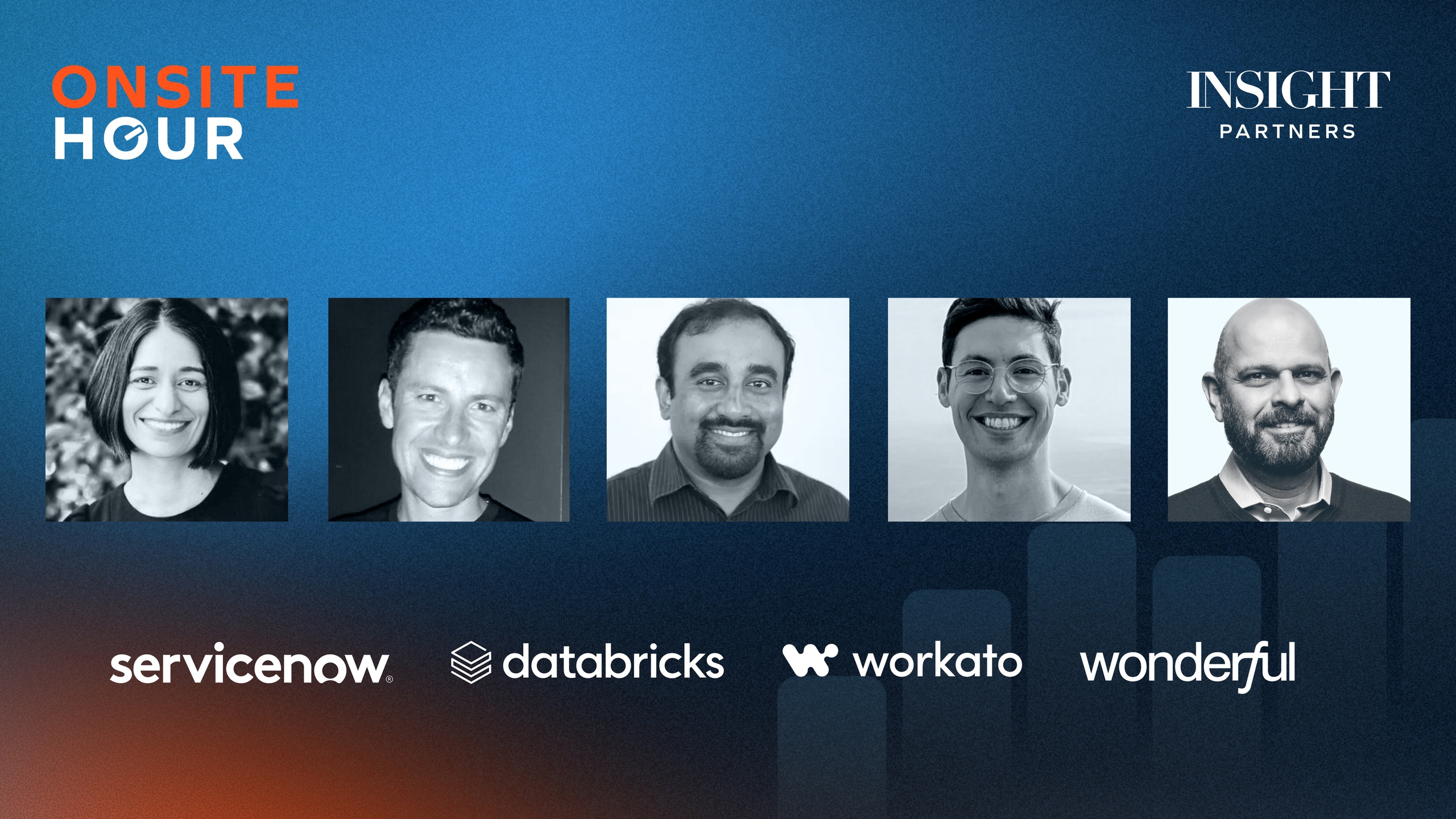
The discussion was moderated by Managing Director Praveen Akkiraju.
Panelists included:
- Miku Jha, Group Vice President of Applied AI Forward Deployed Engineering at ServiceNow
- Marcello Pedersen, Forward Deployed Engineering leader at Databricks*
- Bhaskar Roy, Chief of AI Products at Workato*
- Boaz Francis, Head of Forward Deployed Engineering at Wonderful*
Six recommendations for founders and CEOs
- Hire for spark. Hire the person who owns the outcome, then teach the tools. Francis pressure-tests candidates by breaking their solution to see whether they “light up” instead of shutting down.
- Deploy pods rather than a singular “hero.” Do not wait to find unicorns. Put one FDE at the center as owner and orchestrator, and rotate specialists — data science, data engineering, domain experts, even systems integrators — around them as the problem demands. “It’s always a pod composition,” said Jha. “It’s never an individual FDE.”
- House the team in product, and close the loop. Where the team reports sets its incentives. ServiceNow and Workato both put their FDEs in product and R&D so that field learnings feed the roadmap. Delivering for the customer without routing that signal back is, as Jha puts it, “only half the job.” Build that loop deliberately, regardless of where the team sits.
- Pay base-heavy, and blend the benchmark. The comparable market is limited, so build compensation from a blend of software engineering, product management, and consulting. Lean toward a high base.
- Engineer against burnout. Your best people will leave if they become permanent glue between the customer and the product. Keep the work compounding by giving engineers a fingerprint on the product itself, and rotate them between the FDE team and product and engineering.
- Build the bench to last. Don’t treat the team as a temporary bridge until customers turn AI-native. The shape of the role will keep changing as the frontier moves, but the need — someone to close the gap between a powerful capability and a real business outcome — is not going away.
What makes a great FDE?
Ask four leaders to describe the ideal FDE, and you get four phrasings of the same person.
Jha, who built ServiceNow’s Applied AI FDE org from scratch, calls it “a T-shaped role.” Deep expertise as a full AI/ML stack engineer forms the vertical bar; business capabilities run across the top — translating an engagement into measurable outcomes, partnering with the C-suite, and meeting customers wherever they sit on their AI journey. “The AI/ML is a hard skill,” she said, “but these aspects of business are also a hard skill, which is what makes this role really differentiated.”
“How do you know that you met an FDE? It’s this spark.”
Francis compressed it into three words: “an outcome-obsessed engineer.” He spots one in interviews by deliberately breaking a candidate’s solution. “How do you know that you met an FDE? It’s this spark.” The right person lights up rather than shutting down.
Pedersen looks for a “right-to-left builder” who starts from the business outcome, reasons back to the technology, and proves it fast. “But just as importantly,” Pedersen noted, “we build with our customers, not just for them. Our ultimate goal is ensuring they build the muscle to succeed independently on the platform, rather than creating a dependency on our team.”
Underneath every version of the role is a founder mindset. Customers rarely arrive with a clean problem statement, Jha noted. They have a powerful new capability and a short runway, but no plan. So the FDE has to “thrive in that ambiguity” and own the outcome end to end. Francis hires for that almost literally. Between one in six and one in seven of Wonderful’s new hires are ex-founders. “Those same people who can make a company out of nothing,” he said, “will do well as an FDE.”
Do you need to hire a unicorn?
The panel was unanimous that the unit of delivery is a pod rather than one person. ServiceNow assembles a team around each problem — product, workflow, and business-unit experts, plus systems integrators when useful — with a single FDE as owner and orchestrator. The domain shifts constantly, so the pod flexes, but that one owner “maintains the continuity through the whole thing.”
The interesting disagreement was over who carries that ownership. At Workato, Roy runs the same pod model for enterprise accounts but makes the customer success manager (CSM) the account owner, since the FDE’s skill mix changes project to project. Wonderful and Databricks instead split the job across two people, pairing an FDE with a “deployment strategist.” In their examples, the FDE operates as the CTO, the strategist as the CEO who owns strategy and customer relationships.
How four teams are running the FDE model
Here is how the panelists’ teams compare across the decisions that define an FDE bench.
ServiceNow frames the role as “T-shaped”: a full AI/ML engineering core with hard business skills layered across the top. The team sits in product and R&D — explicitly not go-to-market — and uses a pod model where the FDE owns and orchestrates the problem. Talent comes from the top of the AI/ML engineering pipeline. Success is measured by conversion from “activate” to “expand,” plus productized assets. Comp is calibrated to the top of the engineering ladder.
Databricks looks for a résumé trifecta: product management experience, real software engineering, and a client-facing stint. The team is tied to the product, with engineers rotating between the FDE organization and the product team in both directions. Pedersen runs a “two-in-a-box” model, pairing an FDE with a deployment strategist, and adds full-stack, data engineering, and data science spikes as the problem demands. Success is measured by business value delivered, then platform adoption. Comp blends software engineering (roughly 40%), product management, and consulting.
Workato sources from systems integrators, whose consultants are already customer-facing, and recruits graduates through university partnerships to shape from day one. FDEs sit in the product organization; field work feeds the platform roadmap. For enterprise accounts, the CSM owns the account, and the FDE’s skill set rotates per project. Comp blends engineering, product, and consulting — and success is measured by adoption and consumption growth.
Wonderful is the earliest in its journey of the four. It casts the widest net for talent: ex-founders (about one in six to seven hires), big-tech engineers who never fit the standard mold, and top-consultancy alumni. The org is fluid — “a deployment is a startup” — and the FDE pairs with a deployment strategist, mirroring the CTO/CEO split. Pay is very competitive, benchmarked to the compensation of ex-founders, big tech, and top consultancies. Success is measured by value generated for the customer and self-directed FDE growth.
Where should an FDE team report?
“Is FDE part of your go-to-market motion, or part of your product and R&D?” asked Jha, who places ServiceNow’s team “fairly and squarely in product and R&D.” Roy puts Workato’s FDEs “very specifically, a part of the product organization” for the same reason — proximity to the roadmap. The payoff is a flywheel: When an FDE solves something novel in the field, elements feed back into the platform, so the next customer starts further ahead.
“Is FDE part of your go-to-market motion, or part of your product and R&D?”
There is no universal answer to where an FDE team should report. Pedersen’s Databricks team trades talent with product in both directions rather than living inside it. Across the market, FDEs also sit in go-to-market and services organizations. “It’s an important decision,” Jha said, one every leader has to make deliberately.
How do FDEs work with sales?
An FDE pod lands inside accounts that sales teams guard closely, so the panel spent real time on that relationship. Pedersen frames it as a clean division of labor. When the account executive unlocks the right relationships and works the politics, the FDEs step in to co-build. His team runs a shared Slack channel with sales and holds a customer demo every Friday. “We are purely focused on delivery and enablement,” he said. “Our job is to prove value fast and ensure the customer knows how to succeed on our platform.”
Roy removes the friction structurally. On a consumption platform, every unit of usage an FDE unlocks grows the account and the account executive’s payout, so both pull in the same direction. Handled well, Jha said, the relationship is symbiotic. The FDE expands into lines of business the customer hadn’t considered, which sets up the next renewal.
How do you keep an FDE?
The fastest way to lose an FDE, Jha warned, is to let them become “the permanent glue between the customer and the product,” or worse, a “customer-facing coder” moving from project to project until they burn out. Her fix is to keep the work “intellectually compounding.” Every engagement should leave the engineer’s fingerprint on the product itself, which is why a productized asset carries equal weight to the customer outcome on her team’s scorecard.
The other leaders regenerate the role by moving people through it. At Databricks, Pedersen said the job on each engagement is “to work ourselves out of a job.” They achieve this by upskilling the customer’s team in the trenches and taking what is novel today and building it into the core platform. By rotating engineers between the FDE team and product R&D, field learnings become native features that drive broader customer success on the platform.
Roy has built a career ladder that climbs to an “architect” FDE, backed by a hybrid delivery team. Francis lets growth run self-directed: a startup cohort that begins together looks nothing alike six months in, “because we want you to be doing whatever you are the best at.”
How do you pay for a role with no benchmark?
There is no clean market comparable, so the leaders blend one. Pedersen runs a calculation across software engineering, product management, and technical consulting — weighted nearer 40% software engineering than the 70% his team first assumed, because the role is not a hardcore engineering seat. Roy thinks about the role similarly. Jha, whose team sits in product and R&D, calibrates to the top of the engineering ladder to attract “the best of the best AI-native talent.” Francis notes that a true FDE-specific benchmark is only now emerging.
The sharpest lesson concerned structure. Enterprise outcomes take time and often stall due to factors the FDE cannot control. Loading pay onto short-term variable penalizes engineers for delays that aren’t theirs.
Common misconceptions about the FDE bench
A few things the panel wanted to put to rest.
- “You have to hire unicorns.” The unit of delivery is a pod, and an FDE owns and orchestrates the problem while specialists rotate in as needed.
- “An FDE is just an expensive consultant or sales engineer.” Consultants deliver a fixed, time-and-materials scope; sales engineers build demos to close deals. FDEs own an unscoped outcome and feed what they build back into the product.
- “Pay them like senior software engineers.” There is no clean comparable. Leaders blend software engineering, product management, and consulting. Lean base-heavy, because enterprise outcomes stall on things outside the FDE’s control.
- “It is a go-to-market add-on.” Most of these leaders house the team in product and R&D, so field learnings feed the roadmap. Where it reports is a deliberate decision that shapes everything downstream.
- “The role will disappear as customers turn AI-native.” FDEs predate the current AI wave and grew roughly 40x in 24 months. The shape keeps changing, but the need to close the gap between a powerful capability and a business outcome is not going away.
The bigger picture
Akkiraju closed with an important question: As customers and integrators grow more AI-native, does the FDE fade away?
Francis argued the reverse. The role predates the current AI wave and may outlast the traditional software engineer. “The forward deployed engineer is the future,” he said. Jha agreed the role endures but keeps changing shape, citing the roughly 40x growth in FDEs over 24 months. Even a fully AI-native enterprise still needs someone to tame messy data, orchestrate distributed systems, and navigate regulation, as the frontier advances toward what she called “an Agent economy.”
Pedersen offered the long view. His 2009 title at Google was “deployment engineer,” and the goal has always been to work themselves out of a job. Yet “until there are no mainframes left, we’re going to need to do this work.” Roy grounded it in the buyer: titles churn, but “the customers are always looking to see what the outcomes are.”
The forward deployed engineer is hard to find, hard to price, and hard to keep. But it may be the most durable job description of the AI era precisely because it is built around the one thing that does not automate away: a person who can turn a business problem into a working outcome and carry the customer with them.
Want to go deeper? The series continues
This is the second installment of our three-part July FDE series. The final session is coming up, and if you’re an Insight portfolio company, you can join us here.
*Editor’s note: Insight Partners has invested in Databricks, Workato, and Wonderful.