Insight Partners
More By The Author
Back
Leadership
How Lightrun is teaching software to fix itself
Insight Partners | January 27, 2026| 3 min. read
As software systems have grown more complex, powered by cloud, microservices, APIs, and now AI, engineering’s challenges have shifted from building software to keeping it under control once it’s built.
Once code is running live, it takes on a life of its own. A single missing log line can lead to redeployments, hotfixes, and delays. Developers are steering systems they can’t fully see, relying on tools built for IT operators — systems that show what is broken, not why.
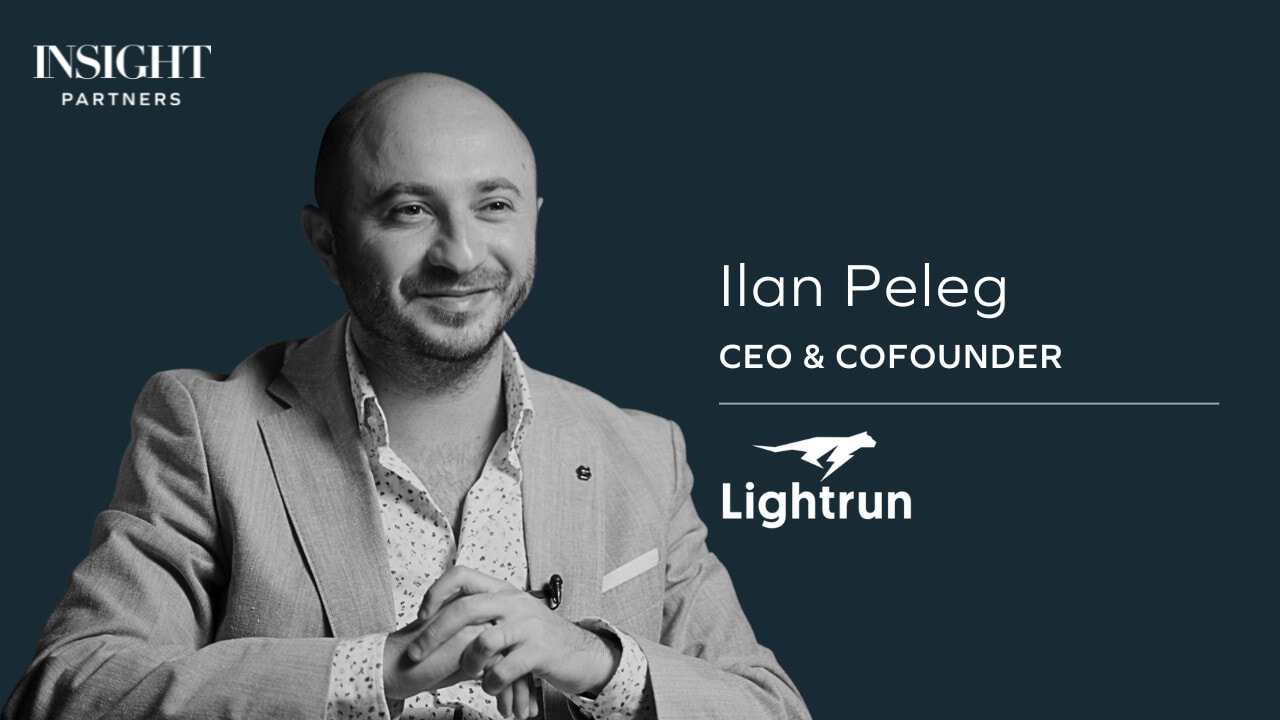
Software developers and entrepreneurs Ilan Peleg and Leonid Blouvshtein spent years wrestling with this issue. “When code meets complex environments … you simply have so many moving pieces,” Peleg says. “It was super challenging for us as developers to fix software issues once software or code [became] part of an overarching system.”
Realizing that most developers were not equipped with the right tooling to troubleshoot and understand live applications in the wild, they saw an opportunity to build their own. “We agreed that a company should be founded [with the] simple yet bold mission to automate how software gets fixed,” says Peleg.
Solving the debugging dilemma
It wasn’t Peleg and Blouvshtein’s first joint venture. In 2013, they launched a home-made food platform called Hommyfood, which was acquired after eight months.
Six years later, in July 2019, they founded Lightrun: a developer observability platform that enables developers to securely add logs, metrics, and traces (snapshots and virtual breakpoints) to live applications in real time, on demand.
Crucially, Lightrun is designed to operate without requiring hotfixes, redeployments, or restarts, connecting developers to their live applications and integrating directly into the developer’s workflow.
This means developers don’t need to switch between separate monitoring dashboards or operations consoles. Instead, they can observe and debug live applications directly inside the tools they already use to write code, such as IntelliJ IDEA or Visual Studio Code.
“Lightrun builds a world of autonomous software mediation,” says Peleg. “Our customers remediate and fix software issues across the software development lifecycle [SDLC] in a matter of minutes, and streamline resilience across the SDLC so you [don’t] need to fear any software bugs in your life anymore.”
A mission in motion
Lightrun exited stealth in June 2020, after securing $4M in seed funding and its first paid clients. By the following April, which saw Lightrun launch a free community edition of its platform, the company had doubled the size of its team and added leading technology companies, including Taboola, Sisense, and Tufin, to its client list.
Insight Partners led Lightrun’s 2021 $23M Series A, which the company used to expand its engineering team and accelerate new enterprise-level features.
Since then, Lightrun has raised a further $83M through an $18M SAFE round in 2023, which Insight supported, and a $70M Series B, co-led by Insight in 2025. Revenues grew over 4x year over year in 2024, and the company now counts global enterprises such as Salesforce, Microsoft, AT&T, SAP, ADP, Priceline, and Inditex as clients.
“We founded Lightrun with the mission of streamlining software mediation,” says Peleg. “A few years [later], here we are serving some of the biggest customers across the globe. Now with AI, we’re going to automate the whole process of software mediation and debugging. Exciting times ahead.”
“Agentic AI is transforming troubleshooting software resilience”
As an expert in automation, Lightrun sees the AI revolution as a natural extension of its product philosophy. The company launched its first AI-based tool, the Runtime Autonomous AI Debugger, in mid-2024.
The tool correlates code changes, logs, runtime data, and observability signals to pinpoint the root cause — just as a software developer would, but faster and with perfect recall. “We literally go step by step and mimic the existing human behavior,” explains Peleg. “We simply streamline these processes that are currently manual to be a fully automated process driven by AI.”
With the rise of agentic AI, Lightrun is taking this further. “Agentic AI is transforming troubleshooting software resilience,” says Peleg. “We are orchestrating tens, and in the future, hundreds of Agents that are purposely built for troubleshooting different types of software issues.”
These specialized Agents — designed to think like performance engineers, site reliability engineers, or security analysts — work together to identify, diagnose, and even remediate failures across the SDLC.
However, Peleg emphasizes that the goal isn’t just speed, but safety. “We keep innovating and keep embracing AI,” he says. “We also [stay] responsible about how we use AI safely. As you move fast, you also tend to break things.”
He warns against overloading software and deployments with code. “More lines of code eventually might also introduce much more risk, more software issues, bugs, hallucinations, and it becomes hard for developers [and] engineers to fully understand what’s going on.”
Lightrun helps teams move fast without “breaking” anything by fixing things before they even have an impact.
“We are [encouraging] everyone to think much more systematically and shift from doing repetitive functional work to more architectural, data-driven decision making.”
AI is also reshaping how Lightrun itself operates, giving the team granular visibility into each of its clients’ needs. “It was very hard to know what [was] actually happening on the customer front,” says Peleg. “But now, suddenly, we can ask AI [for] a breakdown of the very specific challenges that the customer is facing.”
Ultimately, Lightrun sees AI not as an assistant, but as an accelerator — one that amplifies human intelligence, improves resilience, and shortens the time between problem and solution. “We are [encouraging] everyone to think much more systematically and shift from doing repetitive functional work to more architectural, data-driven decision making.”
The future is self-healing
Peleg believes that as AI becomes woven into every layer of software, resilience — the ability to detect, understand, and recover from failure — will define the next era of computing. “Software is already running the world,” he says. “With AI, we’ll have even more software surfaces out there. The resilience part of it is becoming even more critical.”
That’s what Lightrun is building toward. By expanding its observability features, deepening enterprise integrations, and advancing its AI-driven troubleshooting Agents, it is bringing the world closer to fully autonomous systems that can detect, diagnose, and repair themselves before anyone even notices something went wrong.
As Peleg puts it, “If software is already being generated in minutes, it should also be getting fixed in minutes.”
*Note: Insight Partners has invested in Lightrun. This article is part of our ScaleUp:AI 2025 Partner Series, highlighting insights from the companies and leaders shaping the future of AI.