Insight Partners
More By The Author
Back
Leadership
How Optain Health is transforming disease detection through the eye
Insight Partners | March 09, 2026| 4 min. read
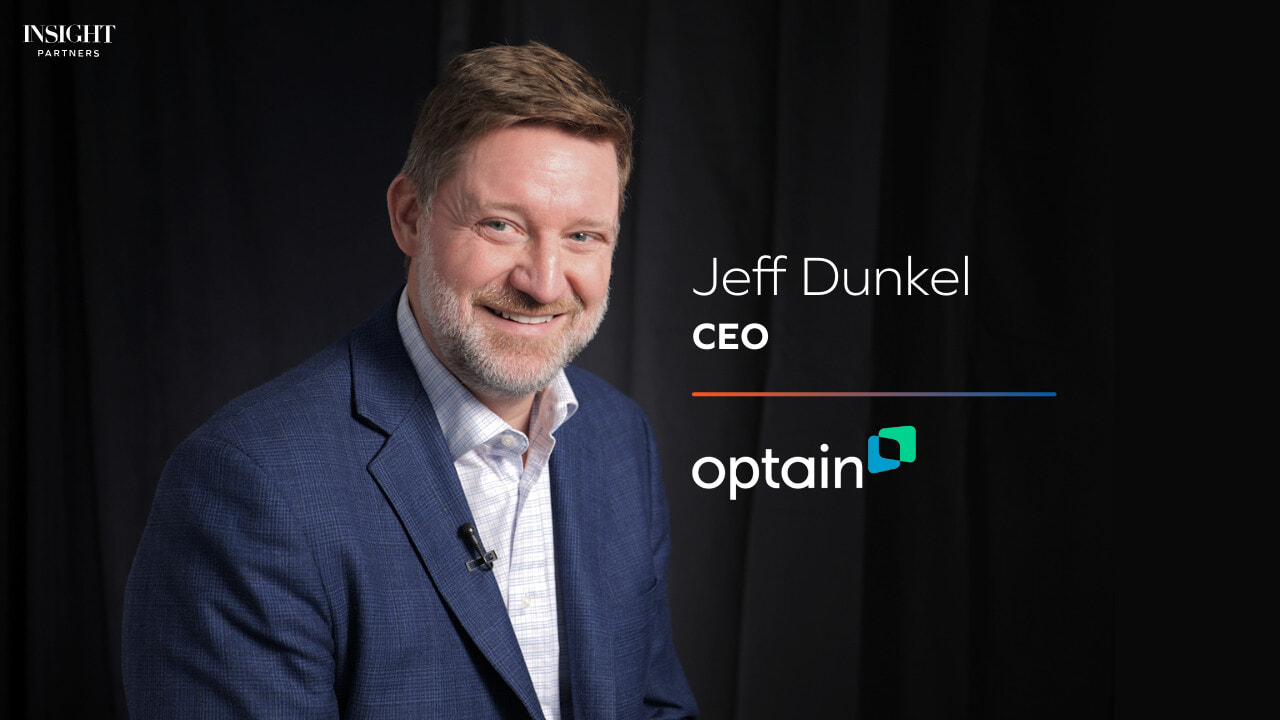
After more than 25 years in healthcare leadership — as CSO at Mindset Medical, EVP of Strategy at Titan Spine (acquired by Medtronic), CEO of NuHope, advisor to the FDA and the White House — Jeff Dunkel knows an opportunity when he sees one.
When he was approached in 2023 to lead Optain Health as CEO, he saw the chance to transform disease detection through oculomics: using the eye to understand the body’s overall health.
Optain is using robotic imaging, AI, and teleophthalmology to deliver it at scale.
“What I’ve learned is…when there is a need, and you see the opportunity to create a solution, you kind of are beholden to do so if you have the capability,” says Dunkel.
The market was waiting
Nearly 30 million people have been diagnosed with diabetes in the United States, and every one of them needs annual screening. But the current system fails them.
The traditional approach has been to force complex, expensive equipment into primary care settings or push patients downstream to referrals, only to then have tests come back with false negatives. Neither approach is efficient nor cheap enough for population-level screening.
“There’s a large population of individuals who have a disease state, and they’re unaware that they have it. And the focus for us is to appropriately identify patients who need help. There’s a lot of waste in the system.”
Optain takes a different approach. Rather than downstream diagnostics, “[We] have a very strong focus on very simple, easy-to-use screening devices,” says Dunkel, to make fast, accurate, accessible frontline screening economically viable. “The market was waiting for someone to get the solution right,” he says. “The customers are begging for the product. You just have to be the one who creates the best product and the best fit.”
The company was co-created in 2023 by Aegis Ventures, which also created the Aegis Digital Consortium, a group of 14 leading U.S. health systems to co-develop AI-driven healthcare companies.
The eye is the window to the body
The eye is the only part of the body where blood vessels and nerves can be directly observed without surgery.
Optain captures an image of the retina and then uses AI to evaluate the quality of the image and analyze it to detect abnormalities. They house millions of retinal images and AI specialists to identify lesions that, if found, might indicate vision loss, vascular patterns suggesting cardiovascular disease, and subtle changes that point to glaucoma, diabetic retinopathy, or age-related macular degeneration.
“We can see blood vessels, we can see nerves, we can see lesions like cotton wool spots. Those can indicate that you’re losing your vision… or are all attributable to disease states…across your body.”
From this single, non-invasive image capture, Optain’s AI or teleophthalmology solutions can screen for multiple disease states. “Our opportunity is to use this non-invasive, rapid-deployed technology…to get the right patients to the right treatment space,” says Dunkel.
And it can be done anywhere. The company’s portable robotic camera captures high-quality retinal images in under one minute without requiring pupil dilation or trained operators. It works in lit rooms, speaks seven languages to guide the patient, and can be deployed in primary care offices, community health fairs, and everywhere in between.
This technology builds on more than a decade of research led by Professor Mingguang He, described by Dunkel as “the world’s best AI ophthalmologist who was creating things that no one in the world thought was possible.”
This sort of collaboration is central to Optain’s strategy. “There is no one who’s going to offer a single solution,” says Dunkel. What excites him is “creating a company that has the ability to act as a conduit for someone else’s technology, to act as a pathway to drive someone else to a proper solution, or as a reason to have enthusiasm as a patient in order to make things better.”
Frontline screening at scale
Optain needed to get more than just the science right.
“If you really want to do screening well, you need to do three things,” says Dunkel. “First, you have to provide clinical value. Second is you need to have a fiscal ROI, which means you need to be affordable. And then, third, you need to have ease of use. It has to be very, very simple. We have an overburdened and overtaxed primary care network in the U.S.”
In September 2025, Insight Partners led Optain’s $26M Series A, also bringing in seven major U.S. health systems, which together deliver care to 28 million patients across 25 states. All seven are deploying Optain’s platform across their networks.
In the same timeframe, Optain acquired EyePACS, the largest teleophthalmology group in the U.S., with whom they had partnered for the last two years.
The combination of Optain’s AI-powered, robotic retinal imaging and EyePACS’ nationwide teleophthalmology network expanded access to early disease detection for communities across the U.S. and worldwide. As of November 2025, Optain’s platform is now live at 200 provider sites globally, with more than 1,000 deployments in planning.
“Optain represents our conviction in the power of better AI — deployed at the edge, inside clinical workflows,” said Scott Barclay, managing director at Insight Partners, at the time of the investment.
“By making retinopathy screening truly accessible, Optain is already changing care delivery — and we believe it will become the upstream gateway in primary care for AI-driven diagnoses across many conditions.”
Better, faster, cheaper
The company was built on AI from day one. “Our thesis was that we could use AI to identify features, biomarkers, lesions, et cetera, that are in the eye that allow us to attribute those to other disease states,” says Dunkel.
AI is embedded throughout, from the screening workflow to company operations to generating new diagnostic data so healthcare providers can better understand their patients.
“Most companies that are AI, they’ll say, ‘We can do these amazing things if you just give us your data.’ We’re the opposite,” says Dunkel. “What we say is, we can use AI, and we can use this image to generate new data for you.”
As a veteran in the space, Dunkel sees AI not as a revolutionary break from the past, but as the latest tool that will help healthcare evolve and improve. Better, faster, cheaper care. “I think that’s what AI is going to give us the ability to do,” he says.
Winning the future with humans
But it is humans who will deliver it. “One thing that is often overlooked when we are talking about AI is that there are still people behind the scenes who are building that,” says Dunkel.
“There are some things where you can kind of tinker around, but a regulated medical device is not a space where you can just tinker and hope to get it right. You have to know what you’re doing,” he says.
“So the real success behind Optain is the team that is building the company. The product, the AI solutions, the teleophthalmology, et cetera, that’s a byproduct of the talent that we brought in. And it’s that talent that’s going to make sure that we win in the future.”
*Note: Insight Partners has invested in Optain Health.