Insight Partners
More By The Author
Back
ScaleUp:AI
How Skyflow is building the trust layer for Agents
Insight Partners | January 27, 2026| 4 min. read
The world has a data privacy problem. Everyday actions that used to be anonymous — like buying a coffee or taking a cab — now involve the exchange of personally identifiable information (PII).
This means companies of every size are now responsible for large amounts of sensitive customer data, often without the architecture to govern it. This has resulted in systemic data breaches that quickly erode customer trust.
The arrival of AI Agents, cloud workloads, and multi-system integration has only intensified the issue. The cybersecurity industry has traditionally relied on a perimeter security model, a “castle-and-moat” approach that assumes data can be trusted once it passes the initial firewall.
But this model doesn’t work in the cloud era, where data is dispersed across various cloud computing and data platforms, such as Snowflake, Databricks*, and AWS.
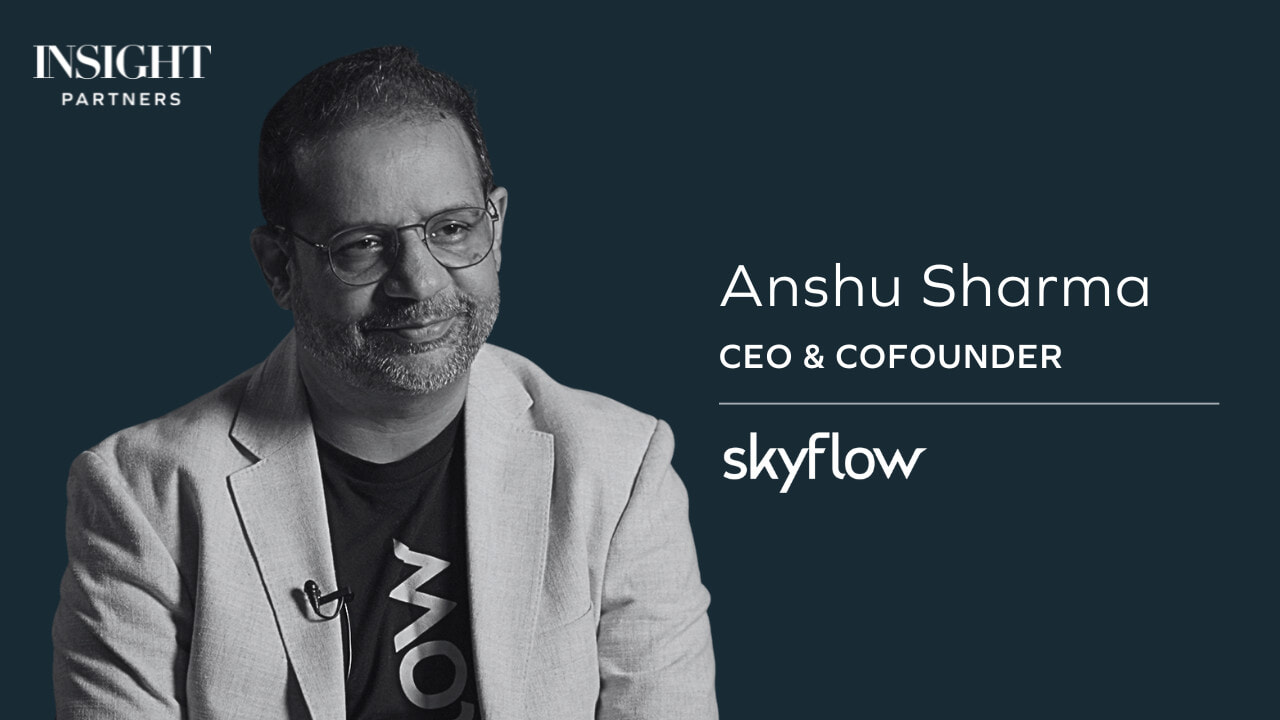
“We need to have a trust layer,” says Anshu Sharma, the cofounder and CEO of data privacy platform Skyflow. “And that trust layer needs to work for the data platforms, for the AI platforms, and the Agents and the applications we’re building.”
Cloud concerns
Sharma spent over a decade in product development and management at major enterprise software companies, where he saw firsthand the fundamental flaw in how the digital world manages personal information.
“During my time at Salesforce, I realized that more and more companies were moving their workloads to the cloud,” he says.
“As more and more core customer data started moving to the cloud, concerns around security and privacy were going up. At the same time, there was this new wave of applications being built on AI, and that meant companies were losing control of [customer] data.”
In 2018, the regulatory landscape shifted, transforming an architectural issue into an acute business need. New privacy laws like the General Data Protection Regulation (GDPR) and the California Consumer Privacy Act (CCPA) increased data breach penalties from thousands of dollars to potentially billions, with the largest GDPR fine to date being a €1.2 billion penalty issued to Meta Platforms Ireland Limited in May 2023.
By that time, while working as a venture partner at a VC that focuses on enterprise SaaS businesses, Sharma had realized that companies needed an end-to-end solution that plugs straight into existing workflows, rather than waiting to perfect their own AI models.
“The idea that you’re going to build your own models on your own GPU clusters is probably true for five to 10 companies in the world,” he says.
“I think the mainstream is moving in the direction of cloud AI and cloud-based AI architectures.”
In 2019, he joined forces with fellow Salesforce executive Prakash Khot and software engineer Roshmik Saha to create Skyflow.
The new architecture for sensitive data
Inspired by the zero-trust data privacy vaults pioneered by companies like Apple and Netflix to protect sensitive customer information, the team’s vision was to deliver the same thing via a simple and elegant API that developers could easily integrate into their applications.
“Skyflow is a security platform for the AI data stack,” explains Sharma. “Companies that are looking to build Agents or applications on top of their [cloud and AI platforms] need to be 100% sure that the data that they’re using…never leaks to a third party. We make sure that doesn’t happen.”
The solution is designed for companies building on cloud-native data and AI platforms, such as Snowflake, Databricks*, Salesforce, OpenAI*, and Anthropic*, that now underpin enterprise operations.
As organizations embrace AI and agentic workflows, they’re faced with an unavoidable challenge: Agents must use personal information to act on a customer’s behalf, but if those systems can access personal information, they can also misuse or expose it.
Skyflow’s premise is simple, says Sharma: “Helping enterprises adopt AI without adding more risk to their workflows and data.”
The core product is a dedicated environment that isolates, encrypts, and governs sensitive data. Applications are given tokens or placeholders that look and behave like real data, allowing operations to run normally while the underlying PII stays protected.
These guardrails around what an AI system can see, do, and remember with personal and business-critical information are what set Skyflow apart from traditional cybersecurity. Instead of trying to secure every system that touches sensitive data, Skyflow removes the data entirely, providing a single, zero-trust layer to govern access.
The road to $100M
Skyflow’s early and continued traction underscores the urgency of the problem it is tackling. The company secured its first customer in a seven-figure deal within just two weeks of launching, and raised a $7.5M seed round in May 2020, followed by a $17.5M Series A in December that year.
In October of 2021, Skyflow raised a $45M Series B, led by Insight Partners. In the three quarters prior, the company had grown 8x, launched solutions across the Americas, EMEA, and APAC, unveiled a partnership with Visa, and hired more than 50 engineers.
Doubling down on AI-related solutions unlocked further growth for Skyflow. After launching Skyflow GPT Privacy Vault, a privacy solution that enables organizations to safely leverage the full power of LLMs, in 2023, its revenues from LLM-related usage grew from 0% to around 30% and Skyflow more than doubled in size, expanding its revenues by 110%.
Following a $30M Series B extension in March 2024, Skyflow’s total equity capital stands at $100M. Today, it supports nearly a billion records of user data and processes over two billion API calls quarterly, with a client list that includes GoodRx, Lenovo, and Hippocratic AI.
A complex horizon
Skyflow’s next phase will involve addressing the security challenges related to the rise of AI and the complexities of global data laws. In practice, this means applying its vault technology to help customers comply with data sovereignty laws without needing to replicate GPU clusters and build separate AI models in every country.
“If you can go down from running 10 copies of the model to one or two, you’re talking about tens to hundreds of millions of dollars in savings for some of the larger companies,” Sharma says. “Even billions.”
Skyflow is also moving beyond data security to focus on what Sharma calls “knowledge protection and knowledge privacy,” which involves securing the core intellectual property and business processes of a company when models are built around them. “How do I secure the knowledge and not just the data? That’s an open and interesting area of research for us.”
Looking to the future, Sharma believes the next chapter of AI will see single, task-based assistants replaced by complex, multi-step, multi-Agent systems that plan, remember, and collaborate.
“Imagine a bunch of MCP servers, Agents, orchestrations, and models all talking to each other…The complexity is orders of magnitude different.”
Enterprises will need observability and enforcement layers that allow these systems to operate predictably and securely, he argues — a new architectural challenge Skyflow is already building for.
“The future of AI is also SaaS”
As AI becomes the backbone of modern enterprise software, Sharma believes companies must rethink how they build trust into every layer of their architecture. The winners, he argues, will be those who embrace cloud-based AI rather than attempting to reinvent it internally.
“You can’t wait for your OpenAI version 4.0 to be updated six months from now,” he says. “You want to use that Agent kit yesterday.”
This shift demands new guardrails, observability, and a secure foundation that can keep pace with rapidly evolving models and increasingly complex agentic systems. That’s where Skyflow sees its role: enabling companies to innovate without compromising customer trust or exposing their most sensitive data.
Ultimately, Sharma believes the industry is reaching a moment of reckoning. “People are beginning to grasp it, but they haven’t fully accepted…that the future of SaaS is SaaS,” he says. “The future of AI is also SaaS.” Skyflow aims to be the trust layer that makes that future possible.
*Note: Insight Partners has invested in Skyflow, Databricks, OpenAI, and Anthropic. This article is part of our ScaleUp:AI 2025 Partner Series, highlighting insights from the companies and leaders shaping the future of AI.