For most of the last decade, the SaaS playbook had one commandment: Keep gross margins above 80%, offload implementation to partners, scale through product-led growth. Professional services were taboo.
The companies that broke that rule built some of the most valuable enterprise software businesses in the world. ServiceNow, Workday, Palantir — all leaned hard into implementation and services during platform shifts, precisely when everyone else ran the other way. ServiceNow had 63% gross margins at IPO; by FY2024, 79%, and a $194B market cap. Workday had 54% at IPO; by FY2026, 76% and $63B. Palantir had 79% at IPO; by FY2025, 82% and over $250B.
History vindicated them. We believe that pattern is playing out again, right now, in AI implementations.
The FDE moment
Palantir invented the forward-deployed engineer (FDE) over a decade ago — an engineer who doesn’t ship from headquarters but embeds inside a customer’s environment and builds there. For years, the world called it a quirk. Expensive. Unscalable. A Palantir thing.
Then 2025 happened.
FDE job postings grew more than 800% between January and September, according to Financial Times analysis of Indeed data. OpenAI’s* FDE team went from two to 52 people in a single year. Salesforce committed to hiring 1,000 FDEs. Anthropic’s* applied AI team — which includes FDEs — is set to grow fivefold. Deloitte launched a dedicated FDE practice in December 2025.
The deployment gap in AI is real, and major players are racing to close it with humans on the ground. One question has yet to be answered: What does the infrastructure for those teams look like?
There is no Salesforce for this
Salesforce created the system of record for sales. There is no equivalent for professional services delivery — the function now responsible for actually making enterprise software work.
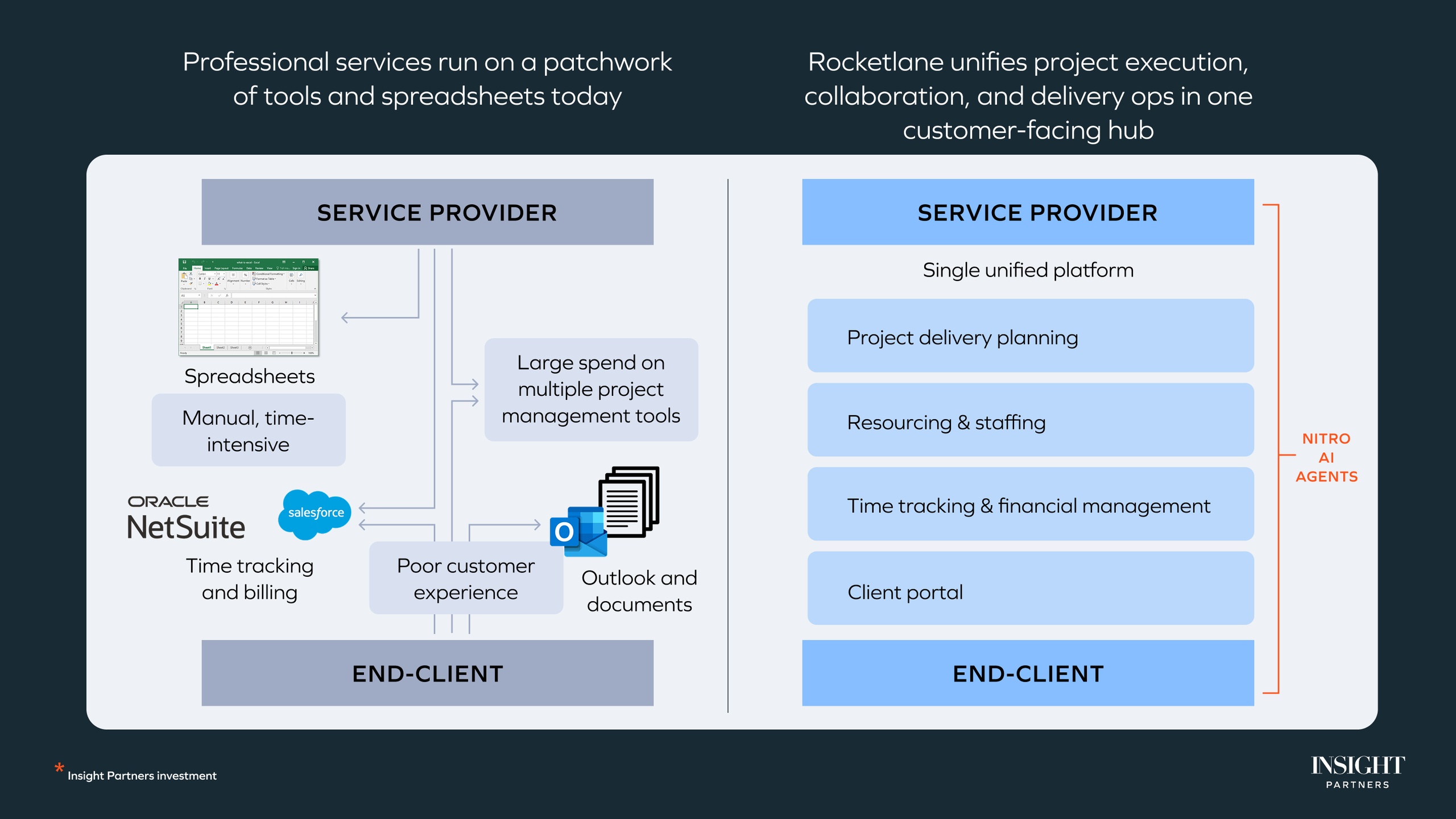
Ask any vice president of professional services how they run their operation. The answer is often some variation of a spreadsheet for resourcing, project management tools for tracking, a Google Doc for the handoff, a separate tool for time logging, a finance system that can’t talk to any of the above. At 10 concurrent engagements, a great operator holds it together. At 50, it frays. At 100, it breaks.
The legacy tools that do exist were designed for large, standalone service firms where billing is the whole game. They solve billing. They don’t solve delivery, resourcing, or the real-time client visibility that a fast-moving company running 50 concurrent AI implementations actually needs.
That gap is the market, and it’s growing fast. Across our portfolio of over 550 companies, more than half grew their customer success (CS) teams in the past year alone, and the share of workforce dedicated to CS and professional services has climbed every year since 2022 (Insight Partners portfolio data). Industry-wide, 42% of SaaS companies now charge for implementations — up from a small minority three years ago.
Rocketlane built a solution for the actual delivery problem
Sri Ganesan, Deepak Bala, and Vignesh Girishankar started with a simple observation: Professional services automation (PSA) tools on the market are generally designed from the back office outward, built to satisfy finance and billing. Few of the established tools had been built from the delivery problem inward.
So they did.
Rocketlane gives implementation teams project templates that standardize delivery, a shared client portal that gives customers live visibility, and a single place where resource allocation, time tracking, invoicing, and governance all live together. Finance and delivery teams work off the same data, so reporting doesn’t require stitching together three different exports.
Built into the platform is Nitro, an AI engine that does real delivery work: configuration, data migration (transformation, validation, etc.), and documentation. It also auto-drafts status updates, flags scope creep before the team catches it, and surfaces signals from projects based on calls, emails, and the project progress itself. The more implementations run through the platform, the smarter the Agents become. It’s a compounding flywheel built on a structured delivery history.
What customers tell us
Rocketlane serves over 750 customers globally, including 17 Forbes Cloud 100 companies and more than 25 companies from Insight’s own portfolio. These are engineering-rich organizations that could build in-house. They chose Rocketlane instead.
Actabl cut implementation time from 450 days to 108 days. GoCardless delivered 59% faster time-to-value. Project44 automated invoicing, improved executive reporting, and sustained around 80% utilization while cutting manual work. Dwolla achieved a 90% customer collaboration success rate.
When delivery teams build their templates, integrations, and client workflows in one system, Rocketlane becomes the operating backbone for delivery.
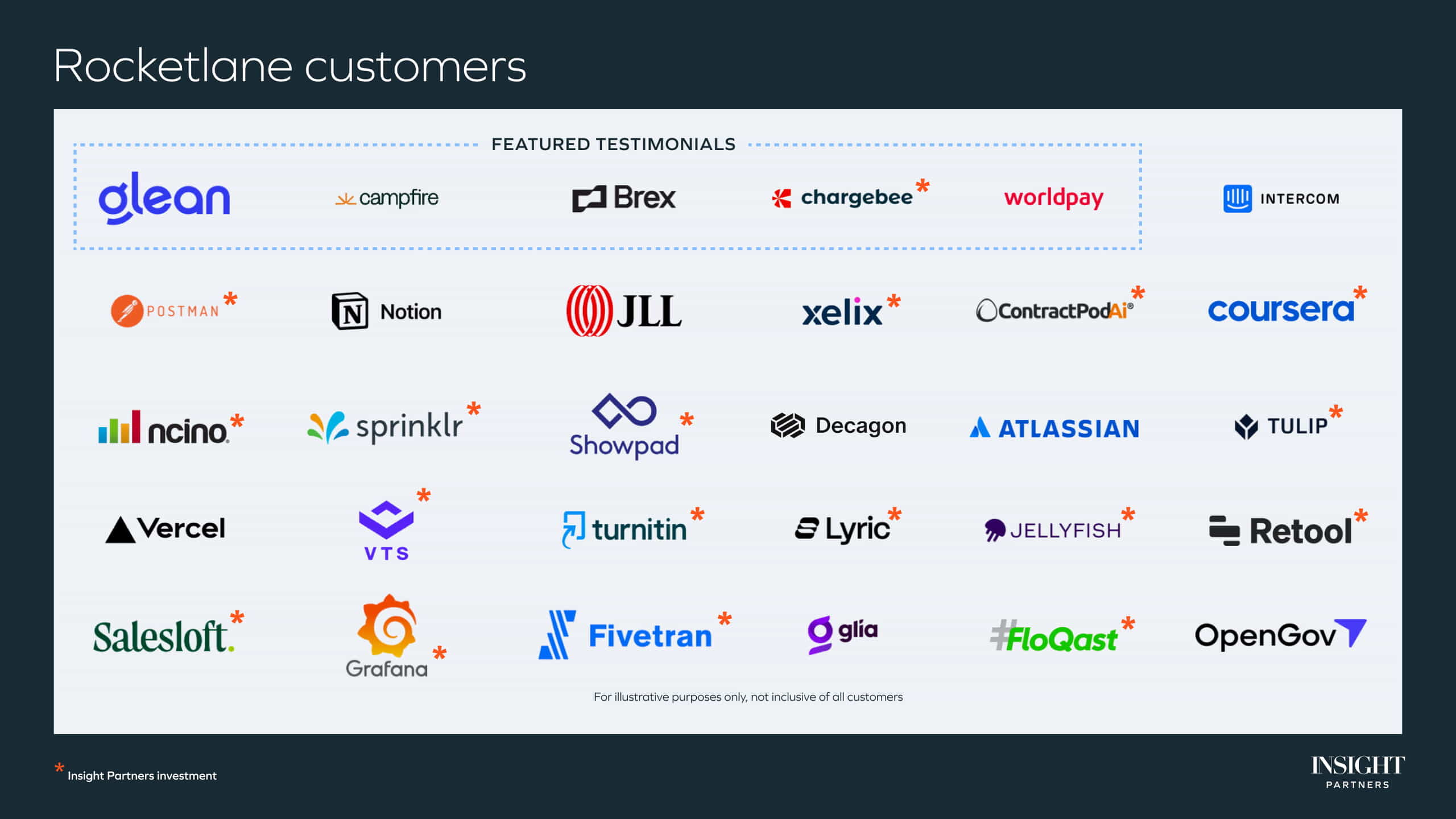
- “Rocketlane has been an excellent partner in setting up our implementation. Their team brought clear benchmarks and best practices that helped us structure our onboarding more effectively from day one. We’ve been impressed with the collaboration so far and we only wish we had started with them sooner.” — Camilla Matias, COO at Brex
- “At Campfire, we’re building the AI-native ERP that lets high-growth companies scale without scaling their accounting team. We partnered with Rocketlane to apply that same philosophy to our service delivery – replacing fragmented processes with a transparent, automated experience that allows us to scale as fast as our customers do.” — Andrew Greener, Head of Business Operations at Campfire
- “For complex enterprise engagements, the ability to capture meeting insights and automate detailed documentation and action items is a game-changer. Rocketlane’s AI, Fills, has significantly reduced our manual overhead, helping us align on our solution design faster with customers, and ensuring both Chargebee and our merchants stay ahead on critical tasks.” — Sukanya Kuppuswamy, Vice President of Shared Services at Chargebee
- “In my experience, most vendors sell you a product and step back. Rocketlane is different. They stayed close, listened, and are highly engaged in helping us get the most out of the platform. The product itself is compelling, but what also stood out was the partnership, the kind that makes you feel like your success is their success. That’s rare, and it matters.” — Michael Veatch, Head of Partner Onboarding & Implementation at Worldpay
Why we invested
Ganesan, Bala, and Girishankar have worked together for over a decade. They co-founded Konotor in 2012, sold it to Freshworks in 2015, and built Freshchat from zero to $13M ARR as the fastest-growing product in the portfolio. When they left to start Rocketlane in April 2020, they ran over 80 customer interviews before writing a line of code.
That discipline shows in the customer testimonials we heard. That history shows a 4.5x growth in average deal size since 2023.
We invested because of our belief that this team is building for a clear market gap: a platform designed around how professional services work actually gets done — not how it gets billed — with AI embedded in a system of record rich enough to make the Agents meaningfully better over time.
The category is large, the tailwind from AI deployment is structural, and the FDE wave is just beginning. We believe Rocketlane is positioned to be the operating system underneath all of it.
*Editor’s Note: Insight Partners has invested in Rocketlane, Lyric, Postman, OpenAI, Anthropic, nCino, Sprinklr, Turnitin, Salesloft, Fivetran, Grafana, Jellyfish, FloQast, ContractPodAI, Showpad, CoLab, Tulip, VTS, Glia, Retool, Monday.com, and OpenGov. For a complete list of Insight portfolio companies, please see www.insightpartners.com/portfolio.