Back
Leadership
How Torq is leading the autonomous SecOps revolution
Insight Partners | August 21, 2025| 4 min. read
The modern cybersecurity landscape is no stranger to challenges. Security operations (SecOps) teams are inundated with thousands of threats each day, many of which are low priority or false positives. Microsoft alone faces an average of 600 million cyberattacks daily.
“Alert fatigue” is just one reason why many threats go unchecked. The industry also faces significant talent shortages — it’s estimated that four million professionals are needed to plug the talent gap in the global cybersecurity industry.
In 2019, entrepreneurs and cybersecurity veterans Ofer Smadari, Leonid Belkind, and Eldad Livni saw an industry plagued by burnout and legacy infrastructure. Traditional security orchestration, automation, and response (SOAR) tools, initially built for manual data entry, could no longer keep pace with the volume and sophistication of modern cyber threats.
The trio had just sold their SaaS security company, Luminate Security, to the United States cybersecurity firm Symantec for $250M, within two years of launching. By December that year, they had identified another opportunity — to address the inefficiencies in large organizations’ cybersecurity operations — and so, Torq (formerly StackPulse) was born.
“Security ops are about finding the needle in a haystack”
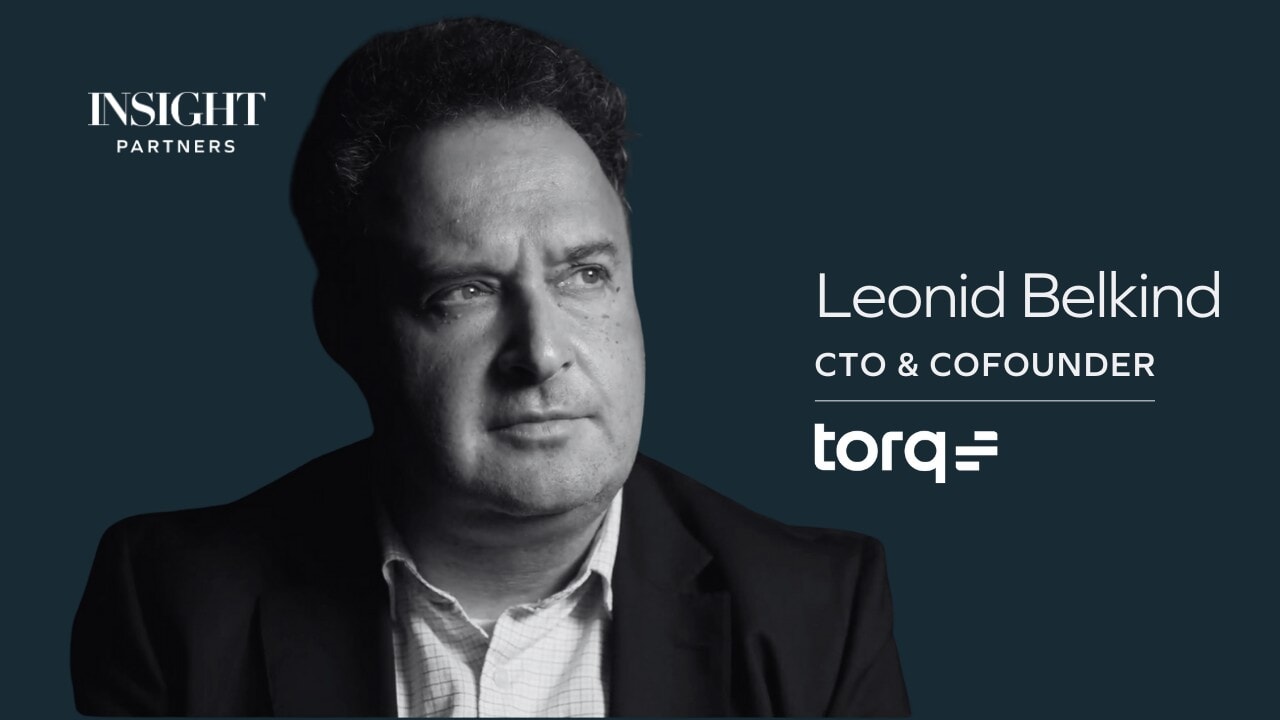
“The biggest risk facing enterprises in today’s world is their inability to cover all sources of security events,” explains Belkind, Torq’s CTO.
Whether it’s inefficient systems, understaffing, or the sheer volume of threats, the average organization fails to check around a third of security alerts, he adds. “Security operations [are] always about finding the needle in a haystack. Guess what? If the needle is in a part of a haystack you aren’t even looking in, your chances of finding it are slim to none.”
Torq landed on a bold vision. To enhance efficiency and alleviate the talent shortage in the sector, it would reinvent the Security Operations Center (SOC) using AI and automation.
“You will not be hiring more team members at the same pace as your tech stack grows,” says Belkind. “So, unless you do something about it, [the threat is] just going to fester.”
In January 2020, the cofounders secured $8M in seed funding and assembled a team to start work on the market’s first AI-native autonomous SecOps platform: a solution that could automate entire security infrastructures with no-code, low-code, and full-code workflows.
“The average enterprise today, for good reasons, unfortunately, overlooks 30%+ of all security signals coming in.”
Traction and turning points
Less than a year later, Torq exited stealth with $20M in Series A funding, attracting investment from Wiz CEO Assaf Rappaport and Armis CEO Yevgeny Dibrov.
Its early customers, including NS1, eToro, Armis, and Healthy.io, used Torq to turn manual security processes into automated workflows, shrinking the time spent blocking malicious traffic while significantly increasing coverage.
In December 2021, Torq raised a $50M Series B, led by Insight Partners. “They share the vision of dreaming big,” Belkind says of the partnership. “They have a lot of pragmatic experience in running [businesses].”
Product innovation and powerful growth
The Torq team doubled down on supporting its growing number of customers. As Cofounder and CEO Ofer Smadari told TechCrunch at the time, the average number of workflows a customer was running on the service was growing 2 to 3x every week.
In 2023, Torq’s third year of operation, the company hit numerous milestones:
- 300% revenue growth and 500% customer growth, adding Blackstone, Carvana, Deepwatch, Nubank, and ZoomInfo to a roster that already included Agoda, Chipotle, Fiverr, SentinelOne, and Wiz.
- Launched Torq Hyperautomation Platform at RSA 2023 — one of the first uses of GPT-style AI in cybersecurity incident response.
- Released Socrates, an AI tool that triages and responds to routine security alerts.
“2023 was a year of dramatic customer and revenue focus, product innovation and expansion, and channel and partner momentum, yielding the strongest year for Torq since it was founded,” said Smadari.
At the start of 2024, Insight led Torq’s $42M expansion of its Series B, followed by a $70M Series C in September of that year. Torq’s traction in the SecOps industry saw its revenues triple for the second consecutive year.
Telling a better story
But it’s more than just the numbers for Torq.
From the company’s sponsorship of Monster Jam to making Grave Digger — considered one of the most famous and recognized monster trucks of all time — part of their booth at the RSA conference, Torq is as bold with its branding as it is in its approach to cybersecurity.
For Belkind, these are more than just stunts. “Perception is everything. It can shape your reality. It can take you places where, just driven by data or logic, you would not have necessarily gone. [Insight] shares that understanding that a perception is what drives reality.”
This means challenging cybersecurity conventions by the way Torq tells its story. “We implement a lot of techniques and approaches that are more apparent in consumer brands,” says Belkind.
“Don’t forget that every enterprise executive is a human being in the end. They don’t care about only spreadsheets, graphs, data — people need to have a connection to a story, work with a brand that means something. And that’s what we’re doing.”
Beyond the AI honeymoon
Belkind is wary of AI hype. “Everybody is currently at the honeymoon stage with artificial intelligence … applying AI to things where it doesn’t really do much good.”
Torq takes a methodical approach. Rather than bolting AI onto products for the sake of it, the team looked at SecOps and broke it down into traditional phases, says Belkind. “We asked ourselves the question, ‘What is the natural native integration of generative AI technologies,’ in each and every phase?”
“Let’s not introduce AI for the sake of introducing AI, but let’s ask ourselves, ‘What are the outcomes that we’re delivering? What are the KPIs by which we’re being measured? How are these being improved by AI?’ and then introduce AI to do that.”
GenAI and agentic AI are now embedded throughout Torq’s platform to facilitate integrations and automate workflows. As one Fortune 500 company CISO and Torq customer put it, “Torq has the best practical use of AI I’ve seen from any vendor.”
In April 2025, the company acquired Revrod, a stealth Israeli AI startup whose technology reduces investigation time by up to 90% and enables SOC teams to handle more alerts without increasing headcount.
For Belkind, this is what the autonomous SOC is all about: “automating the right things and involving people — with their context, understanding, ingenuity — where they bring value … It’s not a feature; it’s a strategy.”
Chance favors the prepared mind
With the SOC market projected to grow from $43.7B in 2024 to $ 81.2B by 2032, security operations must scale with the threat landscape.
But Belkind refrains from making predictions; the best preparation for the future is to be ready for it.
“If anybody had asked me five years ago if the things that are possible by AI today — video generation, photo generation, the Waymo ride I just took — would be possible, I would not have predicted that,” he says.
“The only good advice I can give to anyone trying to prepare themselves for [the future] is be agile, be constantly on the lookout for technological trends, be ready to adopt technology relatively early on — because five-year outlooks are out of the window.”
What he is certain of is that, as threats evolve and proliferate, demand for intuitive, automated security tools will continue to build. “Torq solves [a] fundamental problem that is only going to grow and will never go away.”
Scale up your career: See open roles at Torq.
*Note: Insight has invested in Torq.