Insight Partners
More By The Author
Back
ScaleUp:AI
How A.Team enables companies to build at the speed of AI
Insight Partners | January 28, 2026| 3 min. read
Traditional hiring cycles were not designed for the pace of modern product development. Recruiting, interviews, onboarding, and training take months. Product builders operate in weeks.
This mismatch affects product teams across companies of every size. Enterprises have the resources to hire and train, but they can’t procure, build, or roll out new products at startup speed. Startups can build quickly, but struggle to afford the cost of assembling great teams at the pace they are working.
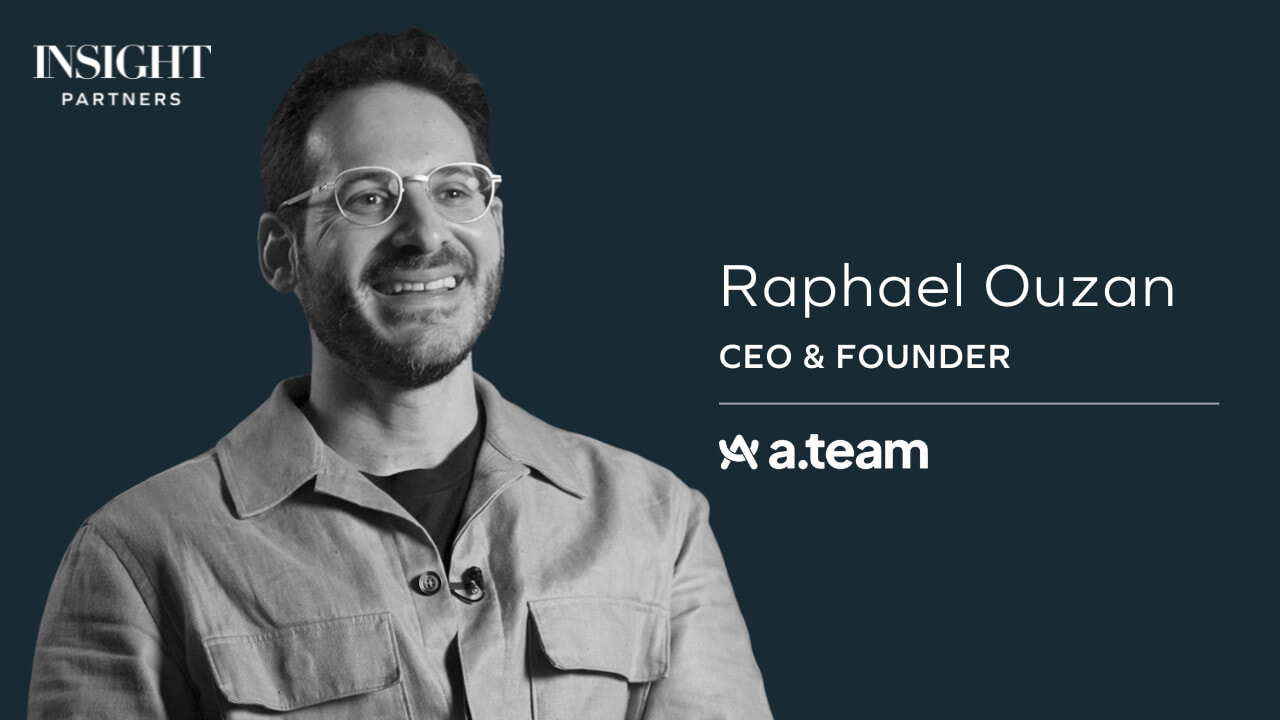
A.Team‘s Cofounder and CEO Raphael Ouzan saw firsthand how the processes for building product teams hadn’t evolved to meet the demands of a world of remote, project-based, tech-driven work. Even in the most advanced environments, he says, team formation remained “very anecdotal, very unscientific…and it surprised us that there was no technology for this.”
“The level of impact that a bunch of people who like to build things can have is absolutely staggering.”
“You need an ecosystem around you”
Ouzan taught himself to code as a teenager, but quickly learned that he worked best when surrounded by a strong team. “You need an ecosystem around you,” he says. “Once you find it … it feels like almost nothing’s impossible.”
But many product builders are in the tech industry or the big consultancies, “feeling that there could be more for them out there, things that they would find more fulfilling, where they could apply their very unique skills,” he says. “If you’re a great engineer or product builder, you don’t necessarily want to join a workforce of hundreds of thousands of people.”
And while online work platforms have taken off over the past decade, they’re “more for the gig economy, which is much more commoditized and low-value types of tasks,” says Ouzan. Between big consulting firms and low-paid freelance platforms, “there’s this void in the middle.”
Assembling A-teams
The pandemic made remote collaboration the norm and exposed just how hard it was to build or scale high-performing teams quickly. So, in 2020, Ouzan teamed up with Kobi Masri, a former engagement manager at McKinsey & Company, to fill that void.
At first, they set out to build a new kind of infrastructure that would let people form teams as easily as deploying a cloud server.
“We said, ‘What if we could bring the best of both worlds?’” recalls Ouzan. “The value creation of some of the biggest firms in the world … with the efficiency [and] speed of those online work platforms, to enable the best builders to team up and do the best work of their career.”
The result was A.Team, one of the first cloud-team formation platforms, building toward a future of work that gives people the freedom to “work on the most meaningful things to you with the people that you want to work with.”
The science of team building
At its core, A.Team is a talent network. AI engineers, product managers, designers, and data scientists — what the company calls “builders” — can apply as individuals or teams, and are then rigorously vetted. Once accepted, they have the freedom to choose “missions” that match their skills and interests.
Then the platform’s proprietary AI, TeamGraph, analyses each builder’s skills, experience, and working styles, to assemble cross-functional teams that plug into clients’ existing internal structures. It allows companies to scale up or down as projects evolve, and accelerate product delivery without the cost or commitment of full-time hires.
The company gained immediate traction. While still in stealth and invite-only in 2021, A.Team attracted 4,000 builders and more than 250 clients through word of mouth. Revenue grew more than sevenfold that year, and in May 2022, the company raised a $55M series A led by Insight Partners.
Building teams for the AI era
Beyond matching talent with projects, A.Team’s vision is to become the infrastructure layer for what Ouzan calls the “builder economy.”
“We’re building the AI-native systems integrator for the application of AI within companies and especially enterprise, by delivering teams of specialized experts and agents that … integrate the different pieces…into a learning system.”
In practical terms, that means A.Team builds small, specialized teams that help companies connect their AI tools, data, and workflows so those systems “talk” to one another.
Instead of buying isolated software or hiring consultants, clients use A.Team to integrate AI directly into their daily operations — whether that’s automating manual processes, embedding generative AI into products, or creating feedback loops where each project improves the next. In this way, the organization itself becomes a learning system.
“As people building companies, we’re in positions where we don’t have a choice but to learn way more than we’re comfortable with constantly.”
To deliver this, A.Team is investing heavily in its TeamGraph technology, evolving it into a learning system that captures how teams collaborate and improve over time. Each mission now gathers data about which tasks can be automated, which require human creativity, and how both can work in tandem. “The ability to compound proprietary intelligence by connecting the different pieces of workflows … that is a game changer,” says Ouzan.
Leadership at the speed of AI
A.Team’s hybrid approach — combining specialized human expertise with AI-led workflows — is proving highly effective.
“Our teams that are building both the specialized Agents and people that are working with clients…they’re the bleeding edge,” Ouzan says. Not just because they’re expert product builders, but because they implement things in a way “that actually supports [companies], doesn’t require a ton of retraining, and that elevates us humans.”
A.Team’s network has now grown to over 11,000 vetted experts, serving more than 500 companies, including eToro, The Economist, Lyft, and PepsiCo. Its teams have helped launch a vaccine manufacturing platform in a month, developed a digital ordering system for a high-growth coffee business, and increased nurses’ productivity by 40% at a Fortune 500 healthcare system.
“There’s no telling how much more powerful the teams can become…They’re learning, not just at the speed of humans, but actually at the speed of AI.”
As AI accelerates, Ouzan believes the real differentiator will be leadership.
“We indeed may be the last generation to just manage humans, but leadership is at an all-time premium, and it matters throughout the organization,” he says. “Efficiency and speed of learning, of implementation, of execution, is really critical — and building AI-led workflows cannot be achieved with an incremental mindset.”
For A.Team, that mindset means “building the unreasonable”: creating the systems and structures that make once-impossible work achievable, and empowering the next generation of builders and leaders to work at the speed of AI.
*Note: Insight Partners has invested in A.Team. This article is part of our ScaleUp:AI 2025 Partner Series, highlighting insights from the companies and leaders shaping the future of AI.