Insight Partners
More By The Author
Back
Leadership
How Chemify digitizes the process of making molecules
Insight Partners | February 18, 2026| 3 min. read
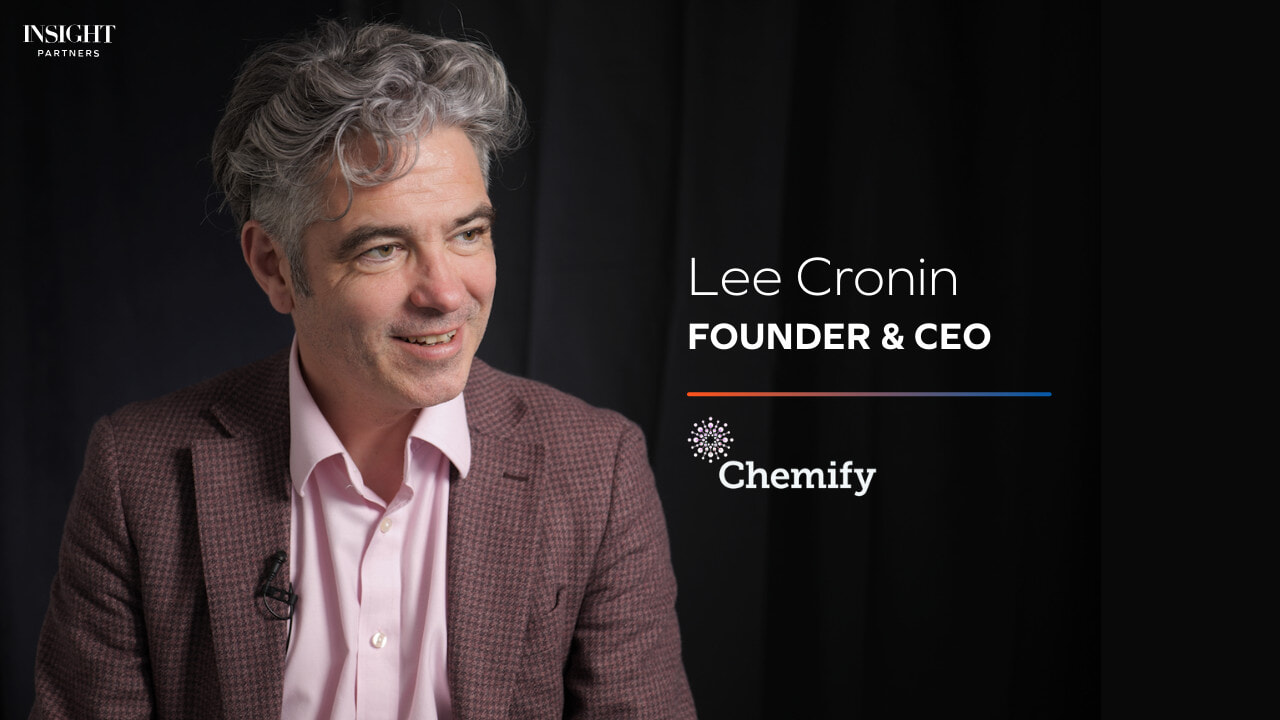
AI enables scientists to design millions of molecules in seconds, but most of the molecules don’t, and can’t, exist outside of a computer screen.
In drug discovery, materials science, and industrial chemistry, this gap between digital design and physical reality causes major bottlenecks in innovation, says Lee Cronin, the cofounder and CEO of Chemify.
“AI discovery is really hard because people think that once they’ve done the discovery on the computer screen, that it exists for real — that’s just not true,” he says. “There’s all this great AI, there’s all this great biology, there’s all this great intent, but there’s no molecules to cure the disease. That’s where Chemify comes in.”
Chemify digitizes the process of making molecules. In a process Cronin calls “Chemputation,” the company uses its proprietary programming language, χDL, to translate molecular designs into executable code, which robots then run to synthesize physical chemicals.
“χDL is literally the Python for chemistry.”
It’s like a 3D printer for molecules, says Cronin. Customers send a molecule idea, Chemify checks whether it can be made, figures out how, then builds it, reliably and on demand. “The problem we’re solving is turning the intent to design a molecule into the real molecule.”
Doing the dirty work
Chemify got its start at the University of Glasgow in 2019. Cronin had spent more than two decades in academia, building large multidisciplinary research groups and pioneering efforts to automate and digitize chemical synthesis.
He and his team developed chemical programming languages, robotic labs, and the Chemputer — an automated system designed to perform chemistry the way software executes code — earning him a reputation as a “robotic alchemist.”
But as AI-driven discovery accelerated, Cronin became increasingly frustrated with the way chemistry was practiced. “Chemistry is actually quite hard and dirty, and no one wants to do the hard bit,” he says. “Everyone’s playing around [with] AI. Let’s draw it and pretend it works.”
“Everyone else is busy talking about it, and I decided to stop talking about it and actually make it work.”
In March 2022, with backing from biotech entrepreneur David Cleevely, Chemify was formally spun out from the university. It was founded to put “picks and shovels in the ground” and build the infrastructure required to make molecular science real and scalable, Cronin explains. “Without these picks and shovels, there will be no assets, there will be no drugs, there will be no cures.”
Engineering a new category
Building a company that combines chemistry, robotics, software, and machine learning is capital-intensive, technically complex to pitch to investors, and difficult to justify in a market fixated on purely digital AI.
“Chemify is a really atypical startup, in that we combine software, hardware, and wetware in one company,” says Cronin. But being able to integrate those disciplines is part of Chemify’s appeal, he argues, and something few companies could achieve.
Cronin is unapologetically ambitious about what that integration enables. “What I’m trying to do is make sure that Chemify remains focused on one thing,” he says, “and that is designing the best, most sophisticated molecules, making them for real, and changing the world.”
That combination of technical depth, clarity, and confidence has proven compelling to investors. In August 2023, the company raised a $43M Series A to scale its molecular design platform and expand its automated synthesis capabilities.
By 2025, Chemify’s shift from research-led innovation to industrial scale was well underway. In June, the company launched its first Chemifarm in Glasgow — a fully automated synthesis facility — creating 60 new jobs and securing multiple commercial contracts, with fresh funding from the Glasgow City Region Innovation Accelerator Programme and Scottish Enterprise.
Momentum continued with a $50M Series B co-led by Insight Partners in October 2025, alongside a major expansion of its lab footprint at Glasgow’s Health Innovation Hub. In December that same year, Chemify received a $1.6M grant to support the discovery of new treatments for tuberculosis and malaria, solidifying its relevance beyond commercial pharma.
Making molecules real
For decades, chemistry has relied on manual processes that are difficult to standardize and reproduce. Recipes are recorded in lab notebooks, with techniques varying from one chemist to the next, and small differences in timing, temperature, or materials can lead to very different outcomes.
That issue has been amplified by AI. Designing a molecule is one thing, but ensuring it can be reproduced reliably and behaves as predicted is another. That’s why Chemify builds reproducibility and validation into the process, says Cronin.
“We can test [whether] that molecule does what the AI intended. Does it bind to the protein? Is it a good catalyst? Is it a good pigment if we’re making a dye? By doing that, we close the loop between intent [and] design.”
This feedback is critical. Validating outcomes and feeding that data back into the system cuts down wasted effort and false positives. This, in Cronin’s view, is what turns chemistry into an engine for drug discovery and materials science, translating AI designs into real-world assets.
“No physical molecule, no asset. No asset, nothing to take forward,” he says. “If you went to the doctor and they said, ‘Oh yeah, we’ve got the drug to cure you. Well, no, actually, we don’t, but I invented it on a computer screen once, and we might make it one day, but we don’t know when.’ That’s the problem we solve.”
The AWS for chemistry
For Cronin, building Chemify has reinforced the importance of founders narrowing their focus while expanding their ambitions. “It is very tempting to bend the thesis so you can open up [more] opportunity,” he says. “We’ve found a problem, and we’ve stuck to that problem.”
That clarity carries through to how simply he defines Chemify. “Problem: People can’t design molecules, because it’s all done by hand. Solution: We’ve built robots, programming language, and we use machine learning to remove the labor and make it much [quicker] and [cheaper].”
“And I truly believe that…we’re going to be a breakthrough company — a once-in-a-generation.”
His advice to founders is to double down on what they believe they can do better than anyone else. In Chemify’s case, he says, “Nobody is digitizing chemistry. And I truly believe that…we’re going to be a breakthrough company — a once-in-a-generation. And that’s what keeps me going.”
Looking ahead to the next three years, Cronin predicts that every major pharma company will be working with Chemify. “In the next five years,” he continues, “we will enable all the AI investments in drug discovery to work.” And in 20 years, he says, “every single molecule invented on planet Earth will go through χDL. We will be the AWS for chemistry.”
*Note: Insight Partners has invested in Chemify.