Insight Partners
More By The Author
Back
ScaleUp:AI
Ethan Mollick on the five rules of great AI leadership
Insight Partners | November 11, 2025| 3 min. read
AI is evolving faster than organizations can adapt. The most forward-thinking founders and executives are already redefining how they organize, manage, and compete in a world of intelligent systems.
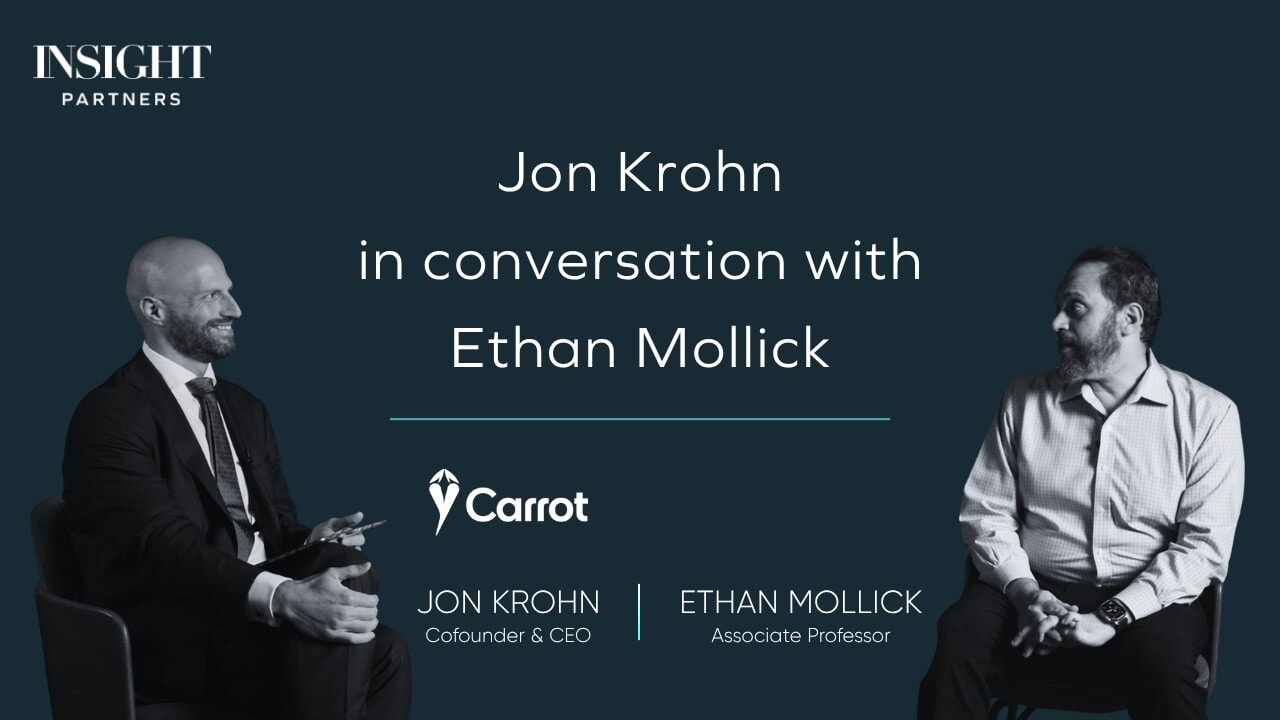
To understand how this transformation is unfolding, Y Carrot Cofounder Jon Krohn sat down with Ethan Mollick, associate professor at the Wharton School, AI thought leader, and author of Co-Intelligence: Living and Working with AI.
Mollick has spent years researching how humans collaborate with machines — and how companies can turn that collaboration into an advantage. Below, he shares five rules shaping what great AI leadership looks like now and in the future.
1. Choose your mode of human-AI collaboration
“When I wrote [Co-Intelligence], AI made a lot of mistakes,” Mollick says. “It wasn’t autonomous … and you had to do all the work yourself.”
But things have shifted since Mollick first began studying human–AI collaboration. He says there are now two main ways people work with these systems: interactively, by engaging in back-and-forth exchanges with a chatbot, or more autonomously, by delegating complete tasks to an AI model. “Increasingly, I assign a task to the AI. I use my expertise to decide what that task is. I evaluate the results, correct my approach, and if that still doesn’t work, I do it on my own.”
That balance — when to partner, when to delegate, and when to take back control — is the foundation of what Mollick calls co-intelligence. “We are starting to see some real autonomy from these machines for some tasks,” he says. “People will increasingly be picking among those sets of modes: things I do alone, things I do co-intelligently, things I assign to AI … and things that happen autonomously.”
2. Great AI management, not great models, creates competitive advantage
Mollick is frank about what will separate leading organizations from the rest. “Part of what worries me about the state of AI is that the capabilities of the systems are quite high, and people are not really using them,” he says. “Everyone wants someone else to answer the question for them.”
His advice is to trial and assess different approaches to management. “If you look at why American firms in particular did so well throughout the 20th century, 20 to 40% of the extra competitive value [came] from better management,” he says. “There was a willingness to experiment with management techniques … that led to the dominance of American firms.”
Today, he says, a lot of companies have given up on that. “They either go to outside consultants to do the work or trust SaaS vendors to tell them how to run their company. And I think that companies that start to experiment are going to be in the best possible shape.”
Already, some are breaking down silos to accelerate innovation. “Let’s pull senior IT people out of the IT department,” Mollick suggests. “Have them sit next to a subject-matter expert and vibe-code applications together — it starts to really change how things operate.”
3. AI transformation has to come from within
Mollick sees a growing divide between organizations that outsource AI adoption and those that build internal muscle. “I actually think there [is] room for consultants,” he says. “Consultants can help organizations make the change they want to make, map processes, things like that. But I think that the change does have to come from within.”
He warns against chasing trendy solutions, for example. “If you built a ‘talk-to-our-documents’ chatbot when I was warning you not to do that a year and a half ago, you now have a mediocre chatbot that cost you a lot of money to make and is now easily beaten by an off-the-shelf model.”
Instead, he advocates an internal structure for scaling AI: “You need three things in your organization: leadership, lab, and crowd. Leadership is the C-level people actively deciding what incentives will encourage people to use AI … The crowd is everyone in your organization using these tools … You need them experimenting.”
As for the “lab,” look outside the IT department, he says. “There’ll be a couple of people who are just really good at AI. Bring those into the lab. They’ll be turning around those ideas right away, testing, refining, and shipping them out.”
4. Incentivize your “secret cyborgs”
For Mollick, one of the biggest untapped advantages lies in what he calls secret cyborgs — employees quietly using AI to boost productivity. “Over 50% of Americans say that they use AI at work, and probably more actually have,” he says. “They self-report that on a fifth of tasks that they use AI for, they are seeing a three times performance improvement.”
Yet organizations are slow to capitalize on these capabilities because employees are not incentivized to disclose them, he explains. “If people think that they’re going to be fired or punished because … they’re showing productivity gains, they’re just not going to show you.”
That’s where leadership and labs come in. “Your secret cyborgs come out of your crowd,” he says. “Leadership needs to incentivize people to [come forward]. Then you need the lab, because you need somewhere for these people to go … to say, ‘Hey, I’ve got this prompt that … saves me five hours a day. Could you make it good and get it out to everybody?’”
5. “Use these models a lot”
When asked how leaders can prepare for what’s next, Mollick’s advice is simple. “Use these models a lot,” he says. “Use frontier models to figure out what they do. You can bet pretty reasonably that they will get better and cheaper.”
He argues that the only way to understand how these systems can help is through consistent, hands-on experience — stop overanalyzing AI and start using it. Instead of tracking every new announcement or waiting for perfect guidance, leaders should pick one advanced model, apply it to real work, and learn from the results. “You need to use them … rather than being skeptical about whether they work.”
*Note: This article is part of our ScaleUp:AI 2025 Partner Series, highlighting insights from the companies and leaders shaping the future of AI.