Back
Leadership
Island’s enterprise browser isn’t just safer — it’s securing and redefining how we work
Insight Partners | August 05, 2025| 4 min. read
Browsers dominate the modern enterprise workday, yet they weren’t built with businesses in mind — they were designed for consumers and advertisers. As a result, enterprises often need to retrofit them with layers of security tools like network firewalls, DLP agents, and antivirus software, creating a costly and complex ecosystem that’s difficult to manage and frustrating for users. Despite these efforts, the approach is falling short: more than one in three sensitive data leakages involve a consumer browser.
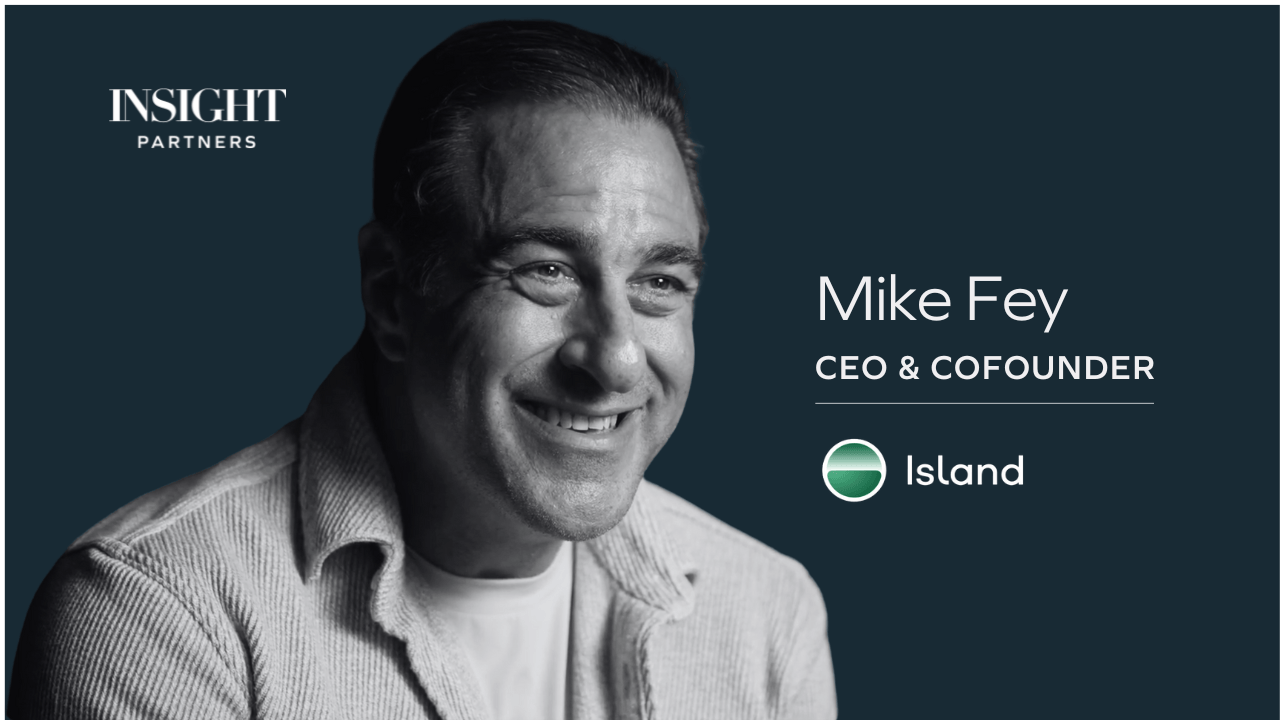
“To truly change the safety and security of [browsers], we had to build it in,” says Michael Fey, cofounder and CEO of Island.
Creating the world’s first enterprise browser
The story of Island began when Fey was serving as president and COO of Symantec. After decades of experience in cybersecurity, serving as president and COO of Blue Coat, executive vice president and general manager at McAfee, and CTO of Intel Security, he was ready to step away from the industry altogether.
Then, Dan Amiga, another cybersecurity veteran and now Island’s cofounder and CTO, reached out with an idea. Amiga had invented remote browser isolation technology while serving as founder and CTO of Fireglass (acquired by Symantec in 2017), and had previously headed software security for the Microsoft Technology Center in Tel Aviv.
The idea was simple: a better way to browse for enterprise users. Initially, it was a cybersecurity play. If you could create a browser based on Chromium — the open-source project that underpins most major browsers — that looks like a standard browser but was secure, you could deliver security by design, built into the application of the business stack.
But it soon evolved into something much bigger. In 2020, Fey, Amiga, and another Symantec colleague, Brian Kenyon, who would become chief strategy officer of Island, quickly realized how broad the use cases were.
“As we got deeper into it, we realized — wait a second — we can get productivity by design, we can get observability by design,” says Fey. This wasn’t just a secure browser; it was a new way of working, and the total addressable market (TAM) was huge.
It was an opportunity not just to disrupt and simplify the entire enterprise cybersecurity stack but also to improve the entire digital workplace experience.
“We realized it would be a big ROI to the customer. They’d save money getting off VDI, getting off backhaul solutions, getting off web filtering and CASBs and MDM and VPNs,” says Fey. “But we also saw that the IT group could deliver a fundamentally better service. And, finally, the end user would have a better life.”
Following their founding in 2020, the team spent around a year and a half in stealth, using the time and initial funding to put together a great technical team and develop a functional product, rather than throwing together a scrappy prototype that they’d inevitably have to rearchitect down the line.
Engaging with multiple organizations as design partners, they created the first enterprise browser — a secure browser that the end user actually wanted to use. So when they emerged from stealth, they were ready to scale and find the right partner to build something enduring.
A meeting of minds
The team’s introduction to Insight Partners in 2020 was a meeting with firm Cofounder and Managing Director Jeff Horing and Managing Director Teddie Wardi.
“When we explained what we’re doing, what we found on the other side was a matching visionary,” recalls Fey. “We found somebody that understood why we existed, what we could do, where we could take this.”
They knew it wouldn’t be a quick couple of years, with a tuck-in acquisition by a large company. “We were in it to build a real, meaningful company. And when we sat down with the Insight team, that’s what they wanted,” says Fey. “They really wanted to be involved in building that. They weren’t looking to cut corners. They weren’t aggressive about short-term wins.”
“We were immediately captivated by the elegance and power of Island’s idea — transforming the enterprise cybersecurity stack by placing the browser at its core,” says Wardi.
“Insight wanted us to build the product the world needed, and to do it right.”
Island publicly launched in February 2022, having raised $100M in funding from Insight and other venture capital firms.
“The pent-up demand was overwhelming”
For a company looking to replace most of the enterprise tech stack, the biggest surprise was how easy the sell was.
“When we started this, we thought it would be a lot harder to get customers to take that big step of trying an alternative browser. We thought it would take a long time to build that groundswell,” says Fey. “The pent-up demand was overwhelming.”
Enterprises just got it. “They’re looking for a new architecture. They understand they built a complexity that they can’t keep growing. They have to reduce the cost structure. They have to simplify the environment,” says Fey.
“I was shocked at how many companies welcomed us in and really became real design partners with us. It was amazing.”
Since then, it’s been a sprint.
The company has established traction across every major vertical and organization size, from Fortune 1000 enterprises to small and midmarket companies, government agencies, and higher education institutions. Weeks after Island’s launch in 2022, it raised $115M in a Series B round led by Insight, valuing the company at $1.3B.
Disrupting the enterprise stack
Island’s customer count has now reached 450, including Mattress Firm, Swiss Life, and Fiverr.
For each of these customers, it’s reshaping their cybersecurity stack. By embedding the core needs of the enterprise within the browser — control, visibility, governance, and protecting users as they traverse the web — a lot of legacy bolt-on tools become obsolete.
“When we show up, customers start asking, ‘Why do I even need this architecture anymore?’” says Fey.
“It’s one of the first times in cybersecurity where we’re seeing entire families of products no longer needed.”
It’s a rare combination: better security, reduced complexity, and a better user experience — all at a lower overall cost.
“We believed that the Island team had the rare ‘N of 1’ quality to overcome technical complexity and transform enterprise cybersecurity,” says Wardi.
“It is an architecturally superior place to be in the design plane, to not be on the outside being bolted in,” says Fey.
The sky’s the limit
In March 2025, Island announced its $250M Series E, bringing its valuation to $4.8B in fewer than five years since its founding. And Fey believes this is just the beginning.
“If we help the world understand that bringing a consumer browser to work is an antiquated concept, that there’s so much more you can do with control with enablement in that last mile, I think we’ll be wildly successful.”
If the reaction on the ground is anything to go by, Island is well on its way.
“I was checking into a hotel … and I had an Island logo on my shirt. And this person checking me in says, ‘Oh, you’re with Island. I love you guys!’” recalls Fey.
“That was shocking to me,” says Fey. “Our thought process was that the end user would never even know who we are. It was always going to be the IT staff and security. So to be in a remote location and have an end user excited that we existed — that was one of our goal states early on.”
It was proof of Island’s core mission. Making the enterprise’s most-used application better for the people who use it.
“We felt if we could please that end user, make them more productive, make them like the environment,” says Fey, “then the sky’s the limit on what we can do.”
Scale up your career: See all open roles at Island.