Insight Partners
More By The Author
Back
Article
On track to diagnose 32,000 patients daily, Proscia is shaping the future of precision medicine
Insight Partners | February 19, 2026| 3 min. read
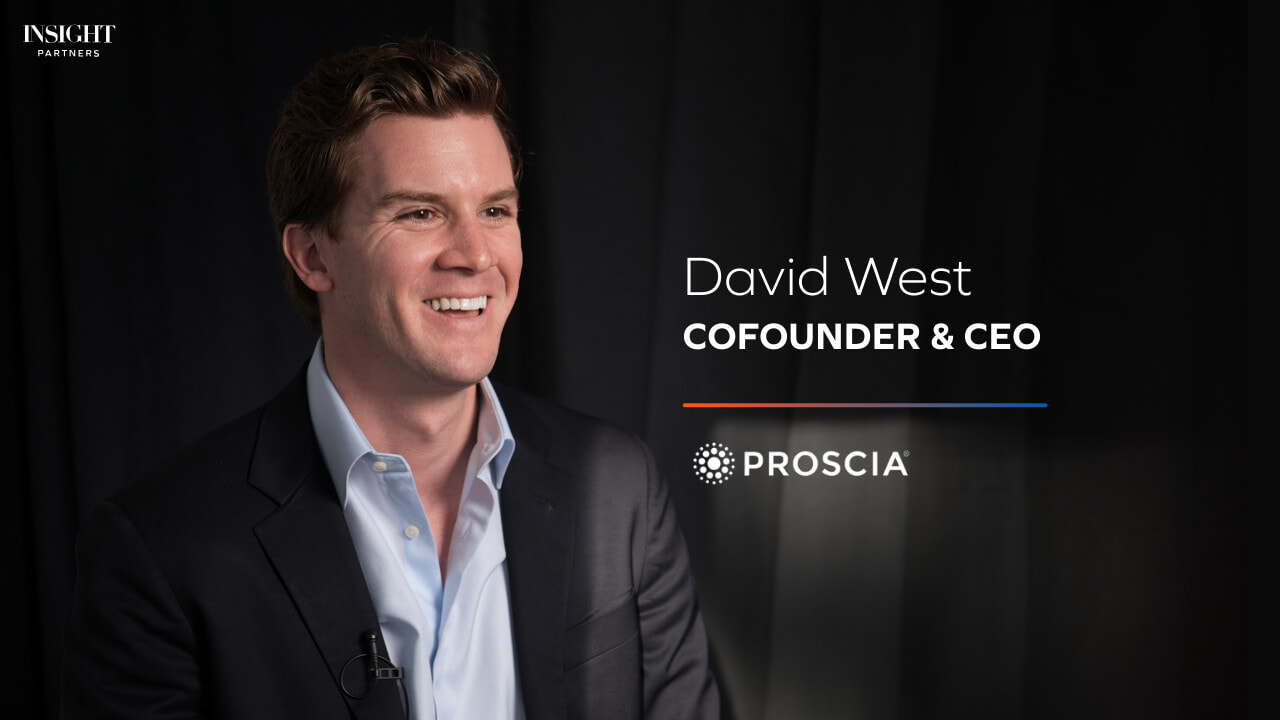
“Pathology hasn’t changed in 150 years,” says David West, cofounder and CEO of Proscia, a digital pathology software company.
West began his career studying biomedical engineering at Johns Hopkins, where he worked with scientists studying the use of computer vision and machine learning to predict cancer outcomes from prostate cancer images.
“When I started talking to pathologists, I’d walk into their office, and they’d have physical microscopes with cardboard slide trays and glass slides,” he recalls. “It felt like something out of the Victorian era.”
While there are perfectly reasonable explanations for using conventional equipment, such as familiarity with the microscope, entrenched workflows, and regulatory caution around new tools, West saw an opportunity for transformation.
“I was inspired to build technology that would help bridge that gap between the way that pathology has been practiced and modern, 21st-century technology. We think pathology deserves great software.”
From research to reality
What started as a pet project — a digital pathology platform to make lab work more efficient — evolved quickly. West and his cofounders, Chief Technology Officer Coleman Stavish andChief Strategy Officer Nathan Buchbinder incorporated Proscia in June 2014 and made their first hires six months before graduating from college.
At the time, pathology AI, or “computational pathology,” was a niche academic field. “I was just totally fascinated by this idea that we can use computers to understand cancer and other diseases in deeper ways,” says West. But few platforms were designed around the realities of anatomic pathology workflows.
Proscia launched its flagship product, Concentriq (then called “Pathology Cloud”), as a cloud-based software platform that enabled laboratories to embark on the journey from microscopes to data-rich images. The team’s proximity to its customers — academic medical centers, hospitals, commercial labs — gave them insight into where digitization could add value without disrupting clinical trust.
“Being able to bring together technologists and medical experts into the room is when the best products are built and real change happens.”
Following a $1M seed round in July 2016, Proscia launched a clinical digital pathology platform in September 2017, enabling anatomic pathology labs to adopt workflow automation and early AI capabilities in phases.
By September 2018, the company had raised an $8.3M Series A to expand Concentriq across both diagnostics and life sciences, fully establishing the platform, data, and AI foundation that still underpins its business today.
Its growth reached an inflection point when the COVID-19 pandemic brought regulatory flexibility that pushed digital pathology forward, accelerating remote review and forcing labs to modernize quickly. Further fueling its momentum, Proscia raised a $23M Series B in December 2020 to expand its platform and AI capabilities, followed by a $37M Series C in June 2022 to cement its AI leadership. It also received FDA clearance in February 2024.
The company now counts thousands of pathologists and scientists spanning major diagnostic laboratories and life sciences organizations — including 16 of the top 20 pharmaceutical companies — among its users.
AI-enabled precision
“In many ways, it feels like this moment came to meet us,” says West, of the explosion in new AI capabilities. “You can imagine in reporting, where you’re bringing together image data and language or text data, it’s a really important technology that is helping us do new things in these data-driven workflows.”
For one thing, automating routine workflows enables more precision. “From the moment an image is created, that data is being used to help automate, for example, case triage, making sure the right pathologists get the right cases,” explains West.
“It might help pathologists solve that needle-in-the-haystack problem where they’re looking for a tiny instance of tumor in dozens of slides with mostly benign tissue. That can be a tedious, time-consuming process.”
“AI is touching every aspect of the pathology workflow.”
As well as saving hours of lab work, AI’s ability to analyze millions of images and masses of clinical data makes it easier to capture insights about diseases, develop better therapies, and deliver those to the patients that need them.
“There are cancer treatments today that are effectively cures, but they’re only cures for 10% of patients,” West says. “If you can use the data and AI to help understand which patients are likely to respond to a drug, that’s an incredibly valuable technology [that] can help the right patients get on the right therapies and ultimately lead to better outcomes.”
Elevating human judgment
Ultimately, the promise of AI in pathology is not about replacing clinicians, says West. “Pathology is human work. We have pathologists and patients on the other side of our software, and we have an incredible reverence for that. What they need is technology that they can trust.”
“Humans have a huge role to play, and AI can help make pathology an even more human discipline.”
In an increasingly complex and bureaucratic healthcare system, administrative tasks take up a significant share of pathologists’ time, and Proscia’s goal is to use AI to strip away that friction and enable clinicians to spend more time on judgment, collaboration, and patient impact.
As AI capabilities continue to accelerate, there are exciting opportunities for healthcare. “There have been these incredible leaps and bounds in the models,” says West. “The question that everyone is asking is, how do you productize these … models into something that works for verticals like healthcare?”
Doing so requires navigating varying healthcare systems. Proscia operates across markets with fundamentally different incentives, such as the largely private United States system and the more socialized models in Europe. “There are ways to make it work in both markets, but you have to be able to adhere to your business model to the realities of those systems.”
“Healthcare is a complicated beast. It takes persistence, patience, capital, and expertise.”
A billion-slide ambition
Every year, roughly a billion slides are created for diagnostic purposes. Proscia’s ambition is to bring those slides into the digital world and use them for faster diagnoses, better treatments, and a deeper understanding of diseases.
In March 2025, Proscia raised a further $50M in a round led by Insight Partners, bringing total funding to $130M. In July that year, it was on track to diagnose 32,000 patients a day, reporting a 400% increase year-over-year.
West wants to scale that number to 50 million patients diagnosed annually over the next five years. “We’re well along our way to doing that,” he says. “Over 8 million patients per year are projected to be diagnosed on our platform, and we’re just getting started.”
*Note: Insight Partners has invested in Proscia.