Back
Leadership
How Valence’s agentic AI makes workplaces more human
Insight Partners | February 17, 2026| 3 min. read
Coaching used to be an executive perk. Today, it’s rapidly becoming core infrastructure, transforming how the largest companies approach talent, learning, and development at scale. That shift didn’t happen because organizations found a way to hire more coaches. It happened because AI unlocked new possibilities for what coaching can be and who it can reach.
When employees have access to an AI coach, it can give an organization new superpowers that human coaching cannot replicate. Even if you could deploy 10,000 human coaches wall-to-wall across a Fortune 500 company, you still couldn’t match the real-time organizational insights, the consistency of cultural and organizational alignment, or the agility at scale that an AI-native platform delivers.
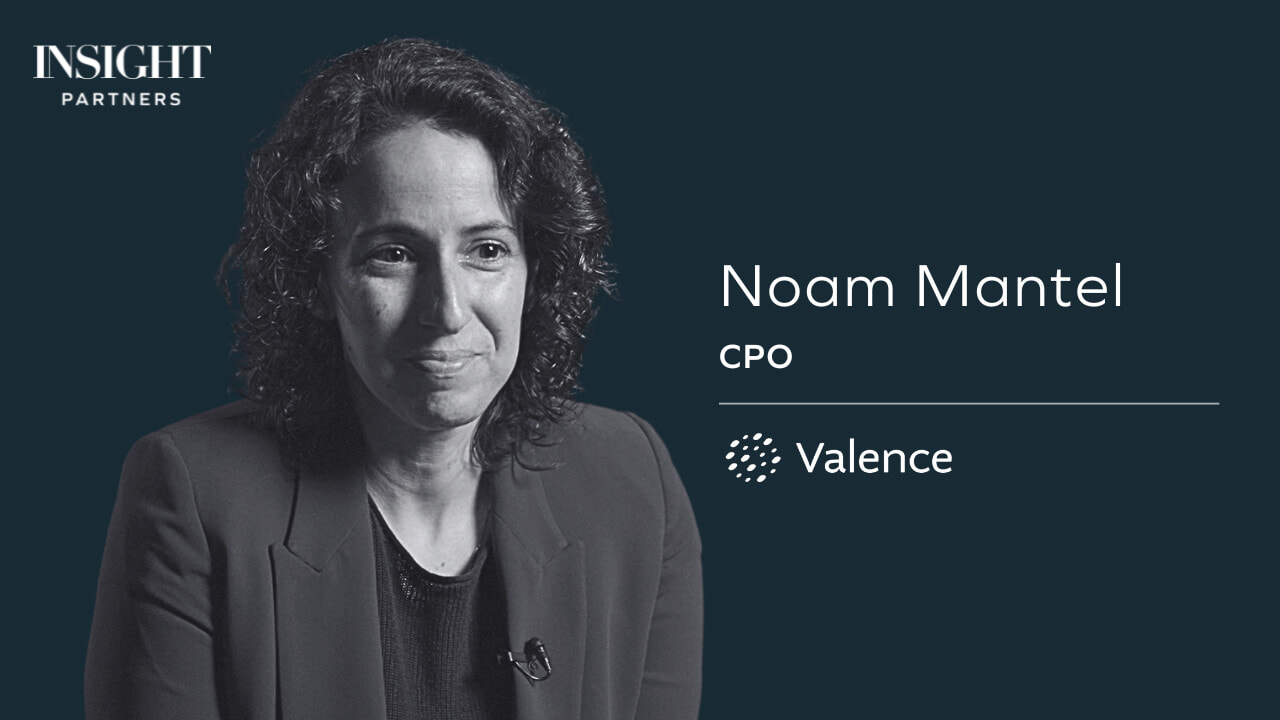
That’s the vision of Noam Mantel, chief product officer at Valence, which is pioneering an AI-native approach to coaching that amplifies what human teams can do.
Valence counts Fortune 500 companies, including Experian, Kraft Heinz, General Mills, and Prudential, as clients, and has already had one million coaching conversations with employees at all levels through its flagship product — an agentic, voice-first AI coach called Nadia.
Mantel joined Valence in August 2025, having led product teams at Slack and AB InBev. “I was really looking for a company that was using AI to amplify humans,” she says. “I was looking for AI to solve some of the real human issues that exist within our work lives.”
Below, she shares lessons for leaders who want to use agentic AI to help people communicate, collaborate, and ultimately build more human workplaces.
1. Use AI to close gaps in people development
Until recently, executive coaching was mainly reserved for executive leaders.
“Not every company can afford that, and those who can, can really afford it for maybe the top 1% of their leadership team,” says Mantel.
The result is a structural gap in people development, one that can’t be closed by simply scaling the old model. AI-native coaching doesn’t just extend human coaching further down the org chart; it delivers something human coaches can’t: organization-wide insights, pattern recognition across thousands of conversations, and consistent alignment with company culture and strategy.
At Delta Air Lines, Valence’s software was rolled out to frontline leaders, with 75% of managers becoming repeat users. Whether you are an executive or manage baggage claims at JFK, the experience centers on navigating day-to-day leadership challenges such as difficult conversations and team dynamics.
For many, it’s the first coaching they’ve ever had. So the real impact, explains Mantel, isn’t measured in time saved or reduced costs, but in the leadership skills that emerge where none existed before. Capability, rather than efficiency.
“Before, there was nobody coaching these managers on how to have tough conversations, or how to lead, or when to give feedback,” she says. “The ROI of Valence will be measured in the net-new capabilities that these managers have.”
Look at where limited resources mean some employees have the support they need to grow in their roles, and some do not. Can AI be used effectively to nurture or educate them at low cost?
2. Context and memory are key to people-centered AI
In order to apply AI to people development, its effectiveness hinges on understanding the context in which people work and make decisions.
“There’s so much about us that makes [humans] unique, and that makes us handle situations in a unique way,” says Mantel. “Then there’s the organization, and each organization is completely its own…and then [there’s the job], and what makes people successful at this specific role. All of that should marry.”
In people development, context is crucial: Relationships, history, and organizational nuance can fundamentally shape how advice should be given and received.
Rather than relying on static data or predefined scripts, Valence built Nadia, an AI-powered coach, to learn through conversation. Over time, repeated interactions enable the system to build continuity and reflect on the evolving dynamics of a person’s role, team, and working relationships.
“[For] people who use Nadia on a regular basis, Nadia already knows the different nuances of the relationship between the manager and the employee, and so is able to give really thoughtful responses,” explains Mantel.
This points to a different model of people support: conversational, ongoing, and embedded in day-to-day work, rather than episodic or policy driven.
Technically, Mantel acknowledges, you could get that advice from a human. But what human coach or HR team has the capacity to consistently offer customized support to thousands of employees full-time?
AI coaching may have fewer humans involved in the delivery, but its capacity to absorb and learn from vast datasets of interactions has the potential to increase the “people skills” of every person in a large organization.
3. Build AI that addresses real human needs
The secret to building an organization that is both AI- and people-first is to put product development into your employees’ hands.
At Valence, every team member, regardless of role, is encouraged to create with AI. “Every single function of the organization is AI-first,” says Mantel. “Every AI feature that comes out, everybody’s expected to try it out.”
Rather than pitching ideas to a siloed product team, teams are encouraged to prototype solutions themselves, based on the issues they encounter in their everyday work. This approach reflects a broader principle for organizations adopting AI. Tools are more likely to resonate with and serve employees when they emerge from lived experiences than when they’re imposed from above.
“Everybody’s creativity juices are flowing extra hard right now,” says Mantel. “Especially the more senior people are really excited [about] getting into ‘build mode’ again.”
By lowering technical barriers, AI is re-engaging human curiosity and craftsmanship. “There was this barrier that existed before that is now completely gone,” she says. “Everybody’s at home tinkering. People are using AI to solve their day-to-day problems. That, to me, is actually one of the biggest unlocks.”
Empowering employees to shape the systems they work with can transform AI from a source of anxiety into agency.
Ushering in the human era of AI
For Mantel, the AI revolution is really about using intelligent systems to help everyone do their best work.
As organizations experiment with agentic AI, there is an opportunity to rethink how growth, support, and leadership are distributed.
Valence’s vision is a workplace where AI doesn’t just coexist with people but helps prepare them for a future where working with intelligent systems is the norm. Through its product, Nadia, the company is using AI coaching to strengthen the distinctly human skills — leadership, communication, and judgment — that will matter most as AI becomes more deeply embedded in everyday work.
“As a team leader, it’s been my focus for so many years,” says Mantel. “The goal is to have every employee at a company be able to thrive at their job.”
*Note: Insight Partners has invested in Valence. This article is part of our ScaleUp:AI 2025 Partner Series, highlighting insights from the companies and leaders shaping the future of AI.