Editor’s note: The following post is adapted from a keynote Hilary Gosher delivered exclusively to our portfolio CEOs throughout 2025. With software at an inflection point, driven by AI and rapid technological acceleration, we’ve updated and expanded this guidance. The stakes for leadership have dramatically changed. We’re sharing this guidance publicly so CEOs everywhere can better understand what it will take to build, compete, and win in this new reality.
AI-native companies are changing the rules of rapid growth. Lovable and Cursor both reached $100M ARR in less than a year, breaking the cloud-native company record of less than 18 months set by Wiz*. With Agents fast becoming reality — almost 50% of companies in Y Combinator’s class of 2025 were agentic startups — it may not be long before we welcome the first one-person unicorn.
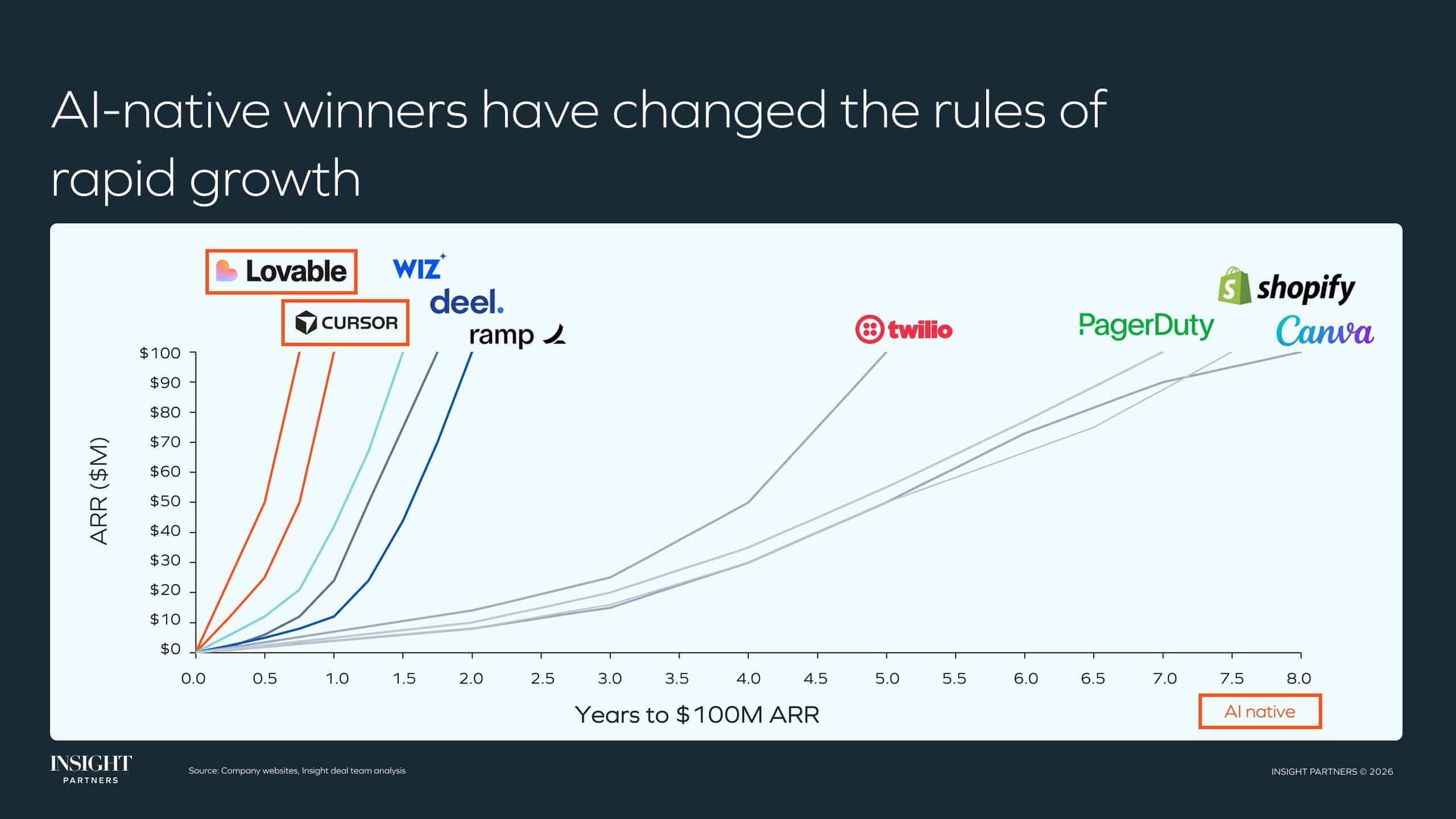
The velocity is staggering. Legora, built entirely on frontier models, went from $4M ARR in 2024 and is purportedly surpassing $250M in 2026 — demonstrating exponential growth that traditional software companies have never experienced at scale. Meanwhile, the public SaaS index is down 37% since Q3 2025, trading at a median 3.5x next-twelve-months revenue. Even ServiceNow, a Rule of 56 company generating billions in free cash flow and growing 20%+ annually with $14B+ ARR, saw its stock drop 30% in a month despite beating earnings and is valued at only 7.0x ARR. The market is saying that in an AI world, even best-in-class traditional growth is insufficient.
The irony of AI velocity is that the SaaS disruptors from the last decade are now themselves at risk of disruption from AI-native startups. Joseph Schumpeter’s theory of creative destruction is materializing as AI innovation revolutionizes economic structures with new products and methods to yield more efficiency and long-term growth. The recent proliferation of new and improved LLM releases, the evolution of autonomous Agents, and the lowering cost of compute make it possible for AI-first companies to build and iterate faster. Even more concerning for incumbents: the LLM labs themselves — Anthropic with Cowork and legal plugins, OpenAI with Frontier — are now entering vertical applications directly, threatening to commoditize entire software categories.
Even though AI-natives operate with 20 to 40% gross margins compared to traditional SaaS margins of 80%+, they can capture wallet share because they deliver fundamentally better outcomes.
We believe AI-first companies will win because they can operate with speed, executing faster across the business. Even though AI-natives operate with 20 to 40% gross margins compared to traditional SaaS margins of 80%+, they can capture wallet share because they deliver fundamentally better outcomes. As Ben Thomson from Stratechery notes: “While businesses may not give up on software, they don’t necessarily want to buy more — if anything, they need to cut their spending so they have more money for their own tokens.”
For three decades, Insight Partners has been at the forefront of technology innovation, investing in next-generation disruptors in internet, mobile, and cloud. These companies, threatened by the speed with which AI-native companies scale, must change. Our guidance for how to grow a software business in the age of AI needs a rewrite.
“While businesses may not give up on software, they don’t necessarily want to buy more — if anything, they need to cut their spending so they have more money for their own tokens.”
Cloud-natives have some inherent advantages: reputation, customer relationships, data, platform positioning, and customer inertia to change. These can be powerful differentiators as enterprise buyers first look to their existing vendors for AI solutions. Trust, user stickiness, and existing ROI may provide some breathing room for cloud-natives to build new AI features that cement value, but they have to hustle to keep that position.
Wharton’s AI Adoption predicts 2026 as the year of proving ROI as organizations move from experimentation to accountable tracking. AI-first companies, with the benefit of a clean slate, can rethink processes entirely rather than simply ‘agentifying’ existing ways of working. When the productivity gains from novel approaches become obvious, we expect enterprises to likely choose best-of-breed over platform convenience, a probability that should keep cloud-native CEOs up at night. Speed of innovation, ease of use, ease of adoption, and the ‘sexiness’ factor of new tools all create a pull toward new entrants.
For cloud-native companies, winning may require a radical rethinking of how the business operates
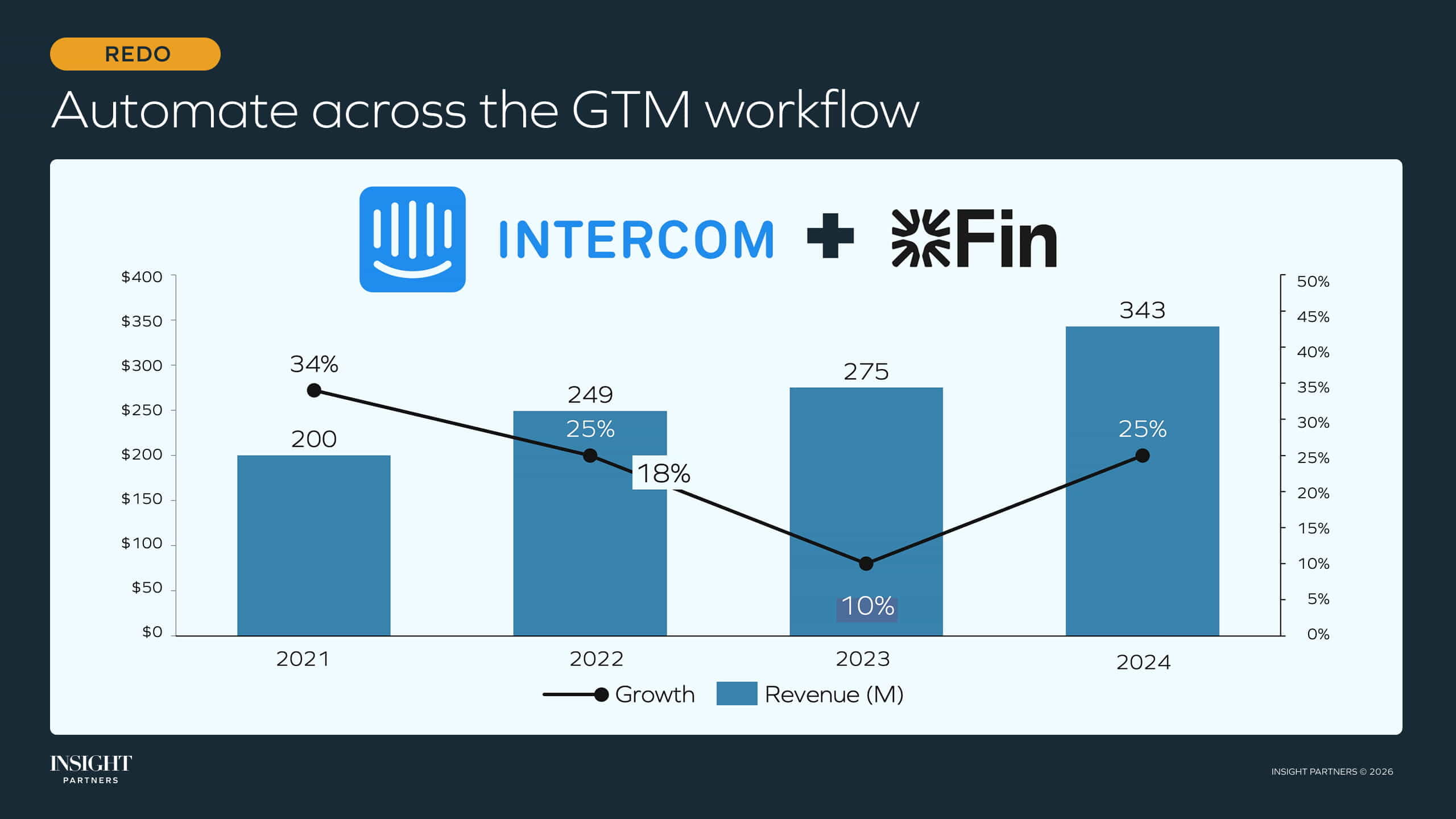
Intercom’s Fin provided early proof that incumbent SaaS companies can pivot to deliver better outcomes with AI products. Post-pandemic, the company went from healthy SaaS metrics to stalling growth. Rather than sprinkling AI into the existing platform, the founders went all-in on the company’s AI Agent called Fin, rebuilding its product for the AI era.
Intercom scrapped its existing roadmaps and reorganized teams, realizing that a ‘wait-and-see’ strategy wouldn’t fly. Although Fin generated some instant demand, customers didn’t fully migrate until Intercom integrated with existing platforms like Zendesk and Service Cloud, also switching to outcome-based pricing per successful resolution rather than per seat. With more than 7,000 customers and over a million resolutions per week, Fin became an early example of AI delivering real outcomes.
Even so, Intercom’s success is not assured as new entrants, like Wonderful* and Sierra, are strong competition, starting where incumbents only arrived after significant effort and investment. In an AI-native world, competitive advantage is measured in weeks, not quarters. What Fin’s initial success demonstrates is not the destination. Radical transformation is the cost of staying relevant.
How do CEOs act with urgency, leading their businesses to make the shift?
The question for cloud-native companies is the same as for Intercom. How do CEOs act with urgency, leading their businesses to make the shift? There’s no delegation. CEO ownership is the difference between growth and disruption. In Insight Partners’ work with portfolio companies, we see CEOs taking three steps, namely:
- Reimagine the future — specifically, make hard strategic choices.
- Renew people and capabilities — build a culture of entrepreneurship and experimentation.
- Redo operations — intentionally change processes and operations.
1. Reimagine the future
Becoming an AI-first company requires defensive and offensive action. But more critically, it should embrace clear-eyed honesty about what’s actually at risk and where you can win.
Understand your true defensibility
The conventional wisdom about moats in software needs updating. Data moats, once considered impenetrable, are, in some cases, proving less durable than expected. We’re witnessing a fundamental reframing from ‘systems of record’ to ‘systems of intelligence’ and ‘systems of action.’ Systems of record store structured data, security permissions, audit trails, and critical workflows that businesses run on. AI is a system of intelligence, and it uses data from the underlying enterprise software to capture transactions and workflows. Leading incumbents are building systems of intelligence, followed by systems of action on top of their existing software and data.
Disruption from AI is nuanced across sectors:
- Protected categories: Deep vertical software with complex business logic and true systems of record (like Salesforce for CRM, Workday for HR, ServiceNow for IT operations) remain relatively defensible. These platforms hold structured transactional data that AI needs to access. These are the core. According to Insight’s CIO Council, which includes 15 global CIOs across industries, AI becomes a better interface, not a better backbone.
- Exposed categories: Horizontal workflow applications that focus more on collaboration and less on systems of record are highly vulnerable. Applications (e.g., Smartsheet*) might not truly be systems of record, creating significant risk. Any software where the primary value is facilitating human workflows, rather than maintaining critical business data, may be more susceptible to displacement by AI-native alternatives with better user experience.
- Gray areas: Some infrastructure and security investments are exposed to entirely new architectural approaches enabled by AI. Companies whose value proposition relies on managing complexity may find that AI eliminates that complexity altogether.
Start with defense and be brutally honest about your weak flank. Assume that AI-native competitors are already mapping how to dismantle your business. Which of your features exist primarily to manage complexity that AI could eliminate? Which customer pain points are tolerated because they were previously unsolvable? Which labor-intensive processes exist only because ‘That’s how it’s always been done’?
Make strategic choices about where to compete
Companies should also shift to offense. The same AI capabilities that threaten your core can be used to strengthen it radically. What is the killer AI application that fundamentally changes the value you deliver to customers? What entirely new capabilities — speed, personalization, automation, intelligence — become possible if you redesign your product as AI from the ground up, rather than layering it on top?
The goal in revising company strategy and vision is to choose where to pivot, what to prioritize, and what to drop. AI should not simply extend your roadmap; it should redefine company strategy to expand total addressable market (TAM) and deepen your moat. That means building capabilities that either collapse customer effort and time-to-value or unlock previously impossible outcomes.
It requires making hard decisions:
- Platform vs. best-of-breed: Are you confident your platform advantage will hold when enterprises encounter AI-native point solutions that deliver 10x better outcomes? In my experience, history suggests that when the delta becomes large enough, customers choose best-of-breed.
- Seat-based vs. outcome-based pricing: Budget wallet share is shifting from seat-based SaaS toward consumption and outcome-based models. IT budgets are realigning because companies need capital for their own AI and token spending. The pricing model that drove SaaS success for 20 years should be revisited.
- Defending vs. attacking adjacencies: With AI enabling infinite software creation, the optimal application of AI coding capability will be to start attacking adjacencies, justifying your existence and presenting opportunities to raise prices. The model makers (Anthropic, OpenAI, Google) will have outsized control as software companies go toe to toe.
- Incremental vs. lighthouse products: There’s no real choice between prioritizing the build of a product that increases TAM and drives new value versus building the chatbot or analytics capability already on the roadmap. CEOs need to find the budget, which is one of the reasons to redo operations, as described here. Use AI to streamline operations, freeing up budget to focus on lighthouse reinvention.
Focus on three strategic imperatives
Based on patterns across the Insight portfolio, companies that stand out are focusing their business strategies on three clear outcomes:
Collapse customer effort and time-to-value in the core
Like Intercom, Optimizely* recognized that AI was an existential challenge. The company reprioritized its work, forming a core AI group with daily standups. It released Optimizely Opal, its Agent orchestration platform for marketers. Opal became the fastest-growing product in the company’s history, delivering measurable results to customers. With Opal, users are running 78% more marketing experiments, launching 24% more personalization campaigns, and increasing win rates by 9%. They’re cutting campaign completion time by 53% and task completion time by 15%. AI collapsed the time and effort for marketers to produce, launch, iterate, and perfect lead generation.
Enhance product capabilities in the core
Electronic medical records (EMR) platform CentralReach* has built multiple AI use cases in tandem, developing both core features and upsell opportunities.
ScheduleAI matches healthcare providers and clients (core) and automatically reschedules cancellations (upsell). This increases provider utilization. ClaimCheckAI flags errors in claims that can lead to denials (core), updates incorrect fields, and finds and attaches documentation (upsell). This has increased payer acceptance of claims by more than a third. Finally, NoteGuardAI checks whether clinical notes meet payer requirements (core) and automatically drafts notes and fills in missing gaps (upsell). This has helped avoid clawback risk.
Together, these new AI features have created a 6.5x whitespace opportunity within the company’s existing customer base — the core delivers better functionality at no cost, the upsell delivers net new services, for which customers are willing to pay.
Deliver net new capabilities in adjacent areas
As companies pivot their strategy, AI can also deliver capabilities that were previously difficult or seemingly impossible to achieve. Hinge Health*, a virtual care platform for people living with musculoskeletal conditions, was heavily reliant on human clinical involvement for monitoring and guidance of patients.
In late 2024, the company launched two AI-powered tools that added new capabilities to its care platform. Movement Analysis uses computer vision technology to guide and monitor users through exercises, adjusting their treatment plans based on what it observes. Robin, an AI health assistant, can recognize pain flare-ups and summarize the situation for the user’s physical therapist. Together, these tools helped the company provide better care for patients while reducing 95% of clinician hours spent on physical therapy. Since implementing AI, Hinge Health has grown revenue by 55% year-over-year from Q2 ‘24 to Q2 ‘25.
Set ambitious AI targets
Reimagining strategy and the company’s ‘right to win’ is the CEO and leadership team’s responsibility. This includes putting a stake in the ground about strategic ambition. At Insight, we’ve coined a 5×5 Framework to drive alignment, specifically discussing how to aim to drive five percentage points of revenue growth and five percentage points of margin improvement through deploying AI.
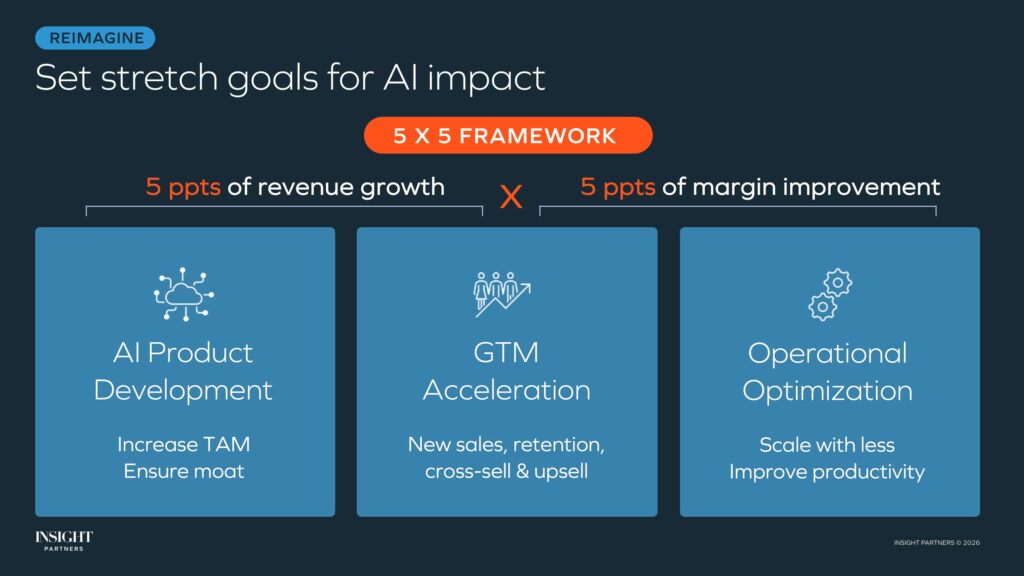
We see that companies that commit to stretch goals begin to build the AI muscles needed to reach their targets. Targets drive transparency and accountability. But those targets must be grounded in reality: You should demonstrate that AI initiatives translate to actual revenue growth and margin improvement rather than narratives alone. The public markets are no longer patient with AI stories that don’t show up in the numbers.
2. Renew people and capabilities
“If we get the right people on the bus, the right people in the right seats, and the wrong people off the bus, then we’ll figure out how to take it someplace great.” Jim Collins’ timeless book, Good to Great, is prescient since a pivot in company strategy to address AI threats and opportunities comes with a parallel pivot in people strategy. Companies need AI-first thinkers who crack open the fissures, yielding a tsunami of change. CEOs should both support these change-agents and give existing teams the skills to surf the resulting waves.
Hire new talent
The bedrock of AI-native companies is a team capable of operating in an AI-first organization. For cloud-native companies, this means hiring and building a talent pipeline to hire ‘AI natives.’
AI talent is scarce and increasingly expensive, so Aptean* chose to build its long-term pipeline. Through ongoing partnerships with Georgia Tech’s College of Computing, the company engages talent early via applied coursework, internships, and real enterprise software challenges. In parallel, Aptean is piloting early high school STEM engagement focused on mentorship and supervised real-world work, helping develop AI-native talent well before traditional recruiting begins.
Since launching in 2025, the program has hired nearly 50 interns and attracted strong demand, with nearly 600 applications through partner outreach alone. To date, Aptean taught over 1,750 people with trainings, bootcamps, and hackathons — with 20% moving onto the next level proficiency targets.
Internally, Aptean launched its “Aptean Academy” to upskill its workforce across beginner, intermediate, and advanced levels. The phased program builds AI literacy, progresses to hands-on application, and culminates in employees designing and deploying AI Agents using the Aptean Intelligence Studio platform. With AI champions, robust hackathon programming, secure experimentation environments, and clear proficiency targets — 50% building simple Agents and 20% building advanced, reusable solutions — the focus has shifted from learning AI to embedding it directly into everyday work and into customer-ready products.
Change your team’s mindset
Alongside new skills, teams need a new mindset that prioritizes AI and agentic workflows. Mindset change should embrace continuous iteration rather than one-off release milestones. Release milestones can be learning experiences rather than waiting for product perfection. AI organizations assume change is constant, a default condition, in which risk is managed, rather than a state to be avoided. In the new way of working, as Brian Stafford, CEO of Diligent*, explains, “CEOs should use LLMs themselves, embrace AI design thinking, and lead by example, encouraging experimentation and iteration.”
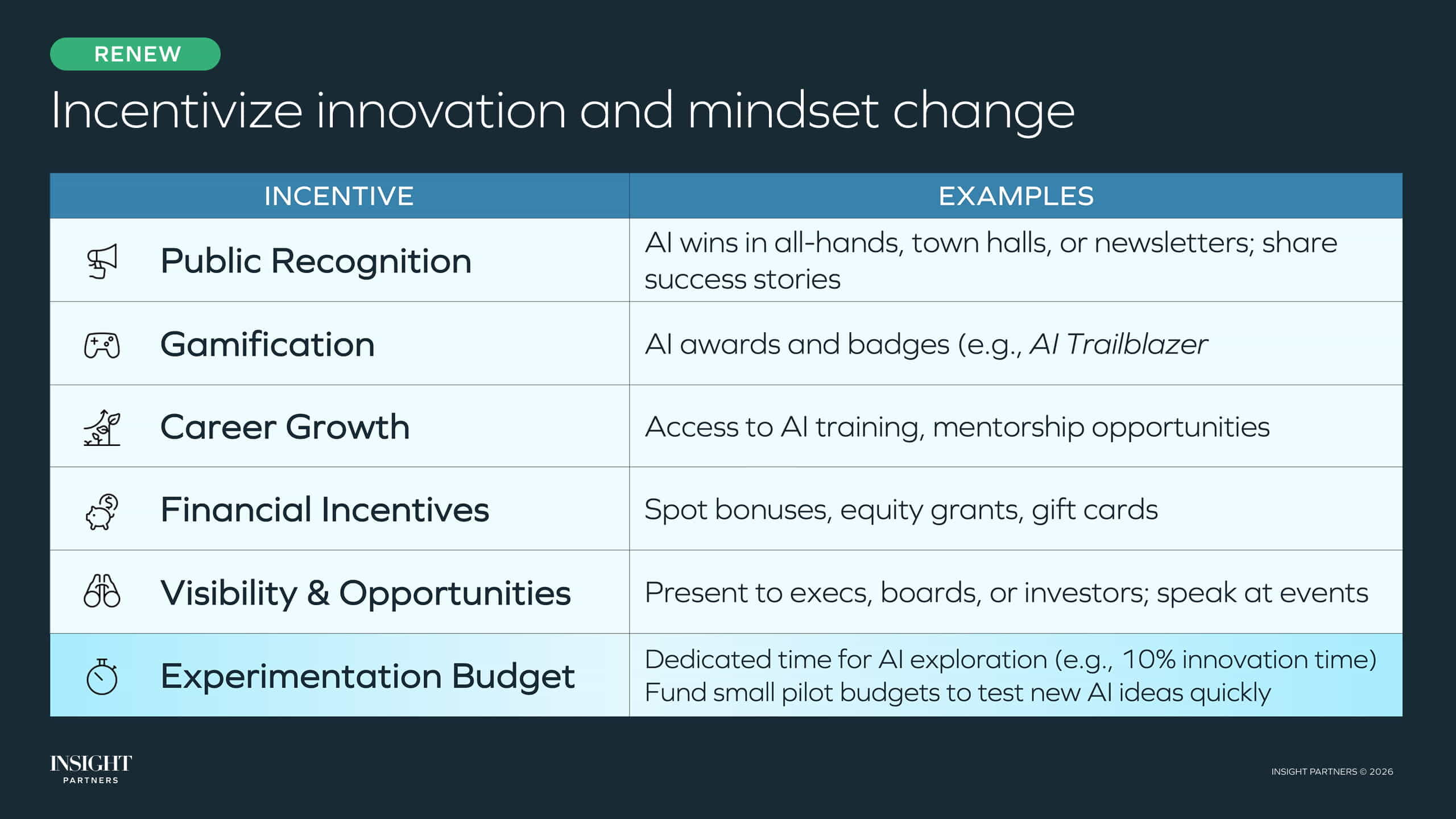
Incentivize entrepreneurial behavior
To encourage mindset change and innovation, leaders can create a scaffolding that rewards AI-first behavior. Ways to do this include public recognition of success during all-hands meetings or CEO updates, highlighting innovative work to the Board, and providing training and mentorship opportunities. Experimentation budgets foster an innovation mindset, allowing teams to carve out dedicated time for AI exploration while funding small pilots to test new ideas.
Communicate clearly
Shifting to an AI-first model requires constant, transparent communication to manage the friction and fear of change. Alongside discussing and role-modelling mindset shift, CEOs need to acknowledge that roles will change, bringing job opportunities and job risks. This may mean the potential loss of some roles, but the shift to an AI-first strategy and mindset is aimed at insulating the business from disruption and ensuring its survival. Many employees are nervous about what AI will mean for their careers and how they fit in current priorities alongside new AI activities. CEOs need to address the need to hire new AI-native talent while also reskilling the existing workforce.
3. Redo operations
At this stage, incremental change is no longer sufficient. AI often does not fully reward partial commitment. Companies that hesitate, pilot endlessly, or delegate transformation too far down the organization may fall behind.
The organization of the future will likely have a flatter structure, with both humans and AI Agents working in tandem. As with any operation, the details matter, and AI improvement derives from a series of small improvements that compound over time.
Redoing operations to drive greater efficiency also frees up budget for redeployment to AI-focused product initiatives. CEOs can lean heavily into new AI products if they can redirect budget from operations.
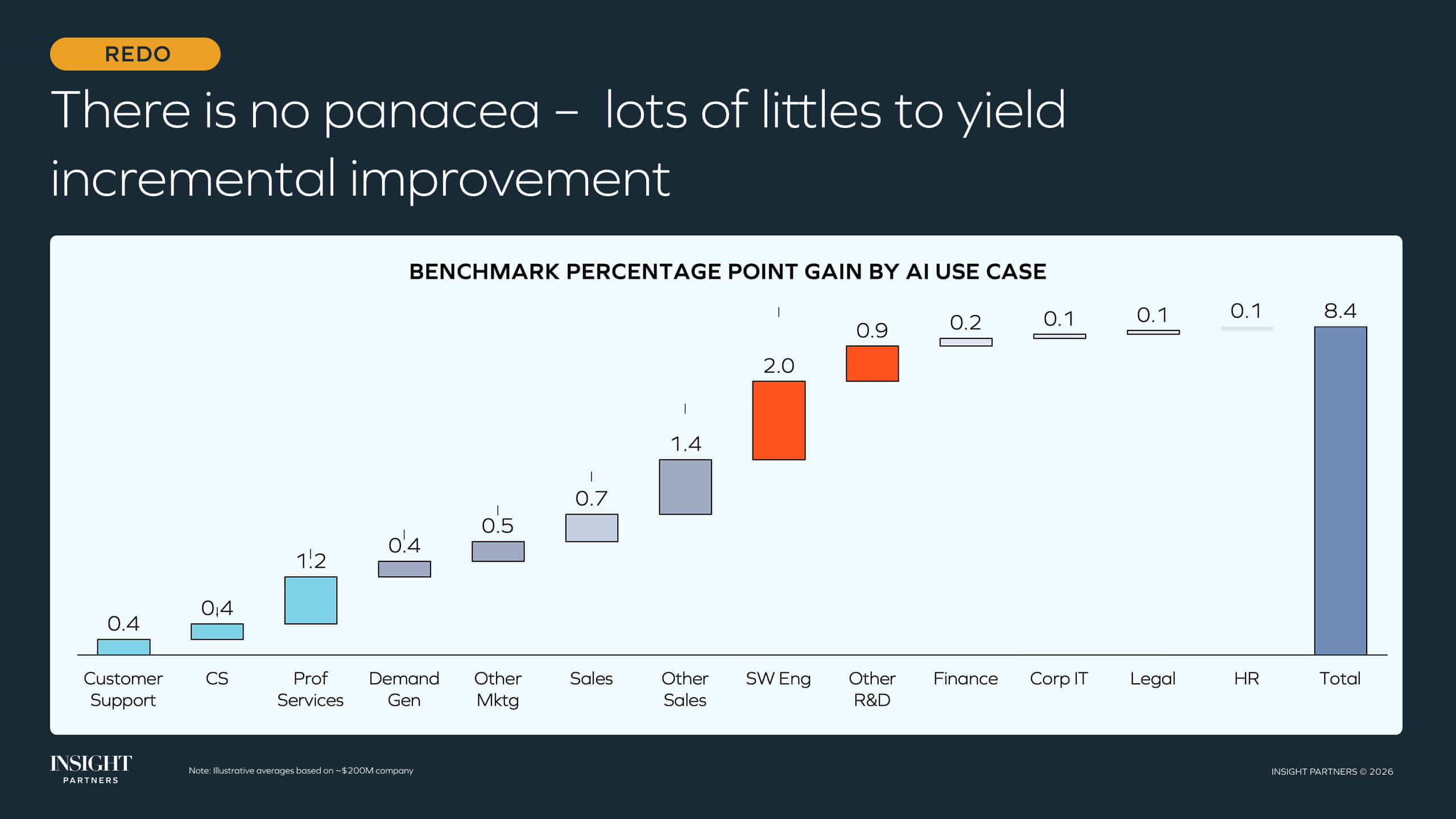
Set up an AI Transformation Office
Setting up an AI Transformation Office (Program Office or AI Center of Excellence) can be instrumental to driving success. The AITO translates company strategy and P&L targets into prioritized initiatives and technical delivery. The AITO is not a governance body. Rather, it’s an execution engine led by the CEO.
While execution is necessarily delegated to the CTO, CIO, and functional leaders, AI transformation cannot be delegated. Both symbolically and practically, the CEO must retain direct oversight of the AI Transformation Office as part of the steering committee. This work cuts across functions, budgets, and long-standing ways of operating, especially in the messy seams between teams where inefficiency hides, and accountability often breaks down. The CEO, with a comprehensive view of company strategy and trade-offs, is often best positioned to break silos, reallocate resources, and guide the organization through the friction that real change requires.
To be an execution catalyst, the AI Transformation Office should operate with a clear mandate to drive outcomes and enforce prioritization, staffed by a cross-functional group that blends technical depth with operational judgment. Rather than relying on ad hoc decision-making, it introduces disciplined intake and triage, encouraging each initiative to be evaluated against speed, feasibility, and measurable upside. Guardrails around risk, privacy, and bias are embedded early, enabling teams to move faster with confidence rather than slowing innovation through late-stage reviews.
Progress is tracked not through activity, but through impact: at the program level, and within individual functions. Early momentum comes from a small number of high-impact pilots that are run as short discovery sprints. In turn, these sprints generate learning quickly and establish repeatable patterns before scaling. Just as importantly, success is socialized. Case studies are shared, teams are trained, and practical clinics help employees apply AI outputs to real work. Adoption happens when people see results, understand how to use the tools, and recognize that leadership is serious about change.
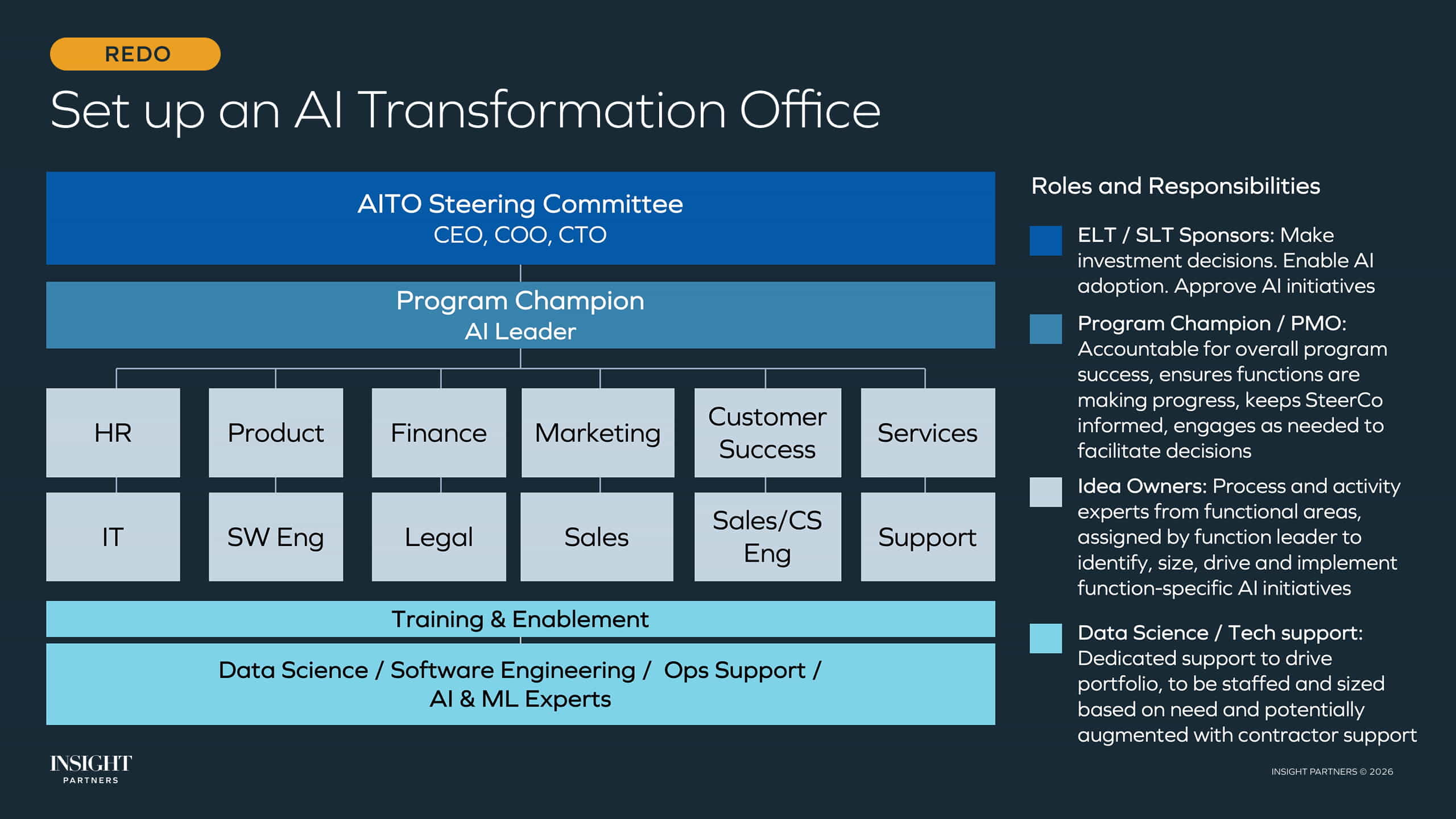
Engineering AI adoption can shift your backlog, ship product faster
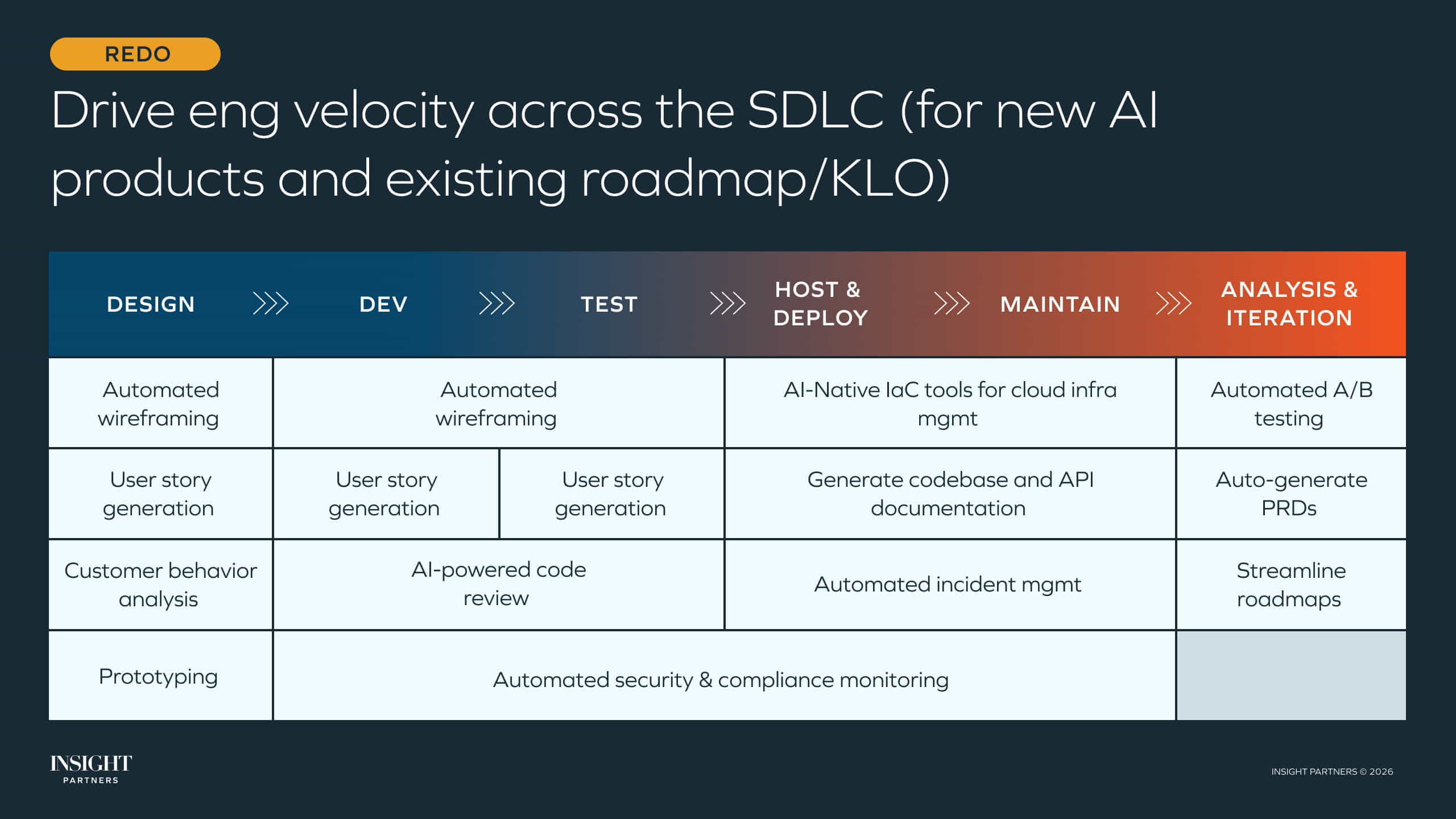
In functional areas, R&D is a large cost line item ripe for AI-driven improvement across the software development lifecycle. Product and engineering teams have been early experimenters with AI, using LLM capabilities to write, debug, and check code. Early data suggests that productivity and quality can improve with increased AI adoption.
One Insight portfolio company with a large legacy codebase applied AI-driven refactoring, testing, and documentation across its core platform. By using LLMs to modernize older services and automate regression testing, the company reduced ‘keep the lights on’ (KLO) engineering work by more than 25%, freeing senior engineers to focus on net-new product development and accelerating release velocity.
AI in GTM turns technology into revenue velocity
AI-first GTM organizations can compress the distance between product capability and customer impact. The goal is a better connection between AI GTM changes and revenue outcomes.
This requires reengineering how companies acquire, retain, and expand customers rather than automating existing motions.
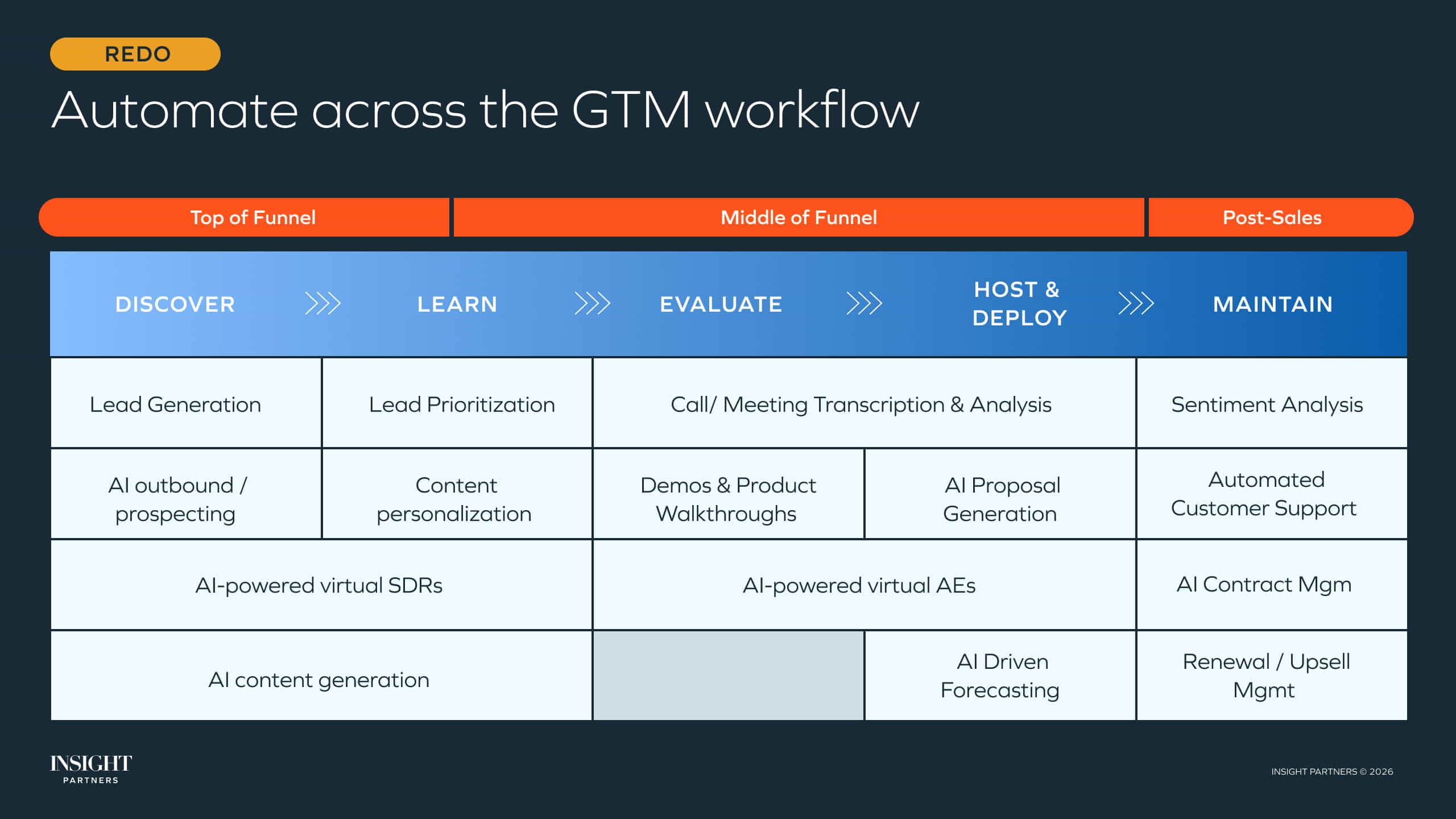
To convert inbound print intent into qualified opportunities, Optimizely turned AI inward. Using Opal internally, the marketing organization deployed more than 80 Agents to accelerate campaign creation, experimentation, and personalization. This shortened the time-to-market for GTM initiatives and increased pipeline efficiency. Similarly, Copado* used its own AI product, CopadoGPT, to help automate its customer success function. Copado’s use of CopadoGPT in customer success is not just cost-saving; it reshaped how teams allocate time — moving human effort away from repetitive support toward expansion, renewals, and value realization.
Decouple growth from headcount
AI can create leverage by allowing output to scale faster than cost. In several cases across Insight’s portfolio, companies are holding operating expenses flat while revenue grows, as AI absorbs incremental workload that would previously have required more headcount. AI is being applied to operational workflows that historically scaled linearly, such as support operations, internal tooling, analytics, and QA.
Automate back-office functions
Finance, HR, legal, and accounting have historically scaled with headcount. AI breaks that equation. Insight portfolio companies are using AI to automate forecasting, contract review, revenue recognition support, hiring workflows, and internal reporting. In practice, this means finance teams closing faster with fewer people and HR teams (such as Brinqa*) onboarding and servicing employees with fewer people. One company has ripped out a simple peer and upward feedback SaaS product and, using prompt-driven development, coded their own replacements. Simple workflow tools that don’t hold critical data are replaced by home-grown agentic workflows.
Competing at the speed of AI
This is a call to action for the continued growth of cloud-native companies. As the public market jitters demonstrate, time is up for cloud-native companies to deliver real AI revenue growth and profitability or face continued market devaluation.
The risks are real, but companies that act decisively are in a great position to navigate this disruption and decipher what comes next. We’re repeating the history of prior seismic shifts. AI is not a technological transition. Rather, it’s a leadership transition: CEOs can pivot to be AI-first, integrating and building products and redoing operations with this ethos in mind. The faster CEOs drive change, the faster cloud-native companies can pivot to compete at the speed of AI.
*Note: Insight Partners has invested in Wonderful, Optimizely, CentralReach, Hinge Health, Aptean, Jellyfish, Diligent, Gelato, Copado, Smartsheet, and Brinqa.
This post contains forward-looking statements and predictions regarding the future of AI. These statements are based on our current expectations and assumptions, and actual results may differ materially from those expressed or implied in these statements. The information provided in this post is for informational purposes only and does not constitute financial, investment, or professional advice. This post should not be considered as a recommendation to buy, sell, or hold any particular investment or security. Investments in AI and related technologies involve inherent risks, and past performance is not indicative of future results.