For the modern operations leader, “AI fatigue” isn’t just a buzzword; it’s a daily reality. A brutal noise-to-signal ratio is currently bombarding operators. On one hand, you see headlines claiming 94% of AI pilots fail; on the other, reports insist AI is already performing 30 to 50% of all manual work. This is why the success rates climb when teams stop chasing tools and start with a framework and intentional approach to AI and operations
The stakes are personal. According to a 2026 Boston Consulting Group survey, 90% of CEOs believe AI Agents will deliver measurable ROI this year. More significantly, 50% of those CEOs believe their very jobs depend on getting the organization’s AI strategy right.
This piece comes from Onsite Hour, a weekly virtual event series for portfolio companies, created by Insight’s 110+ in-house experts. To help leaders navigate this shift without getting lost in the hype, Vice Presidents Jack Rohrer and Jared Brickman have developed a structure designed to move beyond tool-chasing and toward operational execution.
The 3A framework: A roadmap for AI capabilities
Strategic AI implementation requires moving away from “tool cheat sheets” and toward a common operational language. The 3A Framework organizes AI capabilities into three progressive pillars:
- Augment: AI as a human-directed thought partner. You remain in the driver’s seat, using AI to co-think, co-author, or surface insights within your existing workflows — whether that’s an inline copilot, an AI-assisted search, or a conversational model like Claude or ChatGPT.
- Automate: AI begins to run processes in the background with minimal human direction, moving from manual tasks to background execution.
- Anticipate: The far end of the spectrum. Here, AI can use predictive models to decide when and what to activate, often without an explicit human trigger.
“The framework is designed to align your team on a common language and reference point,” says Rohrer. “It allows you to figure out where you are today and, more importantly, where you need to go next.”
From augment to automate
The automate pillar is where operations can gain the most significant scale. However, automation is no longer a binary “on/off” switch. It has evolved into four distinct classes of capability, which represent increasing levels of autonomy and complexity:
- Rules-based: Deterministic, “if-this-then-that” logic. This is classical automation (e.g., Python scripts) used for discrete, repeatable, error-free tasks.
- Hybrid: These workflows maintain a rules-based structure but layer in AI steps to handle unstructured tasks, such as summarizing a company’s service offerings from a website.
- Agents: This is where AI begins to run the workflow. Agents don’t just follow a script; they can decide which tools to use for a specific task and coordinate the work autonomously.
- Multi-Agent: Specialized Agents coordinate with other Agents. For example, a coordinator Agent might assign tasks to a specialized HVAC marketing expert and an email writer to complete a complex, tailored campaign.
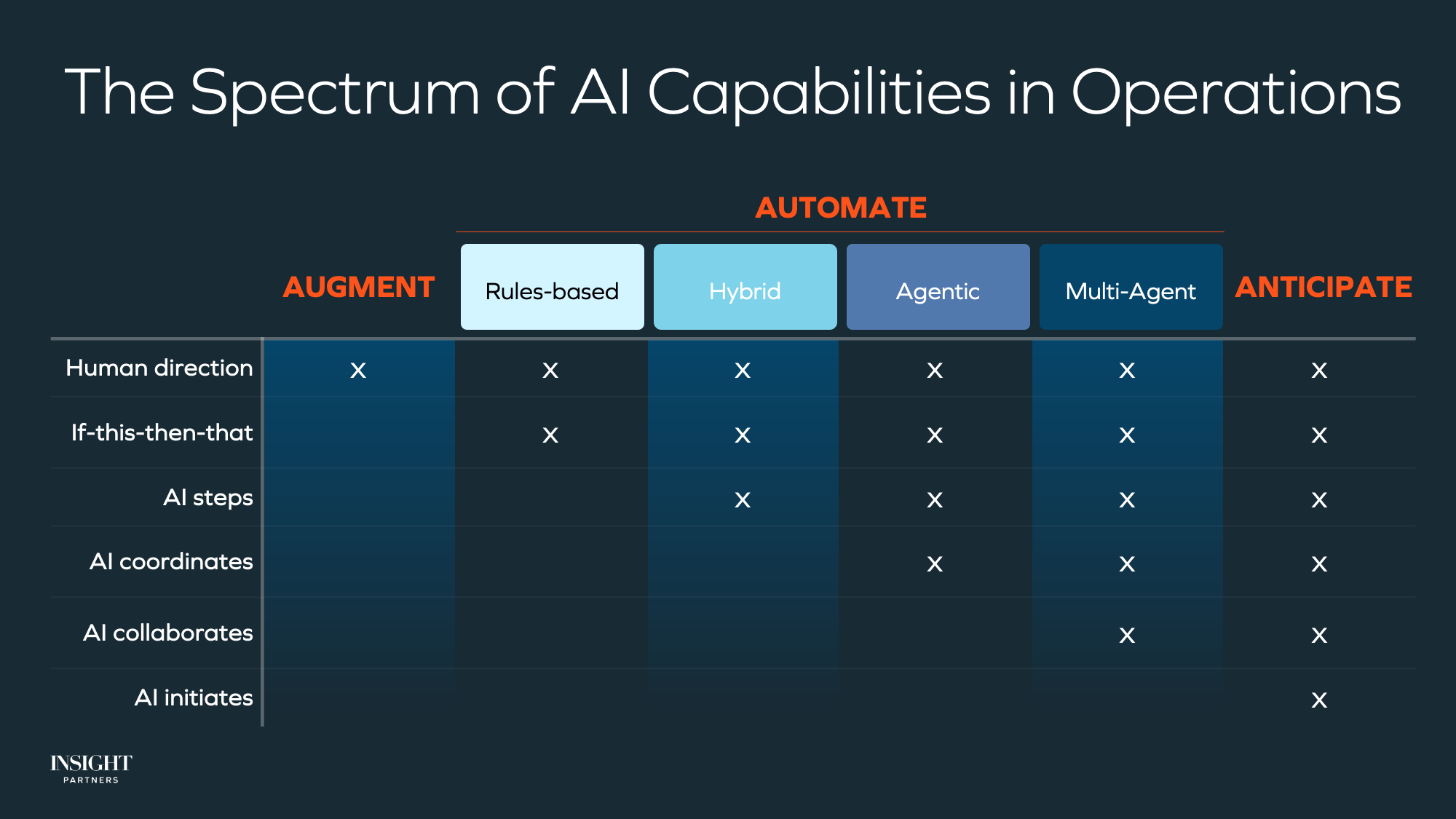
The game-changer in this shift is moving from deterministic reasoning (fixed rules) to probabilistic reasoning (AI inference). While some tasks can be done by following a script, many require judgment, creativity, or synthesis. For example, spinning up a new customer instance in your platform is procedural: provision the environment, configure permissions, and send the welcome email. But figuring out how to retain your customer by de-positioning your competitor requires creative thinking about messaging, packaging, and go-to-market strategy
The anticipate phase
The far end of the spectrum is the anticipate phase. This represents a fundamental strategic shift: moving from reactive systems to autonomous ones.
In this stage, predictive AI identifies intent before a human even enters the loop. For instance, some intent models (like 6sense* or Demandbase) can predict which accounts are “in-market” and automatically trigger the entire 3A workflow.
This tier of the framework also includes autonomous optimization, such as A/B testing Agents that can observe campaign results, identify winners, and automatically update the system’s best practices. During this phase, the system isn’t just following a flow; it’s deciding when the flow should start and how it should evolve.
“The system is constantly optimizing and learning from its performance, thanks to that predictive AI technology. And now you have a truly…autonomous system that is constantly improving on itself, and you’re really anticipating the motion of the work,” explains Brickman.
Why tool categories are blurring
An uncomfortable truth for operators is that the era of the simple decision tree for tools is over. Previously, the rule was simple: If you need outbound, buy Salesloft; if you need data, buy ZoomInfo.
Single tools can now flex across the entire 3A spectrum. A prime example is Claude Code. Within one interface, a user can brainstorm an email (augment), call a Python script (automate), and deploy multiple specialized sub-Agents to build a lead dossier (multi-Agent).
The next level of convergence places agents at the center of systems. They connect directly to your CRM (for example, Salesforce) or communication layers (for example, Slack), pushing enriched data and even hitting “send” on emails without the operator ever leaving the terminal. This shifts the operator’s job from procurement to choosing tools that “flex” to meet the organization’s level of adoption.
“Our ultimate signal for operators is the concept of ‘Minimum Viable Complexity,'” notes Rohrer. “Instead of starting with complex layers like RAG or MCP, put the problem into a powerful model’s context window first. Only add technical layers when the use case demands it.”
Strategy over tooling
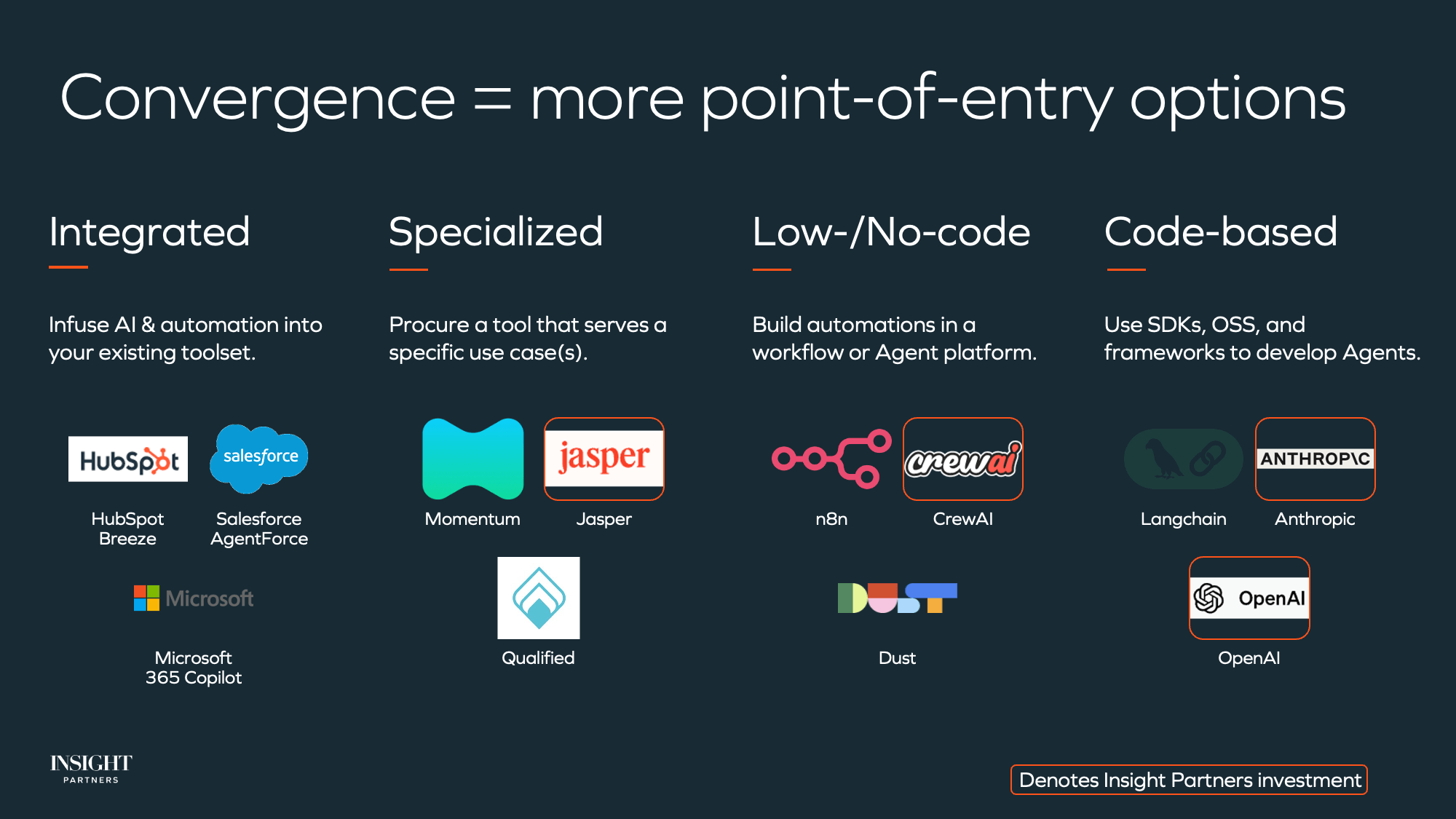
When determining where to enter the AI landscape, leaders should consider categorizing tools by their integration level rather than their specific feature list:
- Integrated: AI features added to your existing stack (HubSpot Breeze, Salesforce Agentforce).
- Specialized: Point solutions for high-friction use cases (Clay for enrichment, Jasper* for copy).
- Low-/no-code: Horizontal platforms for building custom agents without dev resources (Relevance AI*).
- Code-based: Using software development kits (SDKs) and open-source software for deep, proprietary customization.
Case studies in operational AI
AI implementation should be governed by business constraints, not just technical capability.
The recovery play
A low-growth company with messy data and zero dev resources avoided a massive IT overhaul by choosing a specialized path. By using Clay and Jasper to fix “leaks in the bucket,” they modeled $5M in back-to-the-business value without writing a single line of code.
The partner support win
Facing 12-hour response times, a company deployed a specialized genAI chatbot. They chose this path because their partners were impatient and required high-quality, non-deterministic answers. The result was an 80% reduction in response times and a significant lift in partner satisfaction.
The multi-Agent inbound cycle
A business unit manager with no official budget used a corporate credit card to experiment with a low-code, multi-Agent architecture. By autonomizing the entire inbound cycle — from objection handling to booking meetings — they tripled booked meetings at half the cost per meeting.
Your next best action
The 3A Framework proves that you don’t necessarily need to start with the most advanced multi-Agent architecture to see results. You must start where your constraints — budget, risk appetite, and technical resources — align with your needs.
As you plan your roadmap, consider asking yourself: Is your current tool choice shaping your operational possibilities, or is it limiting them? Establishing a common language around augmentation, automation, and anticipation positions your team to build for scale rather than just adding to the noise.
*Note: Insight Partners has invested in 6sense, Jasper, CrewAI, Relevance AI, Anthropic, and OpenAI. For a complete list of Insight’s portfolio companies, please visit https://www.insightpartners.com/portfolio/