Five major trends reshaping AI, software, and leadership: Our investor predictions for 2026
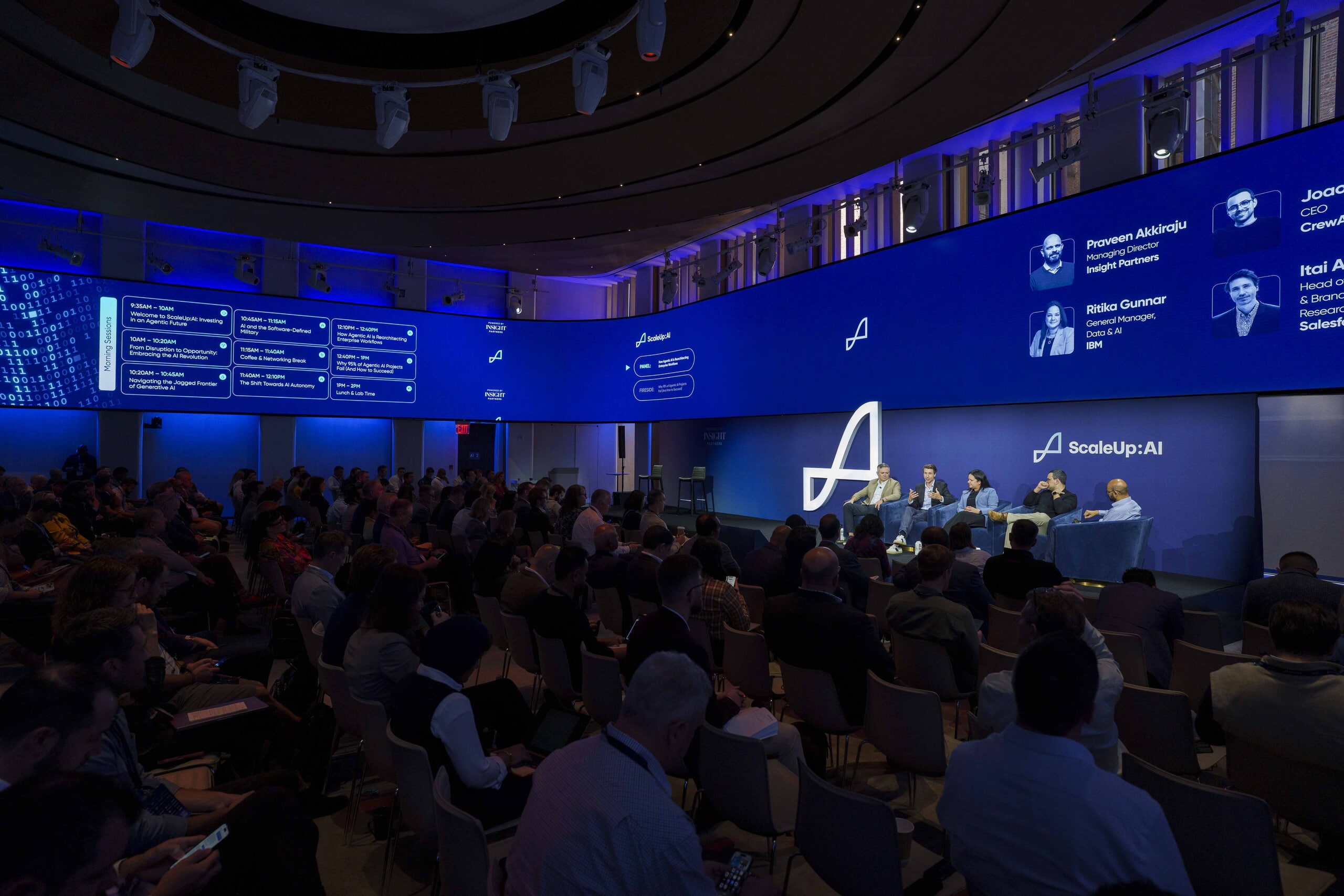
It’s been another busy year out in the world and here at Insight — we began 2025 by announcing our $12.5B Fund XIII and celebrating 30 years of investing in software. We talked IPOs with the NYSE, highlighted our sourcing strategy with Fortune, and our founder, Jeff Horing, sat down for a rare interview on Invest Like the Best to discuss the strategy and history of the firm.
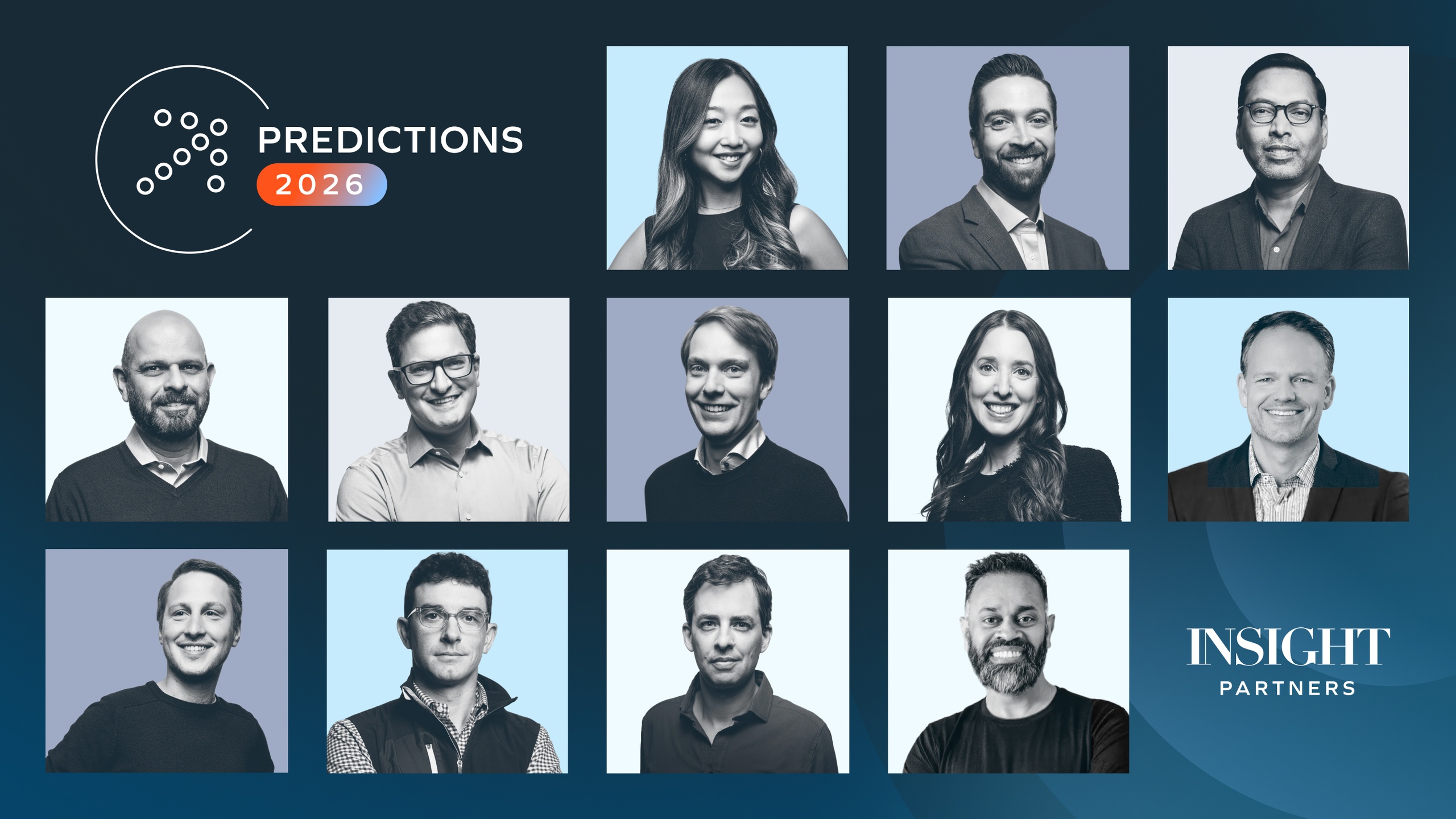
This year, we’ve condensed over seven hours of reflection, animated discussion, and debate with some of Insight’s investors into five major trends, with some specific predictions called out within.
You can revisit our previous predictions from 2023, 2024, and 2025 at the links. Cheers to 2026.
AI progress is accelerating
Despite speculation about a plateau, model capabilities are improving at an accelerating rate. Advances in reasoning, continuous-learning architectures, and agentic systems are enabling complex, long-form tasks that would have seemed like science fiction less than two years ago. The industry is approaching “million-Agent problems” and systems that can complete a full day’s work autonomously.
The “Wall” is a mirage
Despite growing speculation that genAI is hitting a “wall” due to data or compute limits, Managing Director Lonne Jaffe sees little empirical evidence of a slowdown. Legitimate researchers do see evidence of diminishing returns in certain benchmarks, but the overall rate of improvement in capability seems eye-wateringly fast, and the “plateau” narrative, he argues, is mostly psychological.
“People are emotionally attracted to the idea that models will suddenly stop getting better. If the labs go a few weeks without a big release, you immediately see, ‘Oh, maybe we’ve hit the wall.’ But so far, empirically, that just doesn’t seem to be happening, and I wouldn’t suggest making a high conviction bet that the pace of improvement will halt next week.”
Progress is now driven by more than just bigger pre-training runs; new techniques are opening fresh frontiers of improvement, and model releases like Gemini 3 are signs that there is still meaningful headroom remaining in pre-training.
Jaffe, again: “We have whole new frontiers of improvement: reinforcement learning post-training, better data curation, multimodality, improved algorithms — plus lots of data centers and chips coming online now that people started building a while ago.”
Proliferation of autonomous and agentic systems
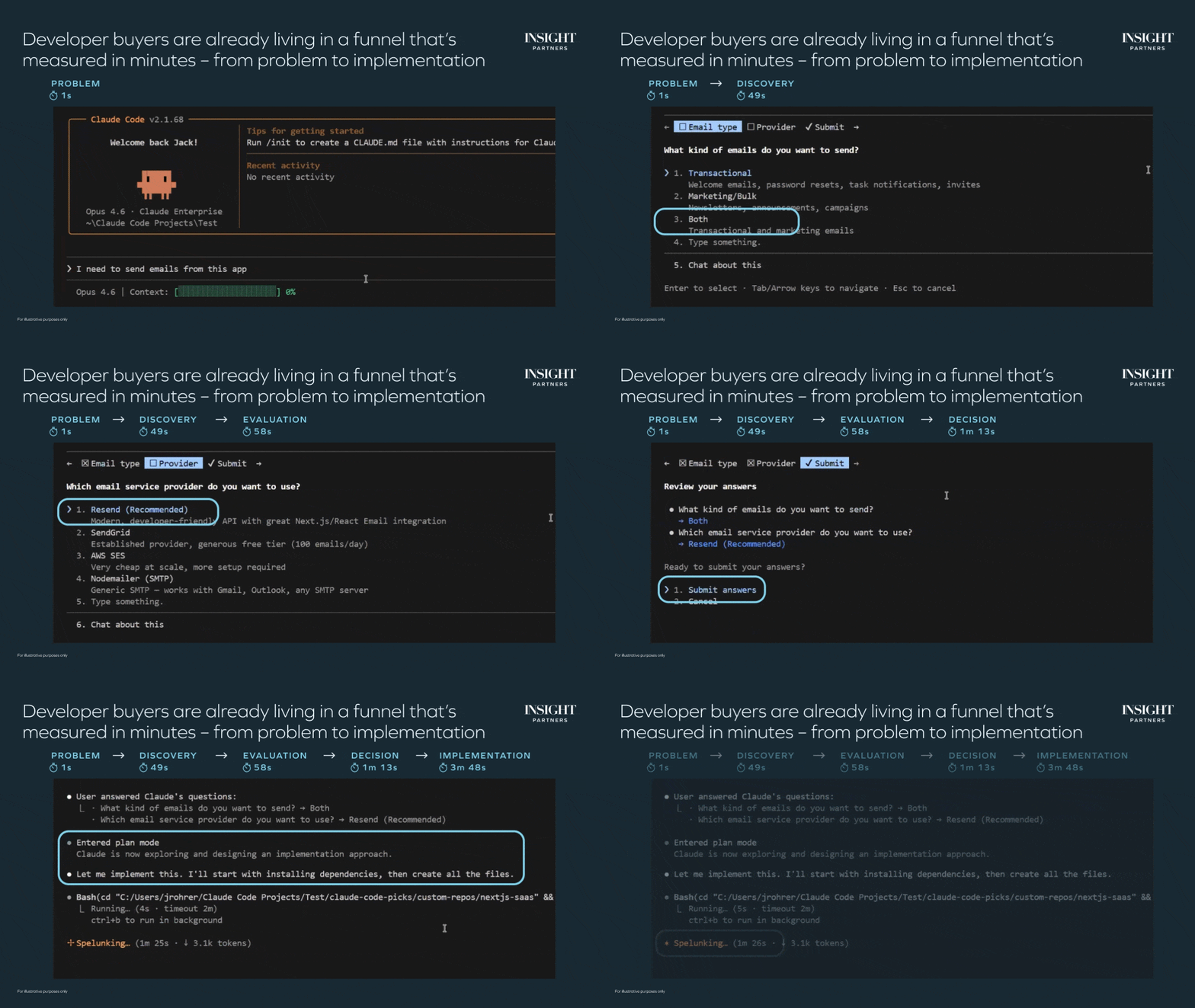
Managing Director George Mathew describes this phase as the convergence of massive intelligence with rapidly improving reasoning: “We’re seeing two vectors of growth in the next wave of AI systems. One is intelligence — models with trillions of parameters, like GPT-5. The other is reasoning. The beauty of where we are with Agents is that longer, more complex, discrete tasks can now be handled end-to-end. Historically, an Agent might work on a task for five minutes; now it can build an entire website.”
This is not just better tooling — it’s the emergence of digital coworkers.
Mathew continues: “You can now build digital autonomous workers that handle large portions of front-office work — outbound and inbound sales, business development — tasks that are repetitive, laborious, and perfect for Agents…We’re heading toward models and Agents that can complete a full day’s worth of work with minimal or no human intervention, and we may already be there in some domains.”
Even seemingly modest improvements can flip AI from “nice demo” to “mandatory” or even, “outsourced.”
Jaffe: “Even what seems like a relatively minor capability improvement can have a major threshold effect. Once you pass human-level performance plus a buffer — we often hold AI to a higher standard than humans — on a task, you can go from, ‘You’d never use this in the real world’ to ‘This is useful’ to ‘It’s so good it doesn’t make sense to have humans do that task anymore’ very quickly, like with elevator computers.”
Coordinating tens of thousands — and soon millions — of Agents will be a defining milestone of 2026 and beyond.
Mathew: “We’re learning how to break large task sets into tens of thousands, even hundreds of thousands of Agents. I predict the first ‘million-Agent problem’ will be introduced and solved in the next 12 to 18 months.”
A key architectural shift will be moving from static models that require constant retraining to systems that retain memory and context more naturally.
Mathew: “Today, we lean on retraining and retrieval-augmented generation to keep context. I think that starts to melt away as model architectures evolve toward continuous learning and better native memory.”
Managing Director Ganesh Bell: “A new computing fabric will emerge to manage more Agents at work than humans. The question isn’t if, but who builds it.”
Run-time is quickly becoming a core metric of progress.
Jaffe: “This coming year, you may see genAI-powered Agent systems that can operate over much longer time horizons in some domains. People are already starting to track, ‘How long can a useful Agent run without intervention?’ as a critical eval. When we go from a half-hour deep research project or coding project to a two-day project — where Agents keep working overnight and deliver genuinely novel work in the morning — that’s yet another meaningful threshold effect.”
Managing Director Teddie Wardi offers a grounding perspective:
“What isn’t being talked about enough is the data layer. There’s a real data-layer bottleneck in enterprise AI deployments. If enterprises actually do what they say they’re planning — like deploying thousands of Agents into production — there’s a huge amount of data-layer work that needs to happen first.”
Investors are also closely watching the rise of robotics and models that understand and simulate physical and 3D environments.
Jaffe: “Robotics is very hard, but we’re starting to see some real threshold effects in embodied AI areas, like self-driving vehicles and robots, as capital and talent pour into the space. The first cars outperform mediocre human drivers; it takes longer for them to outperform really good drivers. AI-powered robot arms and grippers are already getting to the point where they can fold a shirt better than many software investors can.”
Bell adds context: “World models are to physical AI what foundation models were to digital Agents — physical AI and digital Agents will converge faster than people expect.”
Mathew agrees: “World-building models that represent physical reality — images, video, 3D scenes — are one of the big multimodal opportunities coming.”
AI will collapse old software moats while redistributing value across the stack
AI is driving a fundamental re-evaluation of the software industry. It won’t kill SaaS, but it will erode traditional moats like switching costs. Durable advantages shift to customer intelligence, deep domain expertise, and reputational moats built on customer delight. At the same time, frontier model labs are pushing aggressively into the application layer, challenging both startups and incumbents and reshaping where value accrues.
Managing Director Ryan Hinkle: “What happens to SaaS because of AI is not all or nothing. It won’t be universally awesome or universally awful. AI is net positive for SaaS as a market. The question is: Which companies lose to the kids in a garage rebuilding their product AI-first, and which ones unlock new revenue streams with AI?”
Hinkle uses a “systems of record” vs. “system of action” comparison to explain where AI can exponentially enhance value in typical SaaS: “The key question is: What is a system of record? If it’s just a filing cabinet — a digitized storage system — that’s a problem. If it’s a true system of action or work, where knowledge workers can’t do their jobs without it, that’s very different… We expect SaaS applications that are systems of work or systems of action will be huge beneficiaries of AI. The ones that are just filing cabinets are threatened.”
The agentic SaaS paradigm will be the new standard
Managing Director Praveen Akkiraju: “The new archetype will be agentic SaaS — SaaS as we know it, but under the covers, agentic workflows injecting dynamism and intelligence into software that used to be static. The core of the software — the business logic — stays the same. But the application now has more context, can execute tasks autonomously, and the user experience becomes much more dynamic.”
He points to Insight portfolio company, Stampli, as a concrete example:
“Stampli does mid-market accounts payable — a fairly standard workflow — but they transformed the product by injecting AI at multiple layers of the architecture. They can ingest data faster, helping users 5x more productive by completing transactions faster and driving time to value by facilitating faster credit assessments.”
The great value accrual debate
Managing Director John Wolff: “Over the last three years, most of the early economic upside has accrued to the hardware layer. Over time, we believe more value will migrate up to the application layer. Software will turn AI into real business outcomes, but we’re still early in that shift.”

Wolff continues: “Many of the companies performing best are moving beyond point solutions into full platforms and infrastructure, which is why we’re incredibly bullish on Databricks. It sits in the software infrastructure layer that powers this disruption, not just at the application edge.”
Labs like OpenAI, Anthropic, and Google are no longer content to be just model providers.
Jaffe: “A lot of people thought that the frontier labs would just cook models in the oven and then take them out of the oven and hand them to the world to build middleware and on top of… but that’s not how the labs are thinking about it exactly. Their mindset is more, ‘We’re happy to build the middleware and applications ourselves, especially if we’ll do a lot better job at it.’”
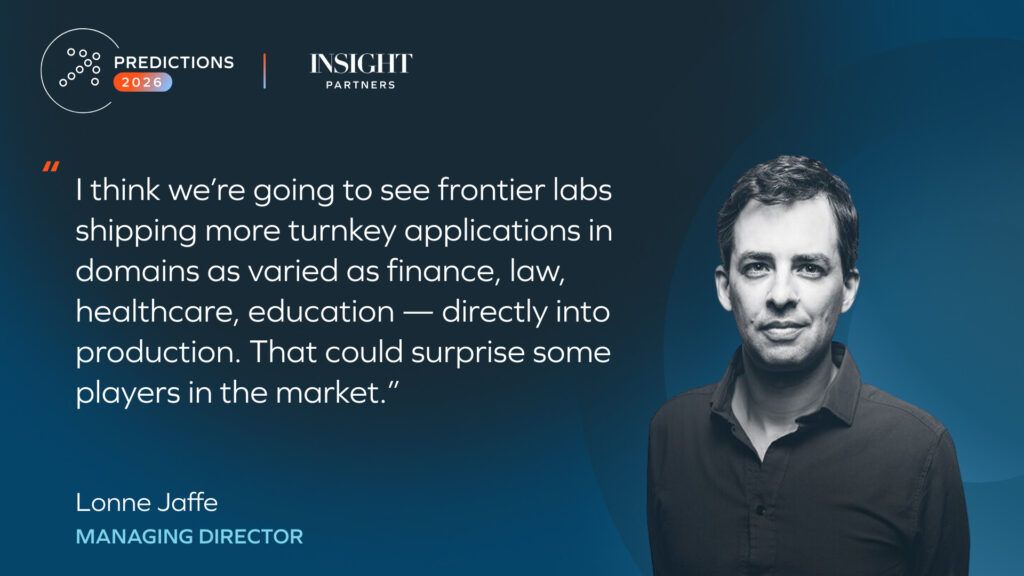
Jaffe continues: “I think we’re going to see frontier labs shipping more turnkey applications in domains as varied as finance, law, healthcare, education — directly into production. That could surprise some players in the market.”
The decline of switching costs
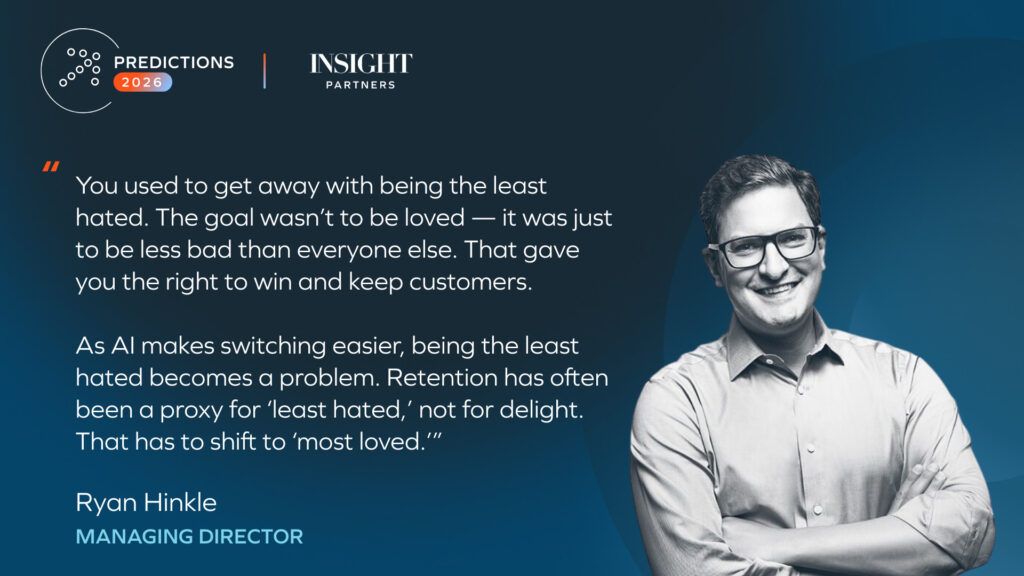
Hinkle: “You used to get away with being the least hated. The goal wasn’t to be loved — it was just to be less bad than everyone else. That gave you the right to win and keep customers. As AI makes switching easier, being the least hated becomes a problem. Retention has often been a proxy for ‘least hated,’ not for delight. That has to shift to ‘most loved.’”
Managing Director Rebecca Liu-Doyle doubles down on the importance of the customer as switching costs erode.
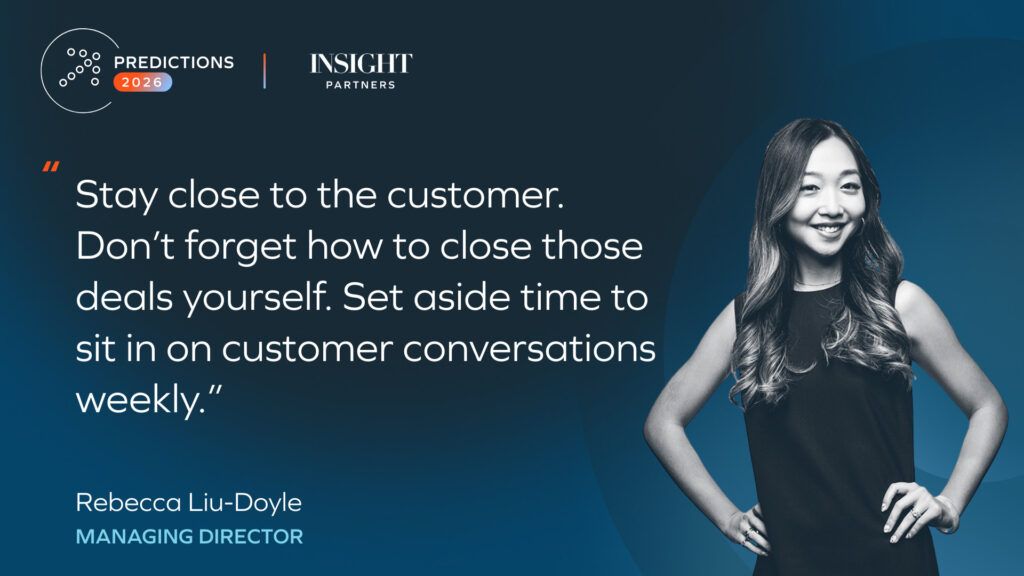
“If there’s one real moat, it’s customer intelligence — knowing what people are actually doing and what’s actually working, and deepening your hooks into customers based on that…. [and for founders] I don’t think there’s such a thing as spending too much time with the customer.”
The AI boom will be defined by real demand — and 2026 will separate durable companies from the rest
The market is in a “both things can be true” moment — simultaneously overhyped and more valuable than most people appreciate. Unlike the dot-com bubble, today’s AI buildout is marked by fully utilized capacity and more closely resembles the cloud era. But massive capital inflows and interconnected risk create fragility. Strategic M&A is accelerating, and 2026 renewals will test which AI startups and scaleups have real staying power.
Wolff: “In the dot-com era, we built massive amounts of infrastructure that never got used. Today, it’s almost the opposite. The dominant bottleneck is power. Every GPU, TPU, and custom accelerator (XPU) that gets lit up with power is immediately put to work.”

Bell: “GPUs are not sitting idle. You can debate infrastructure build out, but this isn’t just ‘faster cloud’ — it’s a fundamentally new compute model. Missing that distinction means missing the entire shift.”
Hinkle agrees: “In the early 2000s, we had capacity in search of a revenue stream. All that capacity is now overutilized. This time, the demand is clearly there.”
Wolff, again: “The AI wave looks like the early cloud era on fast-forward. Demand keeps rising. Everyone wants AI. The limiting factor isn’t interest, it’s compute.”
Incumbents increasingly see buying AI-native products — and teams — as the fastest way to stay relevant.
Managing Director Matt Gatto: “This year, in our portfolio alone, we’ve seen Google buy Wiz, Siemens buy Dotmatics, NiCE buy Cognigy, SAP buy SmartRecruiters, Roper buy CentralReach.… that wave of strategic acquisitions seems likely to persist. Market leaders are trading well enough, sitting on a lot of balance sheet cash, and they know there’s a platform shift. They use M&A to keep up when internal innovation is harder at scale.”
The realities of renewal periods and the pace of competition may present real challenges for AI companies trying to scale in 2026 and beyond.
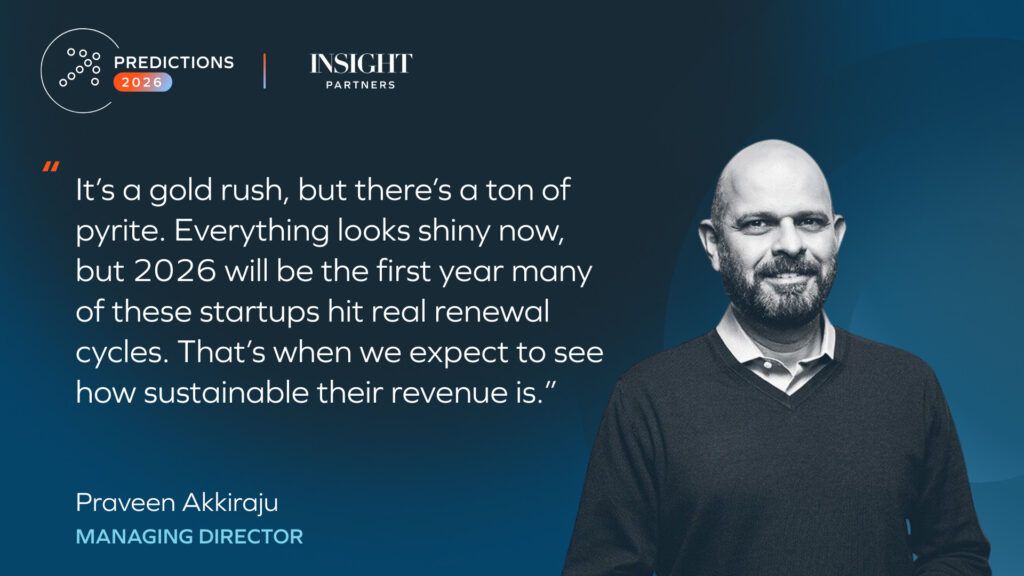
Akkiraju: “It’s a gold rush, but there’s a ton of pyrite. Everything looks shiny now, but 2026 will be the first year many of these startups hit real renewal cycles. That’s when we expect to see how sustainable their revenue is.”
Akkiraju continues: “You’ll see companies that went from zero to six or eight million in ARR in a year. Then you ask, ‘What’s your growth next year?’ If that drops to something like 30%, those companies can become unfundable very quickly.”
Jaffe: “We’ve seen a very short half-life for some kinds of genAI-native startups since early 2023. The pressure is relentless, the ground you’re building on is like quicksand since the model labs are shipping so many capabilities that dramatically change the landscape every few months.”
AI demands a new leadership paradigm to survive and scale
The traditional software scaling playbook is quickly becoming obsolete. The AI era demands a new leadership archetype: highly adaptable, technical builders who iterate rapidly, stay uncomfortably close to customers, and are willing to rethink what “scalable” means. Winners will re-architect internal operations to leverage AI for speed, data-driven decision-making, and continuous reinvention.
Leaders must treat reinvention as routine, not exceptional.
Managing Director Rachel Geller: “One Insight portfolio company dedicated an entire quarter to AI and asked every single person, ‘How are you changing the way you work?’ That was their job — to actively evolve their workflow. That’s the level of top-down transformation required right now.”
Scaling in the AI era looks different
Bell: “Leadership, not category, may determine if pre-genAI companies can transition. Past mental models block progress. Next-gen companies scale with compute and Agents, not just humans.”
Jaffe: “For years, scaling meant pouring fuel on what worked so you could grow efficiently. Things are different in a period of much more rapid change. You may need to reshape your product every year for the next several years — building product strategies and organizations that are highly adaptable becomes key.”
Akkiraju agrees: “It feels like the old patterns have been broken. The rules for how to build successful companies are being rewritten in real time.”
Liu-Doyle offers a different twist on scaling in the AI era: “AI is challenging long-held beliefs about what’s unscalable. Founders should ask whether something is truly unscalable, or whether AI makes it scalable enough to keep them moving faster and closer to customers. The CEOs of tomorrow won’t think like the CEOs of yesterday.”
Vertical and niche AI will create outsized value — especially in “unsexy” categories
While horizontal AI categories like legal and marketing are becoming crowded, significant opportunity lies in vertical-specific applications. AI is making some previously “un-venture-backable” niche markets viable by enabling software to capture value from services and workflow automation, dramatically expanding the total addressable market. From food production to real estate permitting, these “boring” but mission-critical applications are poised to create immense value.
Does “boring” mark the best indicator of new unicorns?
Gatto: “The next wave of unicorns will be boring. Workflow software, infrastructure tools, compliance, automation — categories that don’t sound exciting but are absolutely mission-critical and capable of creating outsized outcomes.”
He points to concrete examples:
“Think about something like [Insight portfolio company] Flovision‘s solutions to measure, optimize, and control food production — on its face, it doesn’t sound thrilling. But it’s applying AI and computer vision to a real, high-value problem for enough customers that it can be a very meaningful business.”
“[Insight portfolio company] Litmus is another good example. It’s horizontal in the sense that it can support multiple industries, but it’s also deeply tied to manufacturing. It takes line-level production data, normalizes it, and makes it usable so plants can actually drive insights and improvement.”

Geller puts it this way: “AI doesn’t just add features — it makes entirely new products possible. It lets you reimagine the user experience and serve customer needs in what could turn out to be sneaky-big markets.”
Several investors highlight that compelling and durable opportunities are emerging in vertical-specific and niche applications.
Wardi explains how AI is changing the math on small verticals:
“Historically, a lot of small vertical subcategories just weren’t venture-backable. AI is changing that. You’re no longer limited to the existing software budget in a niche — you can now tap into the actual labor and external services spend.
Wardi continues: “A market that might have looked like a $200 million opportunity before could now be multiples of that, because you’re not just selling software — you’re automating work that used to be done by people or outsourced providers.”

He uses Insight portfolio company Apricot as a live example:
“Take a company like Apricot in home health documentation. On the surface, it looks like a tiny category. But with AI, you’re not just a system of record. You’re saving nurses hours a day and reducing back-office data entry services. Those services dollars shift into software — and suddenly this little subcategory becomes venture-backable.”
The power of last-mile domain expertise
The success of vertical AI applications typically hinges on deep domain expertise. This becomes a defensible moat against horizontal platforms and generic copilots.
Bell emphasizes the importance of last-mile understanding: “The companies that really win at eliciting user intent sit very close to the experience. Just because you’ve figured out clever copywriting doesn’t mean you understand the last mile.”
Bell continues: “If you’re building for designers, you have to speak designer. The same is true for lawyers, developers, doctors. Knowing your audience — their language, their workflows, their constraints — is everything at that layer.”
Gatto points to Insight portfolio company Filevine as a vertical archetype:
“Filevine is a great example. They had a strong software business pre-AI. With AI, they’ve created a huge amount of new value — efficiency and productivity gains for lawyers — and effectively reimagined the business.”
Gatto continues: “That’s one archetype investors look for — a solid vertical business with real customers that can be transformed and expanded with AI, not replaced.”
Sector spotlight: Healthcare
Managing Director Scott Barclay is emphatic about both the problem and the opportunity: “In the past, injecting software into health often led to incremental change and advantaged slow market leaders. Now, AI software is so good — including clinically — that founders can think more ambitiously, and we will see radically better experiences for patients. Buckle up.”
He uses a Webvan-to-Instacart analogy for digital health:
“There will be new unicorns where you say, ‘Wait, wasn’t this tried before?’ And you’ll be right. These were digital health ideas from 2010 to 2020 that didn’t work then — but with generative AI and better tools, they’ll work now.”
On personal health records and longitudinal data:
“We expect to see entirely new businesses that aggregate institutional records and continuous biomarkers for patients. The engines are now good enough that it will feel like having a doctor in your back pocket — a PHR that actually walks with you through your life.”
On multi-chronic care:
“We’ve seen hundreds of companies say they’ll walk with patients who have multiple chronic conditions. Someone will finally build that, but with 2026 generative AI embedded so deeply that it becomes a truly scalable company.”
On next-gen primary care:
“You’re going to see a whole new version of primary care — primary care plus concierge plus health coaching — online and offline, with a super-intelligent doctor in your back pocket optimizing your next question, next best action, and next best place to go.”
Sector spotlight: Cybersecurity
The proliferation of agentic systems is also reshaping another “unsexy” but essential category: security.
Managing Director Thomas Krane argues we’ve rushed ahead without securing what we’ve built: “Over the last 18 months, we’ve seen a huge pull-forward in adoption of generative AI and agentic systems in business operations, with very little focus on the security implications. We’re in the ‘oh crap’ realization moment.”
“Most Agents today authenticate with static secrets. Those credentials can be reused indefinitely — if you hijack an Agent, you effectively own the organization.”
Krane believes the problem will converge on dynamic identity and credentialing.
“This problem space is going to coalesce around dynamic identity and credentialing for Agents and agentic systems.”
On certificates as the new rails:
“Certificates are going to be the rails that power this. [Insight portfolio company] Keyfactor is rooted in dynamic PKI and certificate lifecycle management — that’s an example of the kind of infrastructure we’ll need.”
And on visibility and privilege:
“SpecterOps can provide Tier Zero visibility into entities with identity-based connectivity — machines and humans. They can define dynamic privilege zones and put real roadblocks in front of the most critical assets.”
Krane also predicts we’ll see a coming shakeout in AI security point solutions.
“There are dozens of AI-powered security operations automation platforms and dozens of AI-driven pen-testing platforms. All of them are tiny, subscale, unproven, and funded way ahead of traction. I predict there is going to be a reckoning.”
But it’s not necessarily newcomers where the value will accrue.
“We expect many [startups] will get taken out for their IP and know-how, while the large platform incumbents will maintain a significant advantage in deploying these systems at scale… Take the recent wave of pure-play ‘security-for-AI’ startups as an example. They might be better off joining forces with an incumbent Extended Detection and Response (XDR) or Security Service Edge (SSE) platform that already has an endpoint Agent or network proxy in place.”
Final words: Advice for founders and builders in 2026
Lonne Jaffe
“Anticipate an eye-wateringly fast pace of improvement in the underlying technologies, and build strategies and organizations that are durable to rapid change and eroding moats.”
George Mathew
“Iterate and build fast. Everything’s changing. Boyd’s Law matters here.”
Praveen Akkiraju
“Founders need to consider designing their teams and product for speed. Given the rapid evolution of underlying AI models, they need to create the right abstractions to leverage new capabilities and continually improve the customer value prop.”
Ganesh Bell
“Build fearlessly beyond the models. The Next Stack is emerging — and the winners sit closest to the last mile.”
Matt Gatto
“Unless product-market fit is clear and unit economics are well understood, grow in a more measured manner before pouring fuel on the fire. Let revenue and traction lead expenses.”
Teddie Wardi
“Good growth with stickiness often beats hypergrowth with pilots.”
Rachel Geller
“We believe companies that are going to be the most successful are the ones that are just innovating faster.”
Ryan Hinkle
“Customer happiness needs to be your North Star as these switching costs come down. Reputational moat will become a critical element of success.”
Thomas Krane
“Think critically about your long-term standalone potential and whether your space might be absorbed by incumbent cyber platforms. Even if that’s the most likely outcome, you can still have a great exit — just don’t raise at a valuation that prevents you from exercising that option.”
Rebecca Liu-Doyle
“Stay close to the customer. Don’t forget how to close those deals yourself. Set aside time to sit in on customer conversations weekly.”
Scott Barclay
“Go fast, efficiently, and with no ego until you find product-market fit.”
John Wolff
“This is a textbook innovator’s dilemma moment, but it’s also an incredible opportunity. The founders who win will be the ones willing to rethink their own business, strip out what no longer serves them, and rebuild for the world that’s coming. If you embrace that reinvention, you don’t just survive the shift, you lead it.”
*Editor’s Note: Insight Partners has invested in Stampli, Databricks, OpenAI, Anthropic, Wiz, CentralReach, SmartRecruiters, Flovision, Litmus, Apricot, Filevine, Keyfactor, and SpecterOps.
This post contains forward-looking statements and predictions regarding the future of AI. These statements are based on our current expectations and assumptions, and actual results may differ materially from those expressed or implied in these statements. The information provided in this post is for informational purposes only and does not constitute financial, investment, or professional advice. This post should not be considered as a recommendation to buy, sell, or hold any particular investment or security. Investments in AI and related technologies involve inherent risks, and past performance is not indicative of future results.