AI flipped the old enterprise buying pattern, as customers used to pick a platform and build up from there. Now, as Databricks’ Jason Martin puts it, they start with a hard problem and find whoever can solve it. “I’m not going to start on the platform, then build up,” he said. “I’m going to pick my vendor based on who can solve this hard problem.” Products got more powerful and more incomplete at the same time. The forward deployed engineer (FDE) is how vendors close that gap.
This piece comes from Onsite Hour, a weekly virtual event series for portfolio companies, created by Insight’s 100+ in-house experts. This blog is the first installment of a three-part series that explains FDEs in plain terms.
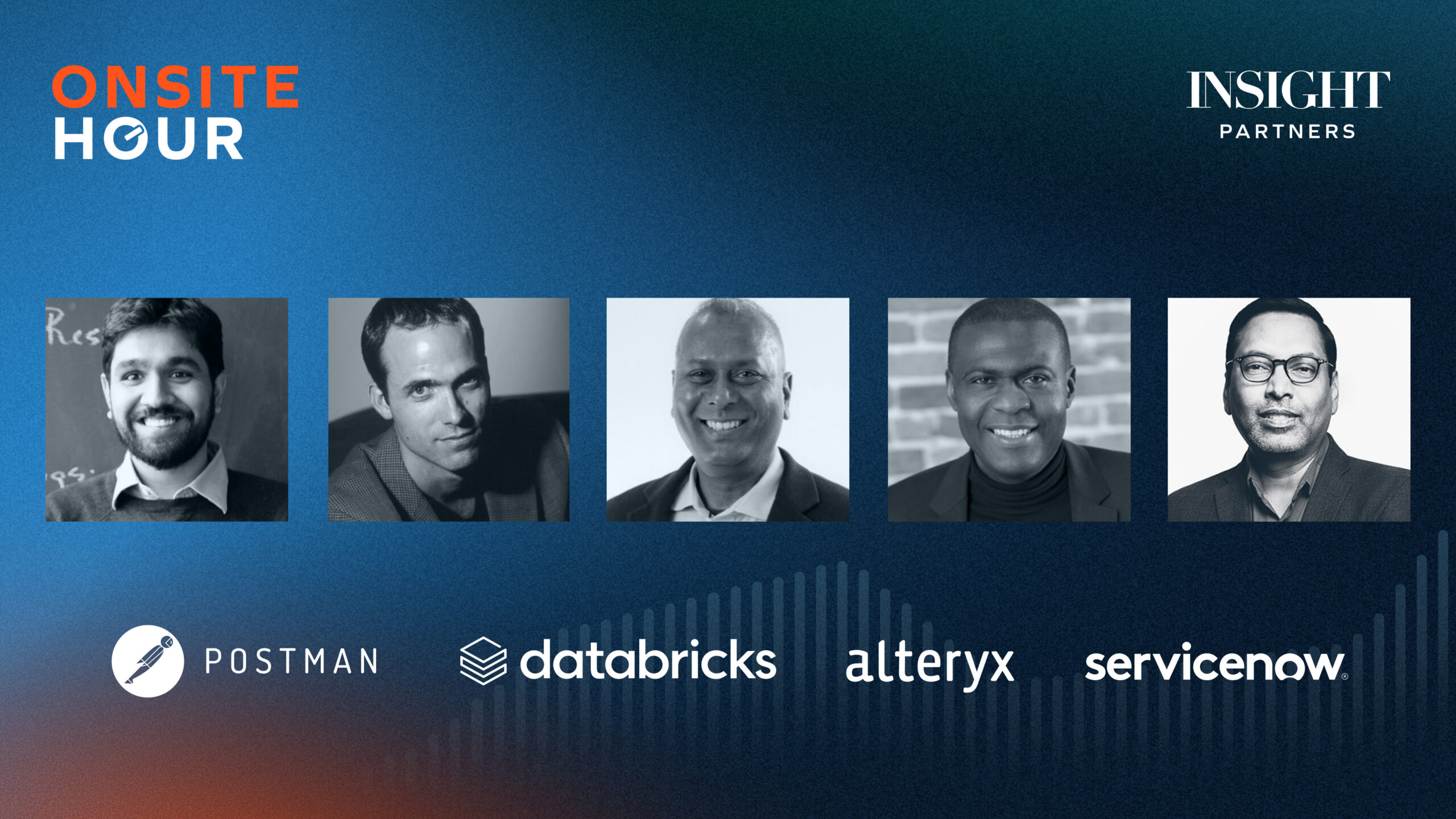
The discussion was moderated by Managing Director George Mathew.
Panelists included:
- Ankit Sobti, cofounder and CTO at Postman*
- Jason Martin, VP of FDE at Databricks*
- Rajkumar Irudayaraj, SVP of Global Technology at Alteryx*
- John Aisien, SVP at ServiceNow
Five considerations for founders and CEOs
1. Pick a North Star. “Figure out your North Star, and as long as you have confidence in the sanctity of that North Star, just stick to it, even when you’re being buffeted from all sides,” said Aisien. His North Star is the number of agentic builds in production.
2. Treat FDE as your primary engine for learning. “If I were starting a B2B business today, I would think about an FDE motion as my primary engineering motion,” said Sobti. The model turns one signal into a pattern, then “a compounding flywheel” that feeds the product.
3. Guard the front door. Demand explodes the moment it works. “Interest is not the same as readiness,” said Irudayaraj. “Define entry criteria, exit criteria, and kill triggers before the build starts, and keep the FDE, ‘a scarce capability.'”
4. Win on talent, and own it from the top. “It’s all about talent,” said Martin. “In AI, the difference between your best person and your medium or worst person is 10x what it was a year or two ago.” At Databricks, even the CEO still weighs in on FDE hires.
5. Design every engagement to end. Solve the hard problem, then leave. Aisien tells his team lead that the goal is “to do yourself out of business, literally.”
What is a forward deployed engineer?
At Insight Partners, we define FDEs as a market response to a growing AI value gap and widespread AI proof-of-concept (POC) failure. In our experience, most AI solutions do not work out of the box for a customer’s specific use case and therefore never make it to production. FDEs “complete the box.” The profile is a highly curious, technical builder with strong interpersonal skills who can navigate organizational resistance, conduct deep problem discovery, and own the outcome.
Unlike other roles, they build the last-mile solution, and the capabilities they create compound back into the core product. Critically, the FDE is not a permanent fixture. Once the outcome is proven, ownership transfers to the teams who productize and run it at scale, and the FDE shifts to the next frontier to keep the discovery engine running.
Here’s how our panelists define it:
- “Give us your hardest problem, we’ll go solve that…you own the IP, we’ll hand it over to you.” — Jason Martin, Databricks
- A catalyst for “terrain capture” using agentic builds “as a building block to solve a business problem” inside accounts where ServiceNow already has incumbency. — John Aisien, ServiceNow
- “We identify a signal…turn that signal into a pattern…and then create a compounding flywheel” that feeds the product. — Ankit Sobti, Postman
- The FDE should be “a permanent learning loop for the company,” not “a permanent crutch for the customers.” — Rajkumar Irudayaraj, Alteryx
How is an FDE different from a consultant or a sales engineer?
A consultant or professional services team delivers a defined scope of work and leaves. A sales engineer demonstrates the product to close the deal. An FDE takes an ambiguous, unscoped problem, builds the last-mile solution, and owns the result. Irudayaraj explained, “I’m not going to build a demo with an FDE. There are others who can do that for you. You have solution engineers who do that all the time.”
Martin described how, at Databricks, pre-sales and post-sales now blur into one motion that leads with the customer’s hardest problem instead of defending billable hours. He pointed to a relationship that began as a $30,000 proof of concept and grew into a multi-million-dollar engagement. “It can’t be about hours and people,” he told the panel. “It’s got to be about outcomes.”
What does an FDE actually do?
The panelists answered with live examples. Irudayaraj described embedding with one of the largest quick-service restaurant chains in the U.S. to automate a manual financial reconciliation that had consumed 300 to 400 hours a year, and then recognizing that thousands of other restaurants shared the same problem. “You create this once, and you don’t have to do it for the rest,” he said. The point of that first win, in his words, is “shortening the distance from executive curiosity to a commercial action.”
“If I were starting a B2B business today, I would think about an FDE motion as my primary engineering motion.”
Find the most painful problem, build a working solution in the customer’s real environment, then turn that one win into something repeatable. Sobti further explained: “If I were starting a B2B business today, I would think about an FDE motion as my primary engineering motion.”
How are leaders launching FDEs?
Each company launched an FDE team for a different strategic reason and runs it in a different part of the business.
Postman launched FDEs to convert its 40-million-developer base into enterprise deals, solving API problems that no product feature could. The team sits outside the revenue org with a hunter mindset, and the north star is new product patterns fed back from the field.
Databricks built its FDE motion around the reality that AI changed what customers buy: When vendors win by solving hard problems rather than selling platforms, FDEs land the logos that the platform motion was missing. The team sits across pre- and post-sales in a positive-margin, outcome-based model, with platform adoption as the north star.
ServiceNow, already embedded in most large enterprises, needed its customers to actually put AI Agents into production. FDEs drive that terrain capture and funnel learnings back into the product, sitting inside engineering and tracked by the number of agentic builds live.
Alteryx faced a different problem: Large customers were paralyzed by AI choices and unclear on what to trust. FDEs de-risk the decision by proving working outcomes in the customer’s own data, deployed as a scarce resource behind a strict front door alongside sales engineering and success.
Who owns the intellectual property (IP) that an FDE builds?
The panel’s answer: You keep what matters. Martin said a vendor “needs to own the IP” for anything reusable, or it cannot be returned to the product, while custom models trained on a customer’s data belong to the customer. Handing over the rest is a feature rather than a concession: “It’s a much better answer for the customer than being like, ‘Oh, I’m locked in now.’”
Databricks increasingly builds in the customer’s own environment and leaves the work there. Irudayaraj reframed the debate, arguing the real prize is not the IP fight: “The best FDE motions don’t just help companies win one or two accounts, they teach the company how to win the next 10, the next 100.”
How do you pay for it, and prove it is working?
Databricks targets positive margin and sells value, not time-and-materials. ServiceNow, Aisien explained, funds its team as research and development, and the value the engineers create rolls into recurring revenue through a usage meter he calls an “assist.” On proof, the speakers agreed on speed. With modern tooling, a solution can come together in days and weeks, and Databricks will sometimes build before a contract exists. “We’re not going to even charge you for it, because we’re pretty confident you’ll say yes,” said Martin. “So we’ll do delivery at risk.”
Launching FDEs today
Here is how the speakers answered when asked what they would do differently if they started over.
1. Start a rotation program between core engineering and the FDE team on day one.
“I wish I had started that from the outset,” says Aisien. “It’s been an absolute game-changer.”
2. Begin earlier-career hiring sooner
AI “turns it all upside down,” Martin said, and you want builders who are “more open to doing it differently, more creative,” and “willing to sleep under the desk sometimes.” Vibe coding is now part of the Databricks interview: “We ask people to vibe code…It’s how they talk about it. Why did they build it that way?”
3. Set the qualification bar and the kill criteria even earlier
“Interest is not the same as readiness,” Irudayaraj said. “I would be much more explicit upfront on what must be true before an FDE engages.”
4. Launch the motion earlier while going up-market
Building it, Sobti said, “Changes the way that you think about building an enterprise product.”
Common FDE misconceptions
A few things the panel put to rest.
- “It is just professional services with a new name.” No. Professional services deliver a fixed scope; FDEs take on the unscoped problem and own the outcome.
- “Palantir invented the FDE.” Palantir coined the term, but not the motion.
- “FDEs only build flashy demos.” The goal is a repeatable pattern running in production, not a demo.
- “It is a late-stage, go-to-market add-on.” The leaders wish they had started sooner.
- “You lose your IP.” You keep the reusable IP; only custom, data-specific work goes to the customer.
The bigger picture
The FDE motion is changing who owns the outcome. “Ten, fifteen years ago, we would simply show demos, PowerPoints, maybe even a POC,” said Aisien. Now, he argued, responsibility is “a lot more balanced between the asset provider and the customer.” He called that “rebalancing the responsibility map for outcomes in a way that I think is really, really healthy for software businesses all around.”
The leaders also see the motion benefiting earlier-stage companies and getting more automated over time. Irudayaraj believes founders “should consider having an FDE motion when they’re incubating” – even “a seed stage company or startup.” Postman is already building its team as “a combination of humans and Agents,” Sobti said, even standing up “a field CTO as an Agent” that anyone in the company can query. “It’s too early to take a victory lap,” he added, “but I really like the leading indicators that I’m seeing.”
Want to go deeper? The series continues
The #1 question from the audience was “What actually makes a great FDE?” If you’re an Insight portfolio company, be sure to tune into the next two sessions in our July FDE series to find out. Otherwise, stay tuned for post-event recaps like this one, which we will publish after each event.
*Editor’s note: Insight Partners invested in Postman, Databricks, and Alteryx.