Insight Partners
More By The Author
Back
Leadership
How Mate Security is building the AI teammates that security operations centers have been waiting for
Insight Partners | June 11, 2026| 3 min. read
Security operations centers (SOCs) are often overwhelmed by alerts that increase daily, including both real threats and false positives. Sifting through them all to work out which is which is a slow and manual process.
Under pressure to clear backlogs, many teams compromise security by muting alerts, tuning down detection rules, or making policy exceptions. But when an analyst creates a static exception to suppress a false positive, they inadvertently create a blind spot in the organization’s defense.
At the same time, threats are accelerating. Increasingly powered by automation and AI, attackers move faster than human teams can respond, turning overload into vulnerability.
AI SOC platform Mate Security was built to replace this brittle, static tuning with dynamic, context-aware AI that automates the investigation process. It provides AI agents that work together to gather context, run investigations, and surface what matters, freeing up security teams to focus on real threats.
From the enterprise, for the enterprise
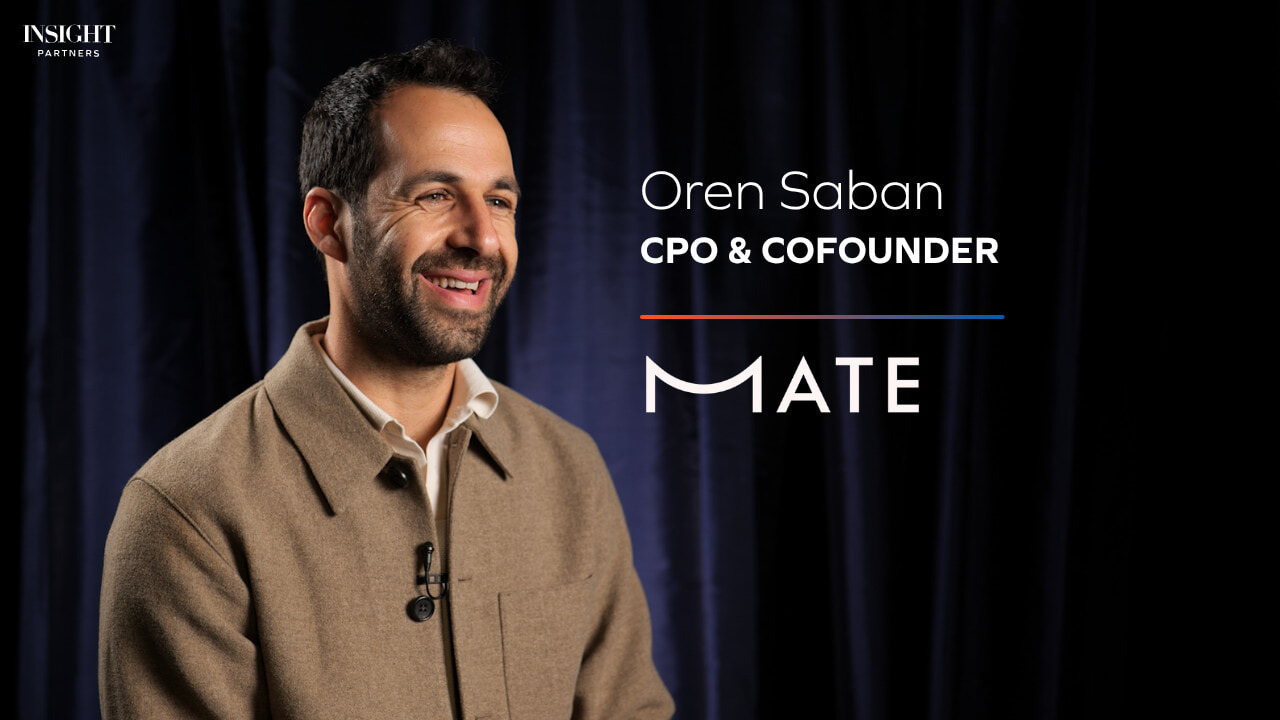
Mate was founded in early 2025 by a team of enterprise cybersecurity veterans with experience in large-scale product development. Oren Saban, the company’s cofounder and chief product officer, befriended CEO Asaf Wiener and CTO Guy Pergal at Microsoft before they went on to senior roles across the industry: Wiener at Wiz, Pergal at Axonius, and Saban at Apex.
The idea for Mate came from a growing disconnect between what security tools promised and what practitioners were actually experiencing, says Saban. “We saw a lot of problems with how the tech works today, and we were very, very eager to solve this.”
“[We] have brought all different things to Mate. One of them is in the enterprise readiness. Mate has been built from the get-go [to support] enterprises.”
After years of watching teams drown in alerts and dashboards that generated more noise, the founders realized that the issue was a lack of usable, organizational intelligence. When recent advancements in AI finally made it possible to tackle the problem meaningfully, they moved quickly.
Mate emerged from stealth in November 2025, with a $15.5M seed round co-led by Insight Partners and Team8, and launched its Security Context Graph a few months later.
An “instant promotion” with AI Agents
At its core, Mate is designed to shift the SOC’s role from reactive triage to real-time decision-making. “Before Mate, you had a queue with hundreds of alerts [that] you have to prioritize,” says Saban. “After Mate, within a few minutes, you’ve already got a prioritized queue with noise reduction. You get to focus on the things while they happen.”
Instead of manually triaging alerts, analysts can assume a supervisor role, overseeing and guiding AI Agents as they conduct investigations. “We call it an instant promotion,” jokes Saban. “Humans are governing that AI is doing the right thing, exactly like you would handle your employees.”
“It feels like your teammate, hence ‘Mate.’”
Automating the repetitive work can also improve timing, which is a top priority for CISOs, says Saban. “Mean time to respond is one of the most important things that people ask about…And the second thing is the threat containment speed. Can we actually stop attacks when they happen, not after the fact?”
Security that understands the stack
The next phase of SOC depends less on deploying AI and more on teaching those systems how the organization actually operates, says Saban. “Any security vendor nowadays has already or will introduce AI Agents to their security stack…What’s special about Mate?” The answer lies in Mate’s Security Context Graph, a dynamic, continuously updated map of an organization’s environment.
This tool, introduced officially in early 2026, connects users, devices, behavior, and historical activity to enable AI Agents to investigate threats with the same context and intuition as a human analyst. “This is the underlying layer that makes Mate accurate, personalized, tailor-made to you,” says Saban.
“You want your doctor to prescribe something that is personalized for you, and it’s the same thing with security.”
Mate is designed to work alongside the rest of the security stack. Customers can connect their own Agents to the Security Context Graph or Mate’s model context protocol (MCP), so that Mate’s Agents can communicate and collaborate with other AI Agents already deployed in the environment, and close the loop on incidents.
When AI has to prove itself
For all its potential, AI implementation in cybersecurity still faces a major hurdle: trust. Research published by the ACM shows that 65% of analysts are skeptical about AI alerts, favoring hybrid human-AI models (79%) over full automation.
Mate’s approach is to ground its reasoning in real organizational data, says Saban. “Then you’re able to reduce the hallucinations dramatically and increase trust.”
“These insights are what’s separating bringing in really good analysts…from an analyst that has been there for years.”
The second ingredient is usability. “If I have to read through a bunch of text and long reports for every alert, I won’t understand what the Agent has done, I won’t build trust, and that really has no impact.” Mate makes its reasoning both accurate and intuitive so that analysts can quickly validate and act on information.
Though Mate initially focused on investigation, it saw customer demand for other services. “Response is a very big thing…Reporting…is a very big thing. The ability to close the loop to detection is a very big thing. They’re pushing us forward to achieve better security with AI.”
The future of SOCs
Looking ahead, Saban wants to see more collaboration in the cybersecurity industry, noting how Mate has built momentum through partnerships and participating in the 2026 Cybersecurity Startup Accelerator run by CrowdStrike, AWS, and NVIDIA.
“The defense side of the world in security has been working in a siloed mode, and we think that the future and where we have to go is to work together as a community to…stop attackers,” he says.
He also predicts a shift in how security teams operate. “The role of the SOC [is] going to converge with security engineering.” As AI Agents take over the repetitive tasks of investigation, triage, and automation, human analysts will move to “the front layer of catching what puts us in danger,” he says.
This is among the most effective ways to combat the increasing threat of AI-powered cyberattacks. With attackers moving at machine speed, security teams can’t rely on manual processes to keep up anymore.
“You can buy ransomware on the dark web for 20 bucks or so, but it will be really hard to build an AI solution for the enterprise that will attack with the same machine-to-machine capabilities,” he says. “We believe that through partnerships, through working deeply together to solve problems, that’s what we can introduce.”
*Editor’s Note: Insight Partners has invested in Mate Security.